Recent Posts







The Global Capability Centers (GCCs) of India are no longer just engines of back-office costs, but they are hubs of strategic innovation. There are more than 1,900 GCCs in India that generate billions in revenue and contribute huge shares of the country’s service exports. GCCs will grow tremendously by the year 2030 and will drive more employment and advanced work on global businesses. This development creates an urgent need for cybersecurity. The Indian cybersecurity market is growing at a tremendous rate; the latest estimates indicate that the market will grow to be within the multi-billion dollar bracket by 2024 and has a good CAGR up until 2030 as organisations seek to upgrade their security systems. The protection of intellectual property, controlled data, and the business concept itself are now strategic investments for GCC business operations and offshore development centers.
Zero-Trust Security is not a list of tools but a change of mindset towards GCC Business Operations and Offshore Development Centres. Practically, it implies identity-first controls; least-privilege access; micro-segmentation of assets; continuous verification; and quick containment in the event of inevitable compromise. This approach balances security with business outcomes, including safe IP monetisation, guaranteed service quality for clients abroad, and reduced regulatory burden. Why India GCCs Need to Go Faster with Zero-Trust From hundreds to thousands of workforce members and contractors are increasing the surface of the insider and lateral-movement risk. Regulators and clients are pushing towards showing data controls: India is advancing with Digital Personal Data Protection rules, which will make privacy compliance operationally binding. GCCs need to incorporate controls whenever audits and contractual requirements are due. The world is going faster towards the use of Zero Trust: According to the latest industry polls, a significant portion of enterprises have already moved to or are in the process of moving to Zero Trust concepts, and it has become the baseline of current cybersecurity. Slow GCCs will be disadvantaged in respect to competition and contracts.
The following is a brief, business-orientated roadmap that is specific to GCC Business Operations and Offshore Development Centres. At every stage, security work is harmonised to quantifiable business commitments.
Zero-Trust security is an economic lever to invest in. Strong controls allow GCCs to open up more important parent organisation requirements, such as product engineering, IP development, training AI models, and monetisation. The same trust translates into increased billing rates, responsibilities, and quantifiable contributions to host states as well as India on the whole. According to recent economic studies, the GCC sector plays an overly significant role in employment and output; security maturity supports that trend.
Zero-Trust security will identify which GCCs will become cost centres and grow into global strategic allies. The most valuable mandates will be captured by GCC Business Operations, who implement a modern security framework that is identity-first, continuous, and automated. The regulatory environment of India is becoming stricter, with clients requesting better guarantees and coverage, so Zero-Trust investment is not an offensive cost but an enhancer of expansion, strength and reputational assets of the offshore development center in India. When your GCC requires a custom Zero-Trust roadmap that is tightly integrated with its maturity and business objectives, the second step is a brief visibility scan that visualises identities, sensitive data and workflows of high risk and then a prioritised, business case-driven implementation roadmap.
A GCC is an offshore facility of a multinational company that undertakes niche roles such as research and development, information technology service and strategic management. It is a government program that gives the women entrepreneurs up to 1 crore in bank loans to fund greenfield projects. Personal responsibilities and unconscious bias are the factors that lead to their mid-career attrition and slow them down in their careers. They introduce new ideas, understanding, and team-oriented leadership that speeds up the advancement of such areas as AI and cybersecurity. By 2030, women are expected to take up 25-30 per cent of GCC leadership positions, which will be paramount to the growth of the Indian market. Aditi, with a strong background in forensic science and biotechnology, brings an innovative scientific perspective to her work. Her expertise spans research, analytics, and strategic advisory in consulting and GCC environments. She has published numerous research papers and articles. A versatile writer in both technical and creative domains, Aditi excels at translating complex subjects into compelling insights. Which she aligns seamlessly with consulting, advisory domain, and GCC operations. Her ability to bridge science, business, and storytelling positions her as a strategic thinker who can drive data-informed decision-making.
Zero Trust: A Business-Orientated Definition
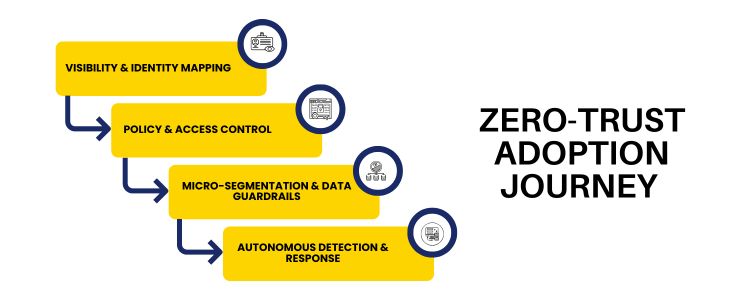
Practical Zero-Trust Implementation
Phase
Focus
Business Promise
Visibility & Inventory
Assign identities and devices and workloads to the cloud and on-prem.
Eliminate the blind spots; the basis risk.
Policy & Identity Hardening
Enforce MFA, SSO, RBAC, and credential hygiene
Reduce account compromise risk
Micro-segmentation & Data Controls
Workload segregation with Network and sensitive IP DLP.
Restrict lateral blast radius; safeguard trade secrets.
Constant Monitoring and Autonomic Reactions.
Analytics of behaviour and machine containment.
Reduce dwell time; ensure uptime and SLA.
Economic Benefits
Operational Implementation
Conclusion

frequently asked questions (FAQs)
1.What is a Global Capability Centre (GCC)?
2.What is the Stand-Up India scheme?
3.What are the challenges associated with women in tech?
4.What is the effect of women leaders in the innovation process?
5.What does the future of women in the leadership of the GCC hold?

Aditi










Error: Contact form not found. Error: Contact form not found.Subscribe to our Newsletter
Subscribe to our Newsletter