Recent Posts







How a quiet transformation in Indian cities is reshaping global business, and why governments, landlords, and legacy tech giants are scrambling to catch up
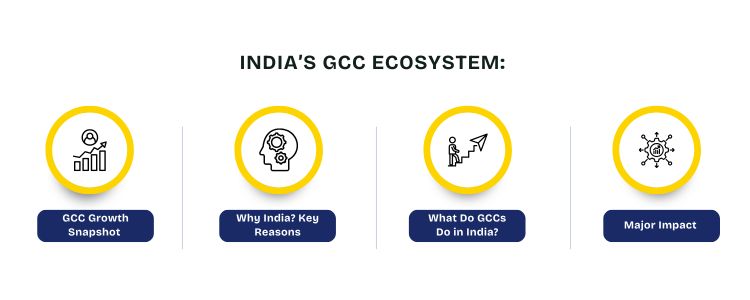
Let’s start with scale. An October 2025 report pegged India’s GCC count at 1,800 centers employing 1.6 million people with revenues at $64.6 billion. Market analysts predict the number will surpass 1,900 by 2025 and reach 3,500 by 2030 India holds about 70% of the world’s GCCs. More striking: approximately 40% of Global 500 companies (excluding India-headquartered firms) have yet to establish a presence in India, suggesting the runway for growth is far longer than many assume. These aren’t call centers. Engineering and R&D services contribute 56% of total GCC revenue share. The talent working in these centers are building AI trading algorithms, designing global e-commerce platforms, and engineering aircraft systems.
Karnataka fired the first shot. On November 19, 2024, Karnataka formally released its GCC Policy 2024-2029, aiming to establish 500 new GCCs by 2029, create 350,000 jobs, and generate $50 billion in economic output. This came after a draft was launched in September 2024. The policy is comprehensive. Karnataka is home to 875+ GCC units with 35% of India’s GCC workforce, and the state isn’t taking chances. The incentives include rental reimbursement and EPF contributions for GCCs setting up in cities like Mysuru, Mangaluru, and Hubballi-Dharwad-Belagavi under the “Beyond Bengaluru” initiative. Tamil Nadu responded with cash. On February 19, 2024, Tamil Nadu’s Finance Minister announced payroll subsidies for high-paying jobs above Rs 1 lakh per month at 30% in the first year, 20% in the second year, and 10% in the third year. This scheme, operational from April 1, 2024, to March 31, 2027, targets GCCs listed in Forbes Global 2000 or Fortune 1000 with at least 200 employees. The results are visible. In fiscal year 2024, Chennai added 95,000 employees to its GCC workforce, surpassing Bengaluru’s growth of 68,000 and Hyderabad’s 75,000, bringing Chennai’s total GCC headcount to over 213,000. CBRE projects Chennai will have around 450 GCCs by 2030, up from 250 currently. But here’s the uncomfortable question: Are these subsidies creating new jobs, or just redistributing existing ones between cities? When over 50,000 jobs were created by more than 40 global companies in Tamil Nadu over three years, how many of those would have come anyway? No state has published an ROI analysis.
The numbers are staggering. India’s office sector achieved 89 million square feet of gross leasing volume in 2024, up 19% from 2023. GCCs drove 77.2 million square feet of office leasing across top seven cities in 2024, a 22.6% year-on-year increase. GCCs currently account for more than one-third of occupied office stock in India’s top seven markets, and their footprint is poised to surpass 300 million square feet in coming years. Bengaluru dominates. In 2024, Bengaluru captured 47% of total GCC leasing demand nationwide. Hyderabad is rising fast. Chennai shows the strongest three-year growth trajectory in GCC interest. Between 2025 and 2026, Chennai is set to add 12-13 million square feet of premium office space tailored to GCC needs. Chennai’s total office stock is expected to surpass 100 million square feet by 2026. The bet: Developers are building specialized spaces assuming demand will continue. GCCs are projected to lease 60-65 million square feet of Grade A office space by 2027.
India holds over 5 million technology professionals, but quantity doesn’t equal readiness. Top emerging skills in demand include GenAI, AI/ML, Data Analytics, Cybersecurity, Cloud Computing, and Robotics Process Automation. The problem: India graduates 1.5 million engineering students annually, but how many can actually work in these cutting-edge domains? Industry insiders privately acknowledge a massive gap between graduation and job readiness, though hard public data is scarce. Salary inflation is real. GCCs are competing with each other, startups, and traditional IT services for the same talent pool. While specific 2024 salary data wasn’t available in search results, the pressure is evident in hiring volumes and competition. Staffing firms see opportunity. Companies like TeamLease, Randstad, and ManpowerGroup have all launched dedicated GCC hiring verticals,
This is where it gets interesting. For decades, TCS, Infosys, and Wipro built empires on the premise that companies should outsource to them. Now those same companies are insourcing via GCCs. The pivot is happening. In December 2024, Microsoft announced strategic partnerships with TCS, Infosys, Wipro, and Cognizant, with each company deploying over 50,000 Microsoft Copilot licenses, collectively surpassing 200,000 licenses. This followed Microsoft’s announcement of plans to invest $17.5 billion in cloud and AI infrastructure in India over four years (2026-2029). But these are AI partnerships, not GCC-specific pivots. US Bancorp has tapped TCS, Wipro, Cognizant, and others as key bidders for a mandate to set up two GCCs in India, one in Hyderabad (wholly owned) and one in Chennai (build-operate-transfer mode). The bank plans to hire between 3,000 and 5,000 employees in India over five years, with the contract valued at roughly $250 million. IT services companies are competing to help clients build in-house centers that will eventually reduce demand for traditional outsourcing.
Here’s what’s remarkable: India has over 1,700 GCCs contributing $64.6 billion and representing 17% of global GCC capacity, yet there’s no formal national GCC policy. States are competing with their own incentive structures. Karnataka has its policy. Tamil Nadu has payroll subsidies. But there’s no coordinated national framework to prevent a race-to-the-bottom on subsidies, no standardization of benefits, no central coordination. The risk: States may be giving away taxpayer money for investments that would have happened anyway, while missing opportunities to negotiate better terms collectively.
When a multinational moves 500 roles from TCS to its own Pune GCC, India’s total employment doesn’t change. The jobs just shift from one company to another. Between 2018-19 and 2023-24, GCCs created over 600,000 new jobs, but how many were genuinely new versus cannibalized from IT services firms? Companies choose locations based on talent availability, infrastructure, and ecosystem maturity. If Karnataka and Tamil Nadu stopped competing with subsidies, would GCCs stop coming? Or would they come anyway because the talent and infrastructure are here? From 2016 to 2024, GCCs have accounted for 40% of overall office leasing activity in India. That’s an enormous bet on continued global economic expansion. When the next downturn hits, will CFOs defend their India GCCs as strategic assets, or shut them down as expensive experiments?
India’s GCC boom is real, massive, and accelerating. As of December 2025, over 1,850 GCC units operate in India, with projections to exceed 3,500 in the next 3-4 years. Cities like Bengaluru, Hyderabad, and Chennai becoming genuine global innovation hubs. Indian professionals accessing high-value work. Multinationals accessing world-class talent at competitive costs. Traditional IT services companies watching their business model erode. Taxpayers in states offering potentially unnecessary subsidies. The missing national coordination that could strengthen India’s negotiating position globally. Will India use this moment to build lasting competitive advantages, better infrastructure, stronger skills development, smarter policy coordination? Or will states continue competing against each other while the national opportunity remains fragmented?
Hyderabad, Bangalore and Pune have become significant pharma innovation centres with global delivery centres of major biotechnological and pharmaceutical firms such as Novartis, Pfizer, AstraZeneca and GSK. They offer an economic benefit of calculation, a variety of scientific and technical human resources, and speedy time-to-market. On average, businesses reduce between 25-40 percent of the operational costs and increase the rate of innovation. The next-generation operations of Pharma GCC focus on advanced molecular modelling, AI/ML-based drug discovery, cloud supercomputing, and data integration platforms, as well as quantum-ready simulations. Pharma GCCs use AI to screen molecules, predict the efficacy of drugs, optimise clinical trials and aid in making data-driven decisions, resulting in smarter, faster and safer drug pipelines. Pharma GCCs will be global innovation ecosystems that are a combination of computational chemistry, generative AI, and quantum computing. They will turn into the hubs linking data science, discovery and regulatory intelligence in the global arena. With multifaceted experience in Legal, Advisory, and GCCs, Yashasvi weaves law, business growth, and innovation. He leads a cross-functional team across legal, marketing, and IT to drive compliance and engagement. His interests span Law, M&A, and GCC operations, with 15+ research features in Forbes, ET, and Fortune. A skilled negotiator, he moderates webinars and contributes to policy forums.
The Numbers That Matter
State Governments: Racing to the Bottom or Strategic Investment?
Real Estate: Building the Infrastructure
Talent Wars: The Skills Gap No One Wants to Admit
Legacy IT Giants: Adapt or Die
The National Policy That Doesn't Exist
Three Questions No One's Answering
The Bottom Line

frequently asked questions (FAQs)
1.Who are the Pharma GCC development leaders in India?
2.Which economic benefits do Pharma GCCs have?
3.Which technologies are influencing Pharma GCC operations nowadays?
4.What is the role of AI in Pharma GCC processes?
5.How will Pharma GCCs look in five years to come?

Yashasvi Rathore










Error: Contact form not found. Error: Contact form not found.Subscribe to our Newsletter
Subscribe to our Newsletter