Recent Posts







Businesses in Israel and the wider Middle East will require Global Capability Centres (GCCs), which should not only be operationally sound but also cyber resilient in nature. The market of cyber-resilient Gccs in these regions is booming. Market projections have projected that the Middle East cybersecurity market will be deep into the tens of billions by 2030, pushed by country transformation programmes, expansion of the digital economy, and an increase of country-of-origin and financially motivated cyberattacks. This blog outlines a viable and prospective roadmap of GCCs in India to correspond to the Israeli gold-standard cyber practices and Middle Eastern regulatory demands. It dwells upon quantifiable results like technology architecture, people and processes, economic benefits, and quantifiable indicators of cyber resilience 2030. In 2024, the cybersecurity ecosystem of Israel announced a flood of external investments, which highlight its status as a digital security innovation center on the planetary level. India has approximately 1900+ GCCs that have about 1.9 million professionals, which makes Indian GCCs flexible options for Middle Eastern businesses that need affordable state-of-the-art cyber capabilities. All these trends form a strategic avenue to safe R&D, SOC and collaborative cyber innovation.
The Middle East has been experiencing a growing threat landscape: industrial control systems (energy, aviation), fintech targets, and more advanced state-grade intrusion attempts. The frameworks at the national level (UAE, Saudi Arabia, Israel) have become stricter on the controls of critical infrastructure and data sovereignty in terms of elevating the standards of any external or offshore GCC support of regional operations.
By 2030 GCCs must: These capabilities transform GCCs into Israeli and Middle Eastern client strategic cyber partners providing scale, cost arbitrage and engineering talent.
CAGRs in many segments are in the double-digit range, making Middle East cybersecurity spending grow through 2030, which generates a sustained market need for security services and engineering talent. The Indian GCCs are able to provide such capacity at reduced operational cost and invest in specialised cyber skilling to match the advanced standards of Israel.
The Mean Time To Detect (MTTD), Mean Time To Respond (MTTR), percentage of systems under zero-trust policy, time to compliance and annualised cost-of-risk reduction are the trackable KPIs. The fact that these metrics are measurably improving shows that the GCC is not merely compliant but robust and economically viable.
By 2030, cyber-resilient GCCs will be appreciated as architects of regional security posture, a coalition of the innovation leadership of Israel and the scale and low costs of India to ensure the digital economies of the Middle East. Those organisational leaders investing in AI-led SOCs, zero-trust architecture and regulatory automation today will enjoy both security and economic benefit in 10 years’ time.
Initiate an audit of your GCC on the cyber posture today with Inductuas GCC to streamline architecture, develop talent, and trace compliance to local frameworks to be the reliable cyber partner of Israel and the Middle East by 2030.
A GDC refers to a single-minded offshore deployment, which provides proficient business, technology and operational services to corporate bodies on a global basis. BFSI, IT services, healthcare, telecom, retail, manufacturing, and other upcoming technologies, including AI and blockchain. They do not only target cost savings but now aim at innovation, automation, R&D, digital transformation, and high-value consulting. They design and create cloud, artificial intelligence, analytics, cloud security, and process automation. A large supply of STEM graduates, multilingual workers and niche skills in AI, ML, cloud, and analytics. Aditi, with a strong background in forensic science and biotechnology, brings an innovative scientific perspective to her work. Her expertise spans research, analytics, and strategic advisory in consulting and GCC environments. She has published numerous research papers and articles. A versatile writer in both technical and creative domains, Aditi excels at translating complex subjects into compelling insights. Which she aligns seamlessly with consulting, advisory domain, and GCC operations. Her ability to bridge science, business, and storytelling positions her as a strategic thinker who can drive data-informed decision-making.
The Risk
Why GCCs Need to Become Cyber-Innovation Hubs?
Strategic Powers and Economic Advantages
Strategic power
What it delivers
Economic advantage
Zero-Trust Architecture
Reduces lateral breach risk
Lowers breach cost and insurance premiums
AI-Driven Threat Detection
Faster detection & automated response
Reduces MTTD/MTR; lowers SOC headcount cost
Hybrid Cloud & Data Sovereignty
Regulatory alignment for cross-border data
Enables market access; avoids fines
OT + IT Integration
Protects critical infra (energy, transport)
Prevents revenue loss from downtime
Continuous Compliance Automation
Real-time audit readiness
Reduces audit costs; speeds market launches
Scalable Economics
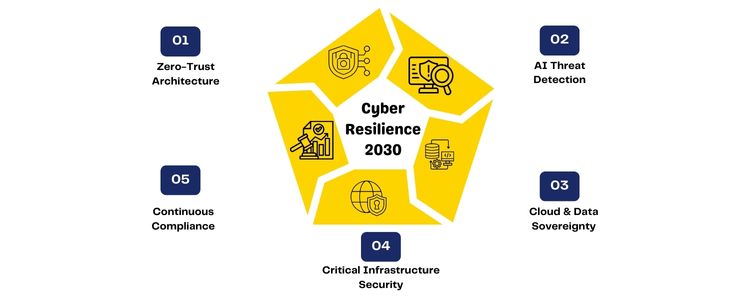
Cyber Resilience 2030
Conclusion

frequently asked questions (FAQs)
1.What is the Global Delivery Centre (GDC)?
2.What are the most suitable industries with the help of GDCs in India?
3.What can GDCs in India do along with offering cost and labour benefits?
4.How are GDCs relevant to digital transformation?
5.What talents do the GDCs of India add?

Aditi










Error: Contact form not found. Error: Contact form not found.Subscribe to our Newsletter
Subscribe to our Newsletter
