Recent Posts






Once, a software team in a Bengaluru GCC recreated a scoring engine three times across different business units; each attempt was expensive, time-consuming, and unreported by the law. A strict IP reuse system was implemented at the centre as a result of the crisis; duplication work vanished, patentable ideas emerged sooner, and time-to-market dramatically decreased. This is the new playbook of Global Capability Centres (GCCs), which seek to transform repeatable engineering into quantifiable enterprise edge.
GCCs in India have transformed into innovation engines. By 2025, there will be more than 1,900 GCCs and almost 2 million professionals. The GCC market has been projected to be around USD 110 billion by 2030. It is evolving into an intellectual property (IP) strategy, and the GCCs’ digital transformation depends heavily on IP reuse.
Reviving computer code, models, or automation not only incurs R&D costs but also conceals patentable advances in unrelated projects. An IP-reuse model transforms the work of one team to become an enterprise asset, increasing the reuse ratio. So, product cycles are also faster, and patent pipelines are easier to determine. The economic benefits of reuse are redundancy in engineering expenditures and higher ROI on investment in digital transformation by making GCCs an engine of profit instead of an engine of cost.
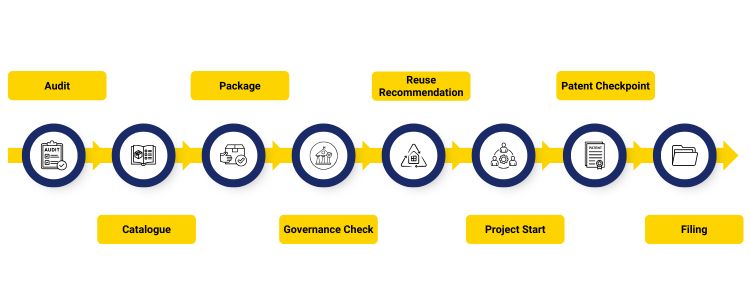
This is an enforceable framework that scales inventions to patents by GCCs while balancing innovation processes with intellectual property and legal scrutiny. Continuous scanning of repositories, models, and documentation, as well as AI tagging and semantic search, identifies candidates for reuse. Transform delivery artefacts (APIs, ML models, test suites) into documented modules with versioning, licensing metadata, and test cases. Establish what constitutes IP, models of ownership, credits to contributions, and open/closed licensing as well as automated compliance gateways. Prior to the start of development, there is one catalogue containing search and recommendation engines, contributor workflows, and analytics that show a user that there is reuse potential. In-house patent verification gates throughout the product life cycle, expedited legal due diligence, inventor incentives, and quarterly Invention Sprints to uncover new filings.
All of this is possible if GCCs integrate governance and enabling platforms, as well as incentives.
The IP risk assessment should be adjacent to reuse efforts. Evaluate open-source compliance, third-party licences, export regulations, and data privacy during the packaging of the assets. Automated licence scanners and routine legal checks reduce IP leakage and reputational exposure. Implementing such controls at the early stage transforms legal friction into a governance benefit.
GCCs are already allocating GenAI and agentic AI to accelerate discovery and documentation. By 2025-2026, most systems in the GCCs will enable auto-documenting code and begin to identify reuse candidates and predict patentability, transforming the manual spotting of inventions into predictive IP pipelines. This AI-native offers an economic boost to GCCs, which reduces the marginal cost of R&D, shortens the commercialisation cycle, and increases more sustainable patent pools that safeguard global products and services.
In the case of Global Capability Centers, IP-reuse frameworks are not an operational luxury but strategic tools that can transform repetition in engineering to enterprise IP. Centres that prioritise disciplined discovery, packaging, governance, and patent acceleration will shorten the time it takes to innovate, increase economic value, and create patent-defensible competitive moats. The innovation in Gcc is that the patent route starts with reuse, and the GCC that has mastered it will turn every line of delivery into a permanent asset.
Hyderabad, Bangalore and Pune have become significant pharma innovation centres with global delivery centres of major biotechnological and pharmaceutical firms such as Novartis, Pfizer, AstraZeneca and GSK. They offer an economic benefit of calculation, a variety of scientific and technical human resources, and speedy time-to-market. On average, businesses reduce between 25-40 percent of the operational costs and increase the rate of innovation. The next-generation operations of Pharma GCC focus on advanced molecular modelling, AI/ML-based drug discovery, cloud supercomputing, and data integration platforms, as well as quantum-ready simulations. Pharma GCCs use AI to screen molecules, predict the efficacy of drugs, optimise clinical trials and aid in making data-driven decisions, resulting in smarter, faster and safer drug pipelines. Pharma GCCs will be global innovation ecosystems that are a combination of computational chemistry, generative AI, and quantum computing. They will turn into the hubs linking data science, discovery and regulatory intelligence in the global arena. Aditi, with a strong background in forensic science and biotechnology, brings an innovative scientific perspective to her work. Her expertise spans research, analytics, and strategic advisory in consulting and GCC environments. She has published numerous research papers and articles. A versatile writer in both technical and creative domains, Aditi excels at translating complex subjects into compelling insights. Which she aligns seamlessly with consulting, advisory domain, and GCC operations. Her ability to bridge science, business, and storytelling positions her as a strategic thinker who can drive data-informed decision-making.
GCCs: Economic Tide, Area, and Level
The Relevance of IP Reuse
A Concise, Five-Layered GCC IP-Reuse Framework.
IP-Reuse Impact Measures
Metric
Typical (pre-framework)
Expected (post-framework)
Innovation cycle time
12–18 weeks
6–9 weeks
Asset reuse ratio
<10%
45–60%
Annual patent filings per GCC
2–4
12–20
R&D cost per project
High
20–30% lower
Time from idea to patent review
Months
Weeks
Effective Measures
Risk, Compliance and IP Risk Assessment
The Next Phase
Conclusion

frequently asked questions (FAQs)
1.Who are the Pharma GCC development leaders in India?
2.Which economic benefits do Pharma GCCs have?
3.Which technologies are influencing Pharma GCC operations nowadays?
4.What is the role of AI in Pharma GCC processes?
5.How will Pharma GCCs look in five years to come?

Aditi









Error: Contact form not found. Error: Contact form not found.Subscribe to our Newsletter
Subscribe to our Newsletter
Insights / News
Quick Links