Recent Posts







An in-depth analysis of how Healthcare GCCs in India are quietly reshaping drug discovery, clinical trials, and patient safety, and why the traditional outsourcing model is obsolete
As of 2025, over 80 healthcare and life science GCCs are there in India. Over 15% of all GCC employees in India work in the healthcare and life sciences sector, with approximately 55% of these GCCs headquartered in the United States. But here’s what makes this remarkable: Healthcare and R&D functions make up 43% of the total workforce in life sciences and healthcare GCCs, highlighting India’s prominence as a preferred hub for these strategic operations. Nearly half the people working in these centers are conducting drug discovery, managing clinical trials, ensuring pharmacovigilance, and handling regulatory submissions to the FDA, EMA, and WHO. Indian GCCs now manage 45% of global drug discovery and development, 60% of regulatory affairs, and 54% of pharmacovigilance operations for global life sciences firms.
AstraZeneca: The Largest Single Healthcare GCC Globally AstraZeneca’s Global Capability Center in India, established in 2014, now employs over 3,100 professionals across IT services, Global Business Services, and R&D Services in Bengaluru and Chennai, with investments exceeding $50 million. In November 2024, AstraZeneca inaugurated its new Global Innovation and Technology Centre in Chennai, which is the company’s largest GCC worldwide and is expected to create 4,000 high-quality jobs. The company plans to hire around 2,200 people in Chennai and Bengaluru in the near future, with the Chennai center hiring around 1,300 people in the next 18 months and another 900 in Bengaluru. What are they actually doing? The R&D team is responsible for regulatory responses to assessment reports and health authority queries, post-marketing safety surveillance and signal management, safety reporting, license renewals and annual reports, variations, patient risk management strategies, and studies supporting 50+ brands of AstraZeneca. With more than 50% of AstraZeneca’s global IT workforce based in Chennai, the center delivers some of the company’s largest IT programs end-to-end.
Bristol Myers Squibb invested $100 million to establish a GCC in Hyderabad employing over 2,000 people, housing Business Insights & Technology and Drug Development teams. The company also invested $100 million to establish the GCC, employing 1,500 professionals and utilizing AI to accelerate drug discovery. Additionally, the Biocon Bristol Myers Squibb Research & Development Center in Bengaluru employs approximately 1,000 people with capabilities spanning clinical development, clinical operations, regulatory, biometrics, and safety.
GSK’s GCC in Bengaluru employs over 2,500 people in global business operations and R&D, with more than 50% focusing on R&D in areas like safety science, regulatory, biostatistics, and clinical operations. The GSK Global Capability Centre in Bengaluru, established in 2021, with investments under $30 million, serves as a strategic arm of GSK.
Pfizer’s Global Drug Development Centre in Chennai employs approximately 1,000 people and is a strategic R&D hub focusing on creating complex sterile injectable drugs and innovative formulations, supporting projects globally, especially in small molecule research and active pharmaceutical ingredients.
Novartis with over 8,000 associates supports numerous high-value functions, including Drug Development, Manufacturing, Supply and Quality, Human Resources, and Legal. Novartis India plans to hire 500–700 people annually to grow its presence in India, with 20% of the company’s global employees from the Indian GCC. The top five pharma GCCs in India—AstraZeneca (3,100+), Bristol Myers Squibb (3,000+), GSK (2,500+), Novartis (8,000), and Pfizer (1,000)—collectively employ over 17,000 people and have invested hundreds of millions of dollars in R&D capabilities spanning drug discovery to regulatory affairs.
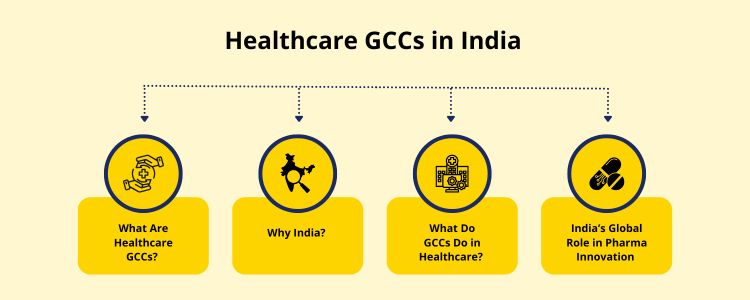
GCCs in India lead implementation of advanced digital solutions, including data analytics, artificial intelligence, and machine learning, which accelerate drug discovery, streamline clinical trials, and optimize supply chain management. The GCCs play a crucial role in the drug development lifecycle for the parent organization, collaborating on drug discovery projects and providing computational chemistry and bioinformatics support, with high-performing computational resources enabling rapid R&D processes. AI has made a significant impact on protein modeling, where tools like AlphaFold can model proteins in hours instead of months, allowing companies like GSK and Sanofi to speed up R&D by 30-40%, enabling faster identification of drug targets. Life sciences and healthcare GCCs in India focus on clinical trials, with centers supporting clinical data management, document writing, and regulatory compliance, as well as biostatistics & programming for sample size calculation and statistical analysis. Indian healthcare GCCs contribute significantly to clinical trials by managing various aspects including data management, patient recruitment, regulatory compliance, and more, with advanced technology and analytics enhancing the efficiency, accuracy, and success rate of clinical trials. GCCs manage global trial data, digital patient monitoring, and compliance reporting in real-time, with specialized teams managing adverse event reporting and patient safety analytics. Modern GCCs span key domains such as clinical trials, pharmacovigilance, regulatory affairs, and real-world evidence analytics, with many centers leveraging artificial intelligence to expedite drug development. Pharmacovigilance, the detection, assessment, understanding, and prevention of adverse effects or any other drug-related problem, is mission-critical. In May 2024, India’s Central Drugs Standard Control Organisation published a revised draft guidance on pharmacovigilance requirements for human vaccines to enhance vaccine safety and efficacy through robust pharmacovigilance practices. The regulatory environment has matured significantly. Bangalore centers support dossier preparation and global regulatory filing for the US FDA, EMA, and WHO. 60% of regulatory affairs for global life sciences firms are being handled out of India. On August 7, 2024, India specified reference agencies whereby local clinical trial waivers may be granted for drugs approved in the US, UK, Japan, Australia, Canada, or in the EU by EMA under specific conditions. Healthcare GCCs handle four core functions: drug discovery using AI and computational chemistry (speeding R&D by 30-40%), clinical trial management with real-time data monitoring, pharmacovigilance for patient safety, and regulatory submissions to FDA/EMA/WHO, collectively managing 60% of global regulatory affairs.
85% of Healthcare & Life Science GCCs are established in Delhi-NCR, Bengaluru, Hyderabad, and Mumbai, with 20% of healthcare GCCs having their centers in 3 or more cities. More specifically: Bengaluru ranks first with approximately 33% of Healthcare & Life Sciences GCCs across India, followed by Hyderabad with 26%, Mumbai with 15%, Delhi-NCR with 12%, Chennai with 6%, and Pune with 4%. Bengaluru, Hyderabad, Mumbai, and Pune contribute to nearly 75% of the total talent for Life Sciences and Healthcare GCCs in India. Tamil Nadu has become a preferred destination for global pharma leaders like Pfizer, Roche, and AstraZeneca to establish their GCCs and innovation hubs.
Cost Advantage (But It’s Not What You Think) Companies setting up GCCs in India could achieve average cost savings of 40-50% compared to their home countries. Healthcare GCCs in India help cut costs by 20% and report savings of 40% in IT support, R&D, and administrative functions. But It’s not just about labor arbitrage anymore. Life sciences multinationals are embedding their most strategic, knowledge-intensive work in India, making it the epicenter for life sciences innovation, compliance, and future growth. India offers 40-50% cost savings, but the real advantage is a 2.7 million-strong life sciences talent pool producing 2.4 million STEM graduates annually, combined with 100% FDI allowance and government support for AI/university partnerships—making it strategic, not just cheap.
The growing number of life sciences and healthcare GCCs shows 20+ in 2010, 45+ in 2015, 100+ in 2024, and is projected to reach 160+ by 2030. The current total talent pool in LSHC GCCs is projected to grow from 40,000+ in 2010 to 100,000+ in 2015, 280,000+ in 2024, and 420,000+ by 2030. Healthcare and Life Sciences account for approximately 25% of India’s GCC market with needs for data management and clinical research. Nearly 23 of the top 50 global life sciences companies have established operations in India, many within the past five years.
70% of finance, 75% of HR, 62% of supply chain, and 67% of IT operations for global life sciences firms are being handled out of India. But there’s significant variation in maturity across functions: According to a maturity assessment, within life sciences functions, GCCs in India show high maturity in Finance & Accounting, IT & Digital, and HR, medium-high maturity in Medical & Regulatory Affairs and Pharmacovigilance, and medium maturity in Research & Development, Procurement, Tax & Legal, and Commercial functions.
While more than 1.5 million STEM graduates are produced annually in India with 65% eligible for healthcare IT and life science employment, eligibility doesn’t equal job-readiness. Companies need to extract more value through optimization and efficiency as labor arbitrage has already provided initial value. The reality: GCCs are investing heavily in upskilling programs because graduates, while theoretically qualified, often lack practical experience in cutting-edge domains like AI-driven drug discovery, complex regulatory submissions, or advanced pharmacovigilance. Healthcare GCCs must comply with HIPAA, GDPR, and ISO standards such as 27001, ensuring safe and compliant healthcare data operations. The regulatory landscape is complex and evolving. India’s 2019 New Drugs and Clinical Trial Rules and subsequent amendments brought positive impact on clinical research and drug R&D ecosystem by providing greater transparency and predictability of timelines. But challenges remain. Internal discrepancies exist in reporting requirements, creating confusion for Indian sites participating in multinational trials. The burden of uninformative safety case reporting adds substantial regulatory review workload. The ratio of insourcing to outsourcing of IT and tech has definitely moved, from 80% outsourcing earlier, they are now doing 70% of work in-house. This poses an existential question for traditional IT services companies. When pharma companies insource through GCCs, what happens to the Wipros and TCSs of the world? They’re pivoting to become GCC enablers, but is that sustainable?
Continued Expansion Healthcare GCCs are projected to grow from 100+ in 2024 to 160+ by 2030, with talent pool expanding from 280,000+ to 420,000+. This assumes continued global pharma R&D investment and no major regulatory shocks. Furthermore, as 70% of finance, 75% of HR, 62% of supply chain, and 67% of IT operations are already handled from India, we may hit saturation. Future growth comes from M&A rather than greenfield expansion.
If you’re a pharma executive considering India: What works: India serves as a key global hub for development, attracting investments of more than $7 billion in healthcare GCCs. The talent, infrastructure, and regulatory maturity are proven. What needs scrutiny: Can you manage the complexity of running globally distributed R&D? Are you prepared for the upskilling investment required? Do you have the right operating model to extract value beyond cost savings? The strategic question: Life sciences multinationals are embedding their most strategic, knowledge-intensive work in India. The question isn’t whether to have an India presence—it’s how strategic you’re willing to make it. India’s healthcare GCC ecosystem isn’t the future. It’s the present. With 45% of global drug discovery and development, 60% of regulatory affairs, and 54% of pharmacovigilance operations already running from India, the pharmaceutical industry’s center of gravity has already shifted. The only question left: Are you positioned accordingly?
Hyderabad, Bangalore and Pune have become significant pharma innovation centres with global delivery centres of major biotechnological and pharmaceutical firms such as Novartis, Pfizer, AstraZeneca and GSK. They offer an economic benefit of calculation, a variety of scientific and technical human resources, and speedy time-to-market. On average, businesses reduce between 25-40 percent of the operational costs and increase the rate of innovation. The next-generation operations of Pharma GCC focus on advanced molecular modelling, AI/ML-based drug discovery, cloud supercomputing, and data integration platforms, as well as quantum-ready simulations. Pharma GCCs use AI to screen molecules, predict the efficacy of drugs, optimise clinical trials and aid in making data-driven decisions, resulting in smarter, faster and safer drug pipelines. Pharma GCCs will be global innovation ecosystems that are a combination of computational chemistry, generative AI, and quantum computing. They will turn into the hubs linking data science, discovery and regulatory intelligence in the global arena. With multifaceted experience in Legal, Advisory, and GCCs, Yashasvi weaves law, business growth, and innovation. He leads a cross-functional team across legal, marketing, and IT to drive compliance and engagement. His interests span Law, M&A, and GCC operations, with 15+ research features in Forbes, ET, and Fortune. A skilled negotiator, he moderates webinars and contributes to policy forums.
The Transformation No One Saw Coming
The Big Players: Who's Actually Building What
Bristol Myers Squibb: $100 Million Hyderabad Bet
GSK: The Bengaluru R&D Powerhouse
Pfizer: Chennai as Innovation Hub
Novartis: The 8,000-Person Operation
What They Actually Do: The Four Core Functions
Geography Matters: Where the Talent Actually Lives
The Economics: Why India, Specifically
The Growth Trajectory: What the Numbers Say
The Functional Maturity Map: What's Actually Working
The Uncomfortable Truths
The Future: Three Scenarios
The Bottom Line for Decision-Makers
frequently asked questions (FAQs)
1.Who are the Pharma GCC development leaders in India?
2.Which economic benefits do Pharma GCCs have?
3.Which technologies are influencing Pharma GCC operations nowadays?
4.What is the role of AI in Pharma GCC processes?
5.How will Pharma GCCs look in five years to come?

Yashasvi Rathore









Error: Contact form not found. Error: Contact form not found.Subscribe to our Newsletter
Subscribe to our Newsletter
Insights / News
Quick Links