Recent Posts







As cost pressures intensify and the demand for specialized talent grows, India has emerged as the premier destination for establishing Global Capability Centers (GCCs). For pharmaceutical CXOs, the question now is, how to architect it for maximum strategic value.
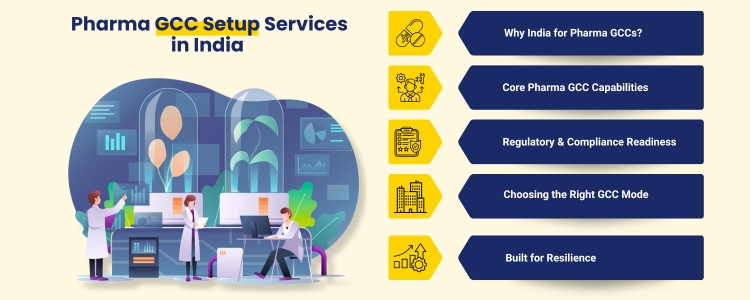
India’s pharmaceutical GCC ecosystem has matured beyond basic operations. Today’s centers function as high – end hubs driving drug discovery, clinical data management, regulatory affairs, pharmacovigilance, and advanced analytics. The value proposition is compelling: accessing highly qualified scientific talent at approximately 40-60% lower costs than Western markets, while simultaneously reducing time-to-market for critical therapeutic developments. The numbers tell the story. India hosts over 1,800 GCCs employing more than 1.6 million professionals, with pharmaceutical and life sciences GCCs representing one of the fastest-growing segments. Major pharmaceutical corporations including Pfizer, Novartis, AstraZeneca, and Johnson & Johnson have already established substantial operations, validating the model’s viability. Strategic Architecture: The most successful pharmaceutical GCC setups transcend simple cost reduction. They embed strategic capabilities that create competitive advantage across three dimensions. Regulatory Intelligence and Compliance: India’s regulatory professionals possess deep expertise in navigating complex global frameworks; from FDA regulations to EMA guidelines and emerging markets requirements. A well-structured GCC can centralize regulatory intelligence, harmonize compliance processes across geographies, and accelerate approval pathways through systematic data management. Clinical Development Acceleration: With its large patient population, extensive hospital networks, and experienced clinical research professionals, India offers unique advantages for clinical operations. GCCs can manage site selection, patient recruitment strategies, data monitoring, and safety reporting while maintaining rigorous quality standards. The time zone advantage enables round-the-clock trial monitoring, effectively compressing development timelines. Digital Transformation and Analytics: Modern pharmaceutical GCCs leverage India’s robust technology talent pool to build advanced capabilities in AI-driven drug discovery, real-world evidence generation, precision medicine analytics, and commercial intelligence. These digital layers transform GCCs from service centers into strategic assets that generate proprietary insights.
Geographic positioning requires nuanced evaluation. Bangalore, Hyderabad, and Pune dominate the pharmaceutical GCC landscape due to their established life sciences ecosystems, specialized talent pools, and robust infrastructure. These cities offer immediate access to experienced professionals and established vendor networks. However, forward-thinking CXOs are increasingly evaluating Tier-2 cities like Ahmedabad, Coimbatore, and Vizag. These locations present compelling economics—real estate costs 30-40% lower, attrition rates significantly reduced, and improving infrastructure. The calculation shifts when building specialized teams rather than scaling generic functions. The optimal strategy often involves a hub-and-spoke model: critical functions requiring deep collaboration in Tier-1 hubs, with scalable operations and emerging capabilities in Tier-2 centers.
India produces approximately 50,000 pharmacy graduates and 8,000 pharmaceutical science postgraduates annually, creating a substantial talent pipeline. Yet quantity doesn’t guarantee quality alignment. Successful GCC talent strategies address three imperatives. Capability Mapping: Define precise skill requirements across regulatory affairs, pharmacovigilance, clinical operations, medical writing, and data sciences. India’s talent depth varies across specializations—pharmacovigilance and regulatory professionals are abundant, while specialized biostatisticians or translational medicine experts require more targeted recruitment. Retention Architecture: Pharmaceutical GCCs in India face 18-25% annual attrition in experienced roles. Sustainable models invest in clear career pathways, continuous learning opportunities, meaningful work exposure to global projects, and competitive total rewards. The most successful centers create centers of excellence that build professional pride and institutional knowledge. Partnership Models: Strategic partnerships with leading academic institutions and research organizations can provide talent pipelines, specialized training programs, and collaborative research opportunities. These relationships strengthen both capability and employer brand.
The captive GCC model offers maximum control, cultural integration, and intellectual property protection—critical considerations for pharmaceutical innovation. However, it demands significant management bandwidth, infrastructure investment, and time to operational maturity (typically 18-24 months to full productivity). Hybrid models combining captive operations with strategic outsourcing partners provide flexibility. Routine transactional work can flow to specialized service providers while high-value, sensitive functions remain in-house. This approach enables faster scaling and risk mitigation during initial phases. Progressive CXOs are also exploring joint venture structures with established Indian pharmaceutical companies. These arrangements provide instant infrastructure, regulatory expertise, and local market access while maintaining strategic control over core capabilities.
Pharmaceutical GCCs operate within a complex regulatory matrix. Beyond general compliance (GST, transfer pricing, employment laws), pharmaceutical-specific considerations include data privacy for clinical information, controlled substance handling protocols, pharmacovigilance reporting requirements, and audit readiness for regulatory inspections. Establishing robust quality management systems aligned with global standards (ICH-GCP, FDA 21 CFR Part 11, EU GDPR) is non-negotiable. The GCC must demonstrate equivalent rigor to Western operations—auditors increasingly scrutinize offshored functions with intensity matching primary sites. Transfer pricing deserves particular attention. Pharmaceutical GCCs handling R&D, intellectual property development, or commercial analytics face heightened scrutiny. Defensible models require careful documentation of value creation, appropriate cost-plus or profit-split methodologies, and advance pricing agreements where feasible.
Successful GCC establishment follows a disciplined progression. The foundation phase (months 1-6) focuses on legal entity formation, location finalization, leadership hiring, and core infrastructure setup. This phase determines long-term success—rushing creates technical debt that compounds over time. The launch phase (months 6-18) emphasizes initial team building, process establishment, and pilot project execution. Starting with well-defined, lower-risk functions enables learning while building credibility. Early wins create momentum and stakeholder confidence. The scale phase (months 18-36) expands scope, headcount, and capability complexity. This phase tests operating model resilience and leadership depth. Successful scaling requires systematic knowledge management, robust governance, and continuous process refinement. The maturity phase (36+ months) sees the GCC evolve into a strategic partner driving innovation, efficiency, and competitive advantage. Mature centers propose solutions, identify opportunities, and operate with substantial autonomy.
Cost savings remain important but are insufficient as primary success indicators. Sophisticated measurement frameworks evaluate multiple dimensions: cycle time reduction in regulatory submissions, quality metrics (audit findings, deviation rates), innovation contributions (patents filed, process improvements), talent metrics (retention rates, skill development), and business impact (revenue enabled, market access accelerated). The most valuable GCCs become indispensable; their contributions so embedded in global operations that the organization cannot imagine functioning without them.
For pharmaceutical CXOs, the GCC decision represents more than operational optimization. It’s a strategic commitment to building sustainable competitive advantage in an industry facing unprecedented pressure on pricing, accelerating technological disruption, and intensifying competition from biosimilars and generics. India’s pharmaceutical GCC ecosystem offers the rare combination of deep domain expertise, cost efficiency, and innovation potential. The opportunity is substantial. The complexity is real. The strategic value, when executed with rigor and vision, can be transformative. The question for pharmaceutical leaders isn’t whether to establish India operations, but whether to architect them for operational excellence or strategic differentiation. That choice will define competitive position for the decade ahead.
Hyderabad, Bangalore and Pune have become significant pharma innovation centres with global delivery centres of major biotechnological and pharmaceutical firms such as Novartis, Pfizer, AstraZeneca and GSK. They offer an economic benefit of calculation, a variety of scientific and technical human resources, and speedy time-to-market. On average, businesses reduce between 25-40 percent of the operational costs and increase the rate of innovation. The next-generation operations of Pharma GCC focus on advanced molecular modelling, AI/ML-based drug discovery, cloud supercomputing, and data integration platforms, as well as quantum-ready simulations. Pharma GCCs use AI to screen molecules, predict the efficacy of drugs, optimise clinical trials and aid in making data-driven decisions, resulting in smarter, faster and safer drug pipelines. Pharma GCCs will be global innovation ecosystems that are a combination of computational chemistry, generative AI, and quantum computing. They will turn into the hubs linking data science, discovery and regulatory intelligence in the global arena. With multifaceted experience in Legal, Advisory, and GCCs, Yashasvi weaves law, business growth, and innovation. He leads a cross-functional team across legal, marketing, and IT to drive compliance and engagement. His interests span Law, M&A, and GCC operations, with 15+ research features in Forbes, ET, and Fortune. A skilled negotiator, he moderates webinars and contributes to policy forums.
The Pharmaceutical GCC Imperative
Location Strategy: The Tier-1 vs Tier-2 Calculus
The Talent Equation: Building Sustainable Capability
Operating Model Design: Captive vs Hybrid Approaches
Regulatory and Compliance Framework
Implementation Roadmap: Phased Excellence
Measuring Success: Beyond Traditional Metrics
The Strategic Imperative

frequently asked questions (FAQs)
1.Who are the Pharma GCC development leaders in India?
2.Which economic benefits do Pharma GCCs have?
3.Which technologies are influencing Pharma GCC operations nowadays?
4.What is the role of AI in Pharma GCC processes?
5.How will Pharma GCCs look in five years to come?

Yashasvi Rathore









Error: Contact form not found. Error: Contact form not found.Subscribe to our Newsletter
Subscribe to our Newsletter
Insights / News
Quick Links