Recent Posts






The quiet revolution happening in boardrooms across the global enterprise landscape bears an unmistakable signature. Where once the talk centered on cost arbitrage and operational efficiency, today’s conversations have pivoted to something altogether more consequential: the fundamental reimagining of how multinational corporations architect their global operations.
The numbers that made GCCs attractive has grown considerably more complex. India, home to more than half the world’s GCCs and a market exceeding Sixty-Four billion dollars in value, once offered a straightforward proposition. Lower labor costs, But the ground has shifted beneath this model. Organizations now face an intensifying skill gap, with niche capabilities required for next-generation centers proving extremely difficult to source. The talent that powered traditional GCC operations, competent in executing well-defined processes, no longer matches the requirements of enterprises seeking transformation partners rather than service providers. Wage inflation in established hubs compounds the challenge. The cost advantage that once justified the GCC model has narrowed as competition for specialized skills drives compensation upward. The most pressing talent gaps concentrate in roles critical to a GCC’s transition from service enabler to product owner, particularly in areas like generative AI application, cloud architecture, and advanced data engineering.
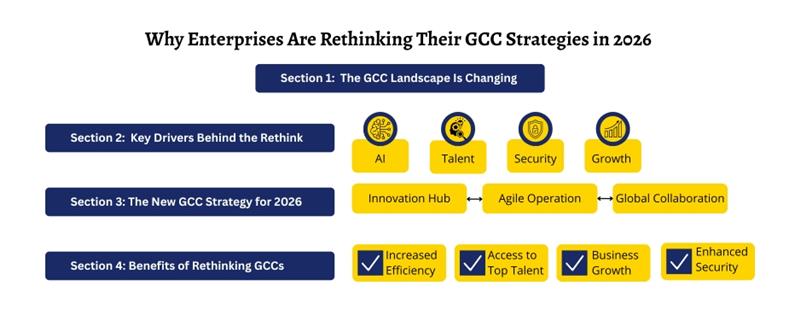
What distinguishes 2026 from preceding years is not simply the acceleration of technological change, though that acceleration is real, but rather a fundamental shift in how enterprises conceive of their GCCs’ purpose. The GCC market is expected to grow to four hundred thirteen billion dollars by 2040, but this growth masks a more profound transformation. Forward-thinking organizations no longer measure their GCCs by traditional metrics of efficiency and cost reduction. Instead, they ask whether these centers drive innovation, own profit-and-loss responsibility, and contribute to competitive differentiation. In 2026, the most successful GCCs will behave like internal startups, agile, cross-functional, insight-driven, and deeply aligned with global business outcomes. This shift from execution to ownership represents perhaps the single most significant strategic recalibration in the GCC model’s evolution. Consider the implications; a GCC designed to process transactions efficiently requires a very different talent profile, technological infrastructure, and governance model than one expected to identify market opportunities and develop proprietary intellectual property. Many enterprises find their existing GCC architectures inadequate for these elevated ambitions.
Artificial intelligence has moved from boardroom aspiration to operational necessity with startling speed. By the end of 2025, AI quietly entered everyday operations, having matured from pilots and proofs of concept. The technology no longer represents a future capability but a present requirement. Yet AI’s integration into GCC operations reveals uncomfortable truths about organizational readiness. Leaders must transition from managing humans alone to managing a hybrid workforce of humans and AI agents, with reports indicating that fifty-eight percent of Indian GCCs are already investing in agentic AI. These autonomous systems handle substantive portions of workload, drafting documentation, conducting regression testing, managing support tickets, functions that once occupied significant human resources. The strategic question enterprises confront: does the existing GCC model support this transformation, or does it require fundamental restructuring? Many organizations discover that legacy process designs, performance metrics, and team structures actively impede AI integration rather than facilitate it.
Regulatory complexity has emerged as another catalyst driving strategic reconsideration. Compliance has moved to the front line, changing how global enterprises create and scale value. What once represented a manageable aspect of GCC operations has evolved into a multifaceted challenge spanning data sovereignty, cross-border information flows, employment law, and intellectual property protection. Enterprises operating GCCs must navigate an increasingly fragmented regulatory landscape where different jurisdictions impose conflicting requirements. The straightforward centralization that characterized earlier GCC models becomes problematic when data cannot freely move across borders, when local content requirements constrain operational flexibility, and when compliance failures carry consequences extending beyond financial penalties to reputational damage and operational restriction. GCCs face increased financial complexities driven by volatile markets, which can impact operational efficiency and growth. The stability that made long-term GCC investments attractive has given way to uncertainty that demands more adaptive, resilient operating models.
Location strategy, once a relatively straightforward decision weighted heavily toward cost considerations, has become a more nuanced calculation. India maintains its position as the dominant GCC destination, but enterprises increasingly explore hybrid models that distribute capabilities across multiple geographies. Bangalore and Gurugram are saturated, with the smartest leaders adopting hub-and-spoke models to tap into rich talent pools in cities like Noida, Jaipur, Kochi, Indore, and Coimbatore. These secondary markets offer not merely lower costs but also significantly reduced attrition rates, often twenty percent lower than metropolitan centers. Yet geographic diversification introduces operational complexity. Managing distributed teams across multiple cities or countries requires sophisticated coordination mechanisms, cultural sensitivity, and technological infrastructure that many organizations struggle to implement effectively. The question of where to locate GCC operations has evolved from a procurement decision to a strategic choice with ramifications for talent acquisition,
Perhaps no challenge provokes more strategic rethinking than talent management. Over seventy-two percent of GCC leaders cite talent management, including retention and skill-gap analysis, as a key priority. The traditional model, recruiting capable professionals to execute well-defined processes, no longer suffices. Enterprises now require talent that can navigate ambiguity, drive innovation, and operate with minimal supervision. Forward-thinking GCCs are shifting from buying talent to a build, borrow, and bot approach involving aggressive internal upskilling, utilizing contingent workforce, and integrating automation. This represents a fundamental departure from the employment models that characterized traditional GCC operations. The generational shift compounds these challenges. Younger professionals entering the workforce bring different expectations around purpose, autonomy, and career progression. The stability and brand recognition that once attracted talent to established GCCs matter less to a generation that prizes meaningful work and rapid skill development. Organizations find their value propositions inadequate for attracting and retaining the caliber of talent their strategic ambitions require.
As GCCs assume greater strategic importance, questions of ownership and governance move to the foreground. Leadership roles must adapt from local to remote, and the shift from vendor-managed to client-employee managed services demands a new mindset. The hierarchical, command-and-control structures that sufficed for operational delivery prove inadequate for innovation-focused centers expected to challenge conventional thinking and drive strategic initiatives. Enterprises grapple with how much autonomy to grant their GCCs. Too little, and the centers remain constrained by headquarters’ limitations, unable to fully leverage their capabilities and market proximity. Too much, and the risk of misalignment or operational divergence increases. Finding the appropriate balance requires ongoing calibration rather than one-time policy setting. The governance challenge extends to how enterprises measure and reward GCC performance. Traditional metrics, cost per transaction, efficiency gains, service level compliance, capture only a fraction of the value that strategically mature GCCs deliver. Organizations struggle to develop measurement frameworks that appropriately value innovation contribution, knowledge creation, and strategic enablement alongside operational excellence.
What emerges from this confluence of pressures is not simply an improved version of the existing model but a fundamentally different conception of what GCCs should be and how they should operate. GCCs have evolved from internal startups driving innovation, AI-led transformation, and enterprise-wide capability building, with talent no longer supporting the business but leading it. This transformation from support function to strategic engine requires enterprises to rethink every aspect of their GCC strategy, from initial scope definition and location selection through talent models, governance frameworks, and success metrics. The most sophisticated enterprises approach this transformation not as a discrete project but as an ongoing strategic evolution. They recognize that the optimal GCC model for 2026 will likely prove insufficient for 2028, given the pace of technological change and market evolution. Building adaptive capacity, the ability to sense shifts in the operating environment and respond effectively, becomes as important as optimizing current operations.
Organizations navigating this transition require partners who understand not only the operational mechanics of GCC establishment and management but also the strategic imperatives driving transformation. Inductus, with its deep experience enabling Global Capability Centers across India, brings a perspective informed by working with enterprises at various stages of their GCC journey. What distinguishes effective GCC strategy in 2026 is not adherence to a standard blueprint but rather a clear-eyed assessment of organizational readiness, strategic ambition, and market reality. Some enterprises may find that their current GCC model, with targeted enhancements, serves their needs adequately. Others may discover that achieving their strategic objectives requires more fundamental reinvention. The difference often lies not in the resources invested but in the questions asked. Does the existing GCC architecture support the organization’s digital transformation ambitions? Can current talent models attract and retain the capabilities required for future competitiveness? Do governance frameworks enable appropriate autonomy while maintaining strategic alignment? Is the organization prepared for the cultural shifts that accompany GCC transformation?
The rethinking of GCC strategies happening across global enterprises in 2026 lacks the drama of sudden market disruptions or technological breakthroughs. It proceeds through thousands of incremental decisions, a revised talent strategy here, a governance model adjustment there, a gradual expansion of the GCC’s strategic mandate. Yet the cumulative effect of these decisions amounts to a revolution in how enterprises organize their global operations. The GCC model that emerges from this period of strategic reconsideration will bear only passing resemblance to its predecessors. Organizations that recognize this reality and act accordingly position themselves for sustained competitive advantage. Those that treat their GCCs as static assets requiring only operational optimization risk finding themselves increasingly disadvantaged by competitors who understand that the future of global enterprise operations is being written in these offshore centers. The question facing enterprise leaders in 2026 is not whether to rethink their GCC strategy but how quickly and effectively they can execute that rethinking. The window for strategic repositioning remains open, but history suggests it will not remain so indefinitely. The enterprises that act decisively, informed by clear strategic thinking, realistic assessment of organizational capability, and sophisticated understanding of the evolving GCC landscape, will shape the competitive dynamics of their industries for years to come.
Hyderabad, Bangalore and Pune have become significant pharma innovation centres with global delivery centres of major biotechnological and pharmaceutical firms such as Novartis, Pfizer, AstraZeneca and GSK. They offer an economic benefit of calculation, a variety of scientific and technical human resources, and speedy time-to-market. On average, businesses reduce between 25-40 percent of the operational costs and increase the rate of innovation. The next-generation operations of Pharma GCC focus on advanced molecular modelling, AI/ML-based drug discovery, cloud supercomputing, and data integration platforms, as well as quantum-ready simulations. Pharma GCCs use AI to screen molecules, predict the efficacy of drugs, optimise clinical trials and aid in making data-driven decisions, resulting in smarter, faster and safer drug pipelines. Pharma GCCs will be global innovation ecosystems that are a combination of computational chemistry, generative AI, and quantum computing. They will turn into the hubs linking data science, discovery and regulatory intelligence in the global arena. With multifaceted experience in Legal, Advisory, and GCCs, Yashasvi weaves law, business growth, and innovation. He leads a cross-functional team across legal, marketing, and IT to drive compliance and engagement. His interests span Law, M&A, and GCC operations, with 15+ research features in Forbes, ET, and Fortune. A skilled negotiator, he moderates webinars and contributes to policy forums.
The Erosion of the Old Certainties
abundant technical talent, and
favorable time-zone coverage created an irresistible trifecta for Western enterprises looking to optimize their operational expenditure. The Architecture of Value Creation
The AI Imperative and Its Discontents
The Compliance Labyrinth
The Geography Question
operational resilience,
and market proximity. The Talent Conundrum
The Question of Ownership and Governance
The Path Forward: Toward GCC 4.0
The Inductus Perspective
A Quiet Revolution

frequently asked questions (FAQs)
1.Who are the Pharma GCC development leaders in India?
2.Which economic benefits do Pharma GCCs have?
3.Which technologies are influencing Pharma GCC operations nowadays?
4.What is the role of AI in Pharma GCC processes?
5.How will Pharma GCCs look in five years to come?

Yashasvi Rathore










Error: Contact form not found. Error: Contact form not found.Subscribe to our Newsletter
Subscribe to our Newsletter
Insights / News
Quick Links