Recent Posts







When multinational corporations announce ambitious expansion plans, the projections shimmer with promise. Five-year roadmaps detail market penetration targets, operational efficiencies, and projected returns that would make any board applaud. Yet a peculiar pattern emerges in the years that follow: somewhere between the boardroom presentation and operational reality, these carefully constructed strategies begin to fracture. The numbers tell a sobering story. Nearly 60 percent of enterprise expansion initiatives fail to meet their original performance benchmarks within the first three years. The gap between projection and reality often widens with each quarterly review, leaving executives to parse what went wrong in strategies that seemed, on paper at least, entirely sound.
The challenge is not one of ambition or even initial execution. Most enterprises approach global expansion with considerable sophistication, armed with market analysis, recommendations, and substantial capital allocation. The failure point emerges later, in what operations theorists call the “middle distance”, that transitional phase when a strategy must transform from concept into self-sustaining operations. Consider the typical trajectory. A technology firm decides to expand into Asian markets, establishing what it terms an “innovation hub” in Bangalore or Hyderabad. Initial progress appears promising. Office space is secured, local talent identified, early projects launched. But within eighteen months, a cascade of complications emerges. The new center struggles to integrate with existing workflows. Communication gaps widen between headquarters and satellite operations. Talent retention becomes problematic. Costs exceed projections while output falls short. What appeared as straightforward replication of successful models reveals itself as something far more complex. The expansion strategy, sound in theory, encounters the friction of implementation at scale.
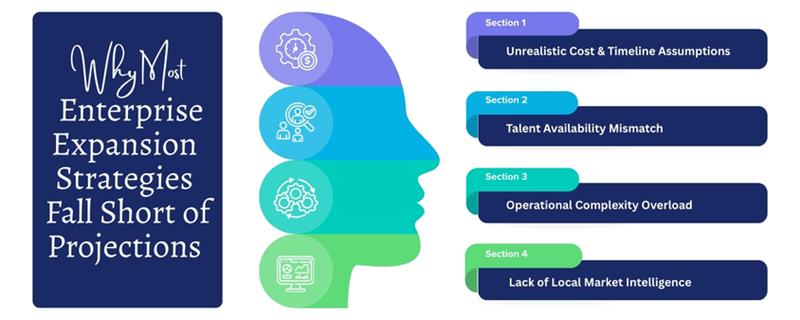
The shortcomings of conventional enterprise expansion strategies cluster around several recurring failure modes, each subtle enough to escape initial notice but substantial enough to derail long-term objectives. The Coordination Deficit manifests first. Enterprises typically underestimate the organizational complexity required to orchestrate distributed operations. What works smoothly within a single headquarters building fractures across time zones, regulatory environments, and cultural contexts. The informal networks that facilitate rapid decision-making in established offices simply do not exist in new locations. Information flows become sluggish, decision rights remain ambiguous, and the nimble responsiveness that characterized the original operation gives way to bureaucratic inertia. Talent Architecture Misalignment presents another persistent challenge. Companies often approach talent acquisition in new markets with frameworks designed for their home geography. They underestimate the nuances of local talent ecosystems, the university pipelines, the competitive dynamics among employers, the cultural expectations around career progression and workplace environment. The result is either an inability to attract top-tier talent or, perhaps worse, successful recruitment followed by rapid attrition as misaligned expectations collide with reality. Operational Infrastructure Gaps become apparent once early momentum fades. Setting up basic operations proves straightforward enough. Establishing the deeper infrastructure required for sustained performance, the vendor relationships, the compliance frameworks, the IT systems integration, the facilities management protocols, demands expertise and attention that stretches internal resources thin. These seemingly mundane operational details accumulate into significant drags on productivity and morale. Cultural Integration Failures perhaps cause the most insidious damage. Remote offices can drift into becoming isolated outposts rather than integrated components of a unified enterprise. Without deliberate efforts to build cultural cohesion, new locations develop their own norms and expectations that may diverge substantially from corporate standards. This cultural fragmentation impedes collaboration, breeds resentment on both sides, and ultimately undermines the value proposition of global expansion. The cumulative effect of these challenges is what economists might call “diseconomies of scale”, the perverse outcome where expansion actually reduces rather than enhances organizational efficiency. Overhead multiplies while synergies remain elusive.
Against this backdrop of recurring failures, a different approach has gained adherents among enterprises seeking more reliable expansion outcomes. The Global Capability Center model, and more specifically the role of specialized GCC enablers, represents not merely an alternative vendor relationship but a fundamental preconception of how enterprises can scale globally. The distinction is worth establishing clearly. A GCC is not an outsourcing arrangement, though it may superficially resemble one. It is a wholly-owned operational center, typically located in a cost-advantaged geography, that functions as an integrated extension of the parent enterprise. The center performs core business functions, product development, data analytics, engineering, and customer operations, with the same standards and strategic alignment as headquarters operations. What distinguishes this model is its emphasis on genuine capability building rather than simple cost arbitrage. A properly structured GCC becomes a center of excellence, not merely a service provider. It houses specialized expertise, drives innovation in its domains of focus, and operates with strategic autonomy while maintaining tight integration with broader corporate objectives. The challenge, however, is that establishing such centers demands capabilities that most enterprises lack. This is where GCC enablers enter the equation, serving as specialized partners who possess the operational expertise, market knowledge, and established infrastructure to transform GCC concepts into functioning realities.
The value proposition of a competent GCC enabler operates across multiple dimensions, each addressing specific failure modes in traditional expansion strategies. Market Intelligence and Site Selection begins the relationship. Enablers bring granular understanding of regional talent markets, regulatory environments, infrastructure quality, and economic stability. They can distinguish between geographies that merely appear attractive and those that genuinely match an enterprise’s specific operational requirements. This frontloaded expertise prevents costly missteps in foundational decisions that become nearly impossible to reverse. Accelerated Operational Launch represents the most immediately visible benefit. Where internal expansion efforts might require twelve to eighteen months to achieve basic operational status, enablers with established infrastructure can compress this timeline substantially. They maintain ready facilities, possess established vendor relationships, understand local compliance requirements, and can rapidly mobilize recruitment efforts. This acceleration is not merely about speed but about maintaining strategic momentum and reaching productivity milestones before organizational patience and budget tolerance exhaust themselves. Talent Ecosystem Access perhaps provides the most sustainable competitive advantage. Effective enablers do not simply recruit on behalf of clients. They maintain ongoing relationships within local talent communities, understand the nuances of attraction and retention in specific roles and seniority levels, and can architect compensation and benefits structures that compete effectively without overpaying. They bring established employer brands in markets where the client enterprise may be unknown, significantly easing recruitment challenges. Operational Excellence Infrastructure encompasses the unglamorous but essential foundations of sustained performance. Enablers implement proven processes for facilities management, IT infrastructure, vendor management, compliance monitoring, and financial operations. They bring economies of scale in these operational domains, spreading fixed costs across multiple client engagements while maintaining quality standards. This allows the client enterprise to focus leadership attention on strategic matters rather than operational troubleshooting. Governance and Integration Frameworks address the coordination deficits that plague distributed operations. Sophisticated enablers establish clear communication protocols, decision rights frameworks, and performance management systems that maintain accountability while preserving appropriate autonomy. They facilitate cultural integration through deliberate programs that build connections between headquarters and remote operations, preventing the drift toward isolation that weakens many expansion efforts. Risk Mitigation and Compliance Management becomes increasingly valuable as regulatory complexity grows globally. Enablers maintain expertise in local labor law, tax regulations, data protection requirements, and industry-specific compliance obligations. They absorb the burden of monitoring regulatory changes and adjusting operations accordingly, protecting client enterprises from costly violations or operational disruptions.
Skeptics might reasonably question why enterprises would engage enablers rather than building these capabilities internally. The calculus rests on several economic realities.
For most enterprises, the specialized expertise required to establish and operate global centers represents a tangential capability at best. A financial services firm excels at financial services, not at navigating Indian real estate markets or understanding Indonesian labor law. Attempting to develop these capabilities internally diverts leadership attention and organizational resources from domains where the enterprise possesses genuine competitive advantage.
Expansion strategies exist within specific strategic windows. Market opportunities, competitive dynamics, and internal organizational readiness create moments when expansion makes strategic sense. The ability to act decisively within these windows carries substantial value. Enablers collapse the time required to achieve operational status, allowing enterprises to capture opportunities before windows close.
Expansion initiatives carry substantial execution risk. Enablers with proven track records effectively transfer much of this risk, providing greater certainty around timelines, budgets, and operational outcomes. For publicly traded enterprises answerable to quarterly earnings expectations, this reduction in outcome variance justifies considerable premium.
Building internal capabilities creates fixed cost structures and organizational commitments that prove difficult to unwind if strategic priorities shift. Enabler partnerships, properly structured, provide operational capabilities with greater adaptability to changing circumstances.
The conventional metric for evaluating global expansion efforts tends toward crude cost comparison: operational expense in new location versus comparable expense at headquarters. This framing misses the strategic value equation. More sophisticated analyses examine several dimensions of impact. Time-to-productivity measures how quickly new operations contribute meaningful output rather than consuming integration resources. Talent quality and retention metrics assess whether the center attracts and maintains the caliber of expertise required for strategic objectives. Innovation contribution evaluates whether the center generates new capabilities, intellectual property, or process improvements rather than simply executing assigned tasks. Cultural integration indices, though harder to quantify, measure whether remote operations function as genuine team members or remain perpetual outsiders. When evaluated across these dimensions, successful GCC implementations enabled by competent partners demonstrate substantially superior outcomes compared to traditional expansion approaches. The projections that seemed overly optimistic in conventional strategies become achievable benchmarks in properly structured GCC models.
For corporate strategists contemplating global expansion, several implications emerge from this analysis. First, Recognize that expansion capability represents a specialized expertise distinct from your core business competencies. The temptation to treat expansion as a straightforward extension of existing operations underestimates the complexity involved and increases failure probability. Second, Evaluate potential enabler partnerships not primarily on cost grounds but on operational track record, market expertise, and cultural fit. The cheapest provider often proves most expensive in total ownership cost once failures and remediation expenses accumulate. Third, Structure the enabler relationship as a true partnership rather than a vendor engagement. The most successful implementations feature deep collaboration, transparent communication, and aligned incentives that reward long-term success rather than short-term metrics. Fourth, Maintain realistic timelines that allow for proper foundation building. The acceleration enablers provide is substantial but not magical. Sustainable operations still require thoughtful implementation, not merely rapid deployment. Fifth, Invest in integration from inception rather than treating it as a later-stage activity. The coordination and cultural challenges that derail expansions are easier prevented than remedied. The pattern is clear enough in retrospect. Traditional enterprise expansion strategies stumble not from flawed logic but from underestimating implementation complexity. They treat expansion as a replication challenge when it is actually a capability-building exercise. GCC enablers, properly engaged, provide the specialized expertise and operational infrastructure that transforms ambitious projections into achievable outcomes. The era of expansion as internal initiative has given way to expansion as orchestrated partnership. The enterprises that recognize this shift position themselves to capture the benefits of global scale while avoiding the pitfalls that have trapped their predecessors.
Hyderabad, Bangalore and Pune have become significant pharma innovation centres with global delivery centres of major biotechnological and pharmaceutical firms such as Novartis, Pfizer, AstraZeneca and GSK. They offer an economic benefit of calculation, a variety of scientific and technical human resources, and speedy time-to-market. On average, businesses reduce between 25-40 percent of the operational costs and increase the rate of innovation. The next-generation operations of Pharma GCC focus on advanced molecular modelling, AI/ML-based drug discovery, cloud supercomputing, and data integration platforms, as well as quantum-ready simulations. Pharma GCCs use AI to screen molecules, predict the efficacy of drugs, optimise clinical trials and aid in making data-driven decisions, resulting in smarter, faster and safer drug pipelines. Pharma GCCs will be global innovation ecosystems that are a combination of computational chemistry, generative AI, and quantum computing. They will turn into the hubs linking data science, discovery and regulatory intelligence in the global arena. With multifaceted experience in Legal, Advisory, and GCCs, Yashasvi weaves law, business growth, and innovation. He leads a cross-functional team across legal, marketing, and IT to drive compliance and engagement. His interests span Law, M&A, and GCC operations, with 15+ research features in Forbes, ET, and Fortune. A skilled negotiator, he moderates webinars and contributes to policy forums.
The hidden architecture behind successful global expansion reveals why traditional strategies stumble.
The Persistent Problem of Scale
Where Traditional Strategies Encounter Resistance
The GCC Model as Strategic Infrastructure
How Enablers Transform Expansion Economics
The Economic Logic of Partnership
First is the matter of core competency.
Second is the time-value consideration.
Third is the risk transfer element.
Fourth is the flexibility consideration.
Measuring Impact Beyond Cost Reduction
The Path Forward for Enterprise Leaders

frequently asked questions (FAQs)
1.Who are the Pharma GCC development leaders in India?
2.Which economic benefits do Pharma GCCs have?
3.Which technologies are influencing Pharma GCC operations nowadays?
4.What is the role of AI in Pharma GCC processes?
5.How will Pharma GCCs look in five years to come?

Yashasvi Rathore










Error: Contact form not found. Error: Contact form not found.Subscribe to our Newsletter
Subscribe to our Newsletter
Insights / News
Quick Links