Recent Posts







One of the GCC leaders attends a stressful cross-continent meeting: deadlines are missed, a customer is dissatisfied, and the team is split into onsite and remote employees. Instead of repeating herself, she listens, acknowledges the unspoken frustration, and resumes the conversation. In half an hour, the room will transition from defensiveness to collaborative problem-solving. The difference in leadership that Global Capability Centres (GCCs) require is a slight shift: emotional clarity versus technical adherence. GCCs are not back-office cost centres anymore. Only in India, there are over 1,900+ GCCs amounting to approximately US $65 billion and employing close to 1.9 million individuals; this market is approximately US $99-105 billion by 2030 with workforces that are projected to increase to about 2.5-2.8 million. The leaders have to deal with intricate human dynamics across cultures and time zones as GCCs assume work of increased risk and value.
GCC leaders need emotional intelligence, which is practical and measurable: the skill of identifying triggers (self-awareness), remaining resourceful despite the pressure (self-regulation), comprehending colleagues of different cultures (empathy), and building trusting relations that can make decisions across the borders faster (social skills). EI is also a competitive business competency, as research is connecting it to increased productivity and better team performance, and it is not a soft skill.
Retention and cost control: GCCs that invest in manager capability and employee experience reduce unnecessary attrition and waste associated with rehiring, onboarding, and lost delivery time. The most recent GCC industry dashboards show an ongoing emphasis on individualised rewards and retention drivers, with a moderate level of attrition. Higher productivity: Several studies demonstrate that EI is related to better individual and team performance; the high performers are identified more by their emotional skills than technical ability and raw IQ. The point: EI development translates into increased output per head. Faster global coordination: Influential leaders without authority reduce the duration of decision-making between HQ and GCCs, reducing time to market of services and products and enhancing customer satisfaction.
The ability to hold emotion, meaning, and context is unique to humans, whereas automation and GenAI handle routine tasks. GCC leaders who combine domain expertise with emotional depth will unlock new enterprise values, whether they are running sensitive regulatory programmes or leading high-trust AI labs. The future head of GCC is a data-savvy, emotionally intelligent, and culturally nimble strategist and humanist.
Emotional intelligence for GCC leaders is not a leadership decree; it is a competitive weapon of GCC performance, retention and expansion. Investment in EI by GCC leaders is more than just a goodwill gesture; it is a payoff in the form of faster decision-making, less fluctuating delivery, and quantifiable monetary benefit. EI is the competency that transforms potential into performance for GCCs seeking to shift their focus from cost arbitrage to strategic impact.
Hyderabad, Bangalore and Pune have become significant pharma innovation centres with global delivery centres of major biotechnological and pharmaceutical firms such as Novartis, Pfizer, AstraZeneca and GSK. They offer an economic benefit of calculation, a variety of scientific and technical human resources, and speedy time-to-market. On average, businesses reduce between 25-40 percent of the operational costs and increase the rate of innovation. The next-generation operations of Pharma GCC focus on advanced molecular modelling, AI/ML-based drug discovery, cloud supercomputing, and data integration platforms, as well as quantum-ready simulations. Pharma GCCs use AI to screen molecules, predict the efficacy of drugs, optimise clinical trials and aid in making data-driven decisions, resulting in smarter, faster and safer drug pipelines. Pharma GCCs will be global innovation ecosystems that are a combination of computational chemistry, generative AI, and quantum computing. They will turn into the hubs linking data science, discovery and regulatory intelligence in the global arena. Aditi, with a strong background in forensic science and biotechnology, brings an innovative scientific perspective to her work. Her expertise spans research, analytics, and strategic advisory in consulting and GCC environments. She has published numerous research papers and articles. A versatile writer in both technical and creative domains, Aditi excels at translating complex subjects into compelling insights. Which she aligns seamlessly with consulting, advisory domain, and GCC operations. Her ability to bridge science, business, and storytelling positions her as a strategic thinker who can drive data-informed decision-making.
How Emotional Intelligence (EI) Appears in GCC Leadership
Why Does EI Generate Quantifiable GCC Results?
Making The Difference with EI
EI Competency and GCC Impact
EI Competency
The Way it Manifests in GCC Leadership
Business impact
Self-awareness
Realises personal bias in escalations.
Fewer client escalations; lower burnout
Self-regulation
Handles inter-time zone stress well.
Better customer service; more consistent shipment.
Empathy
Understands cultural and personal constraints
Higher engagement; reduced attrition
Social skills
Negotiates with HQ without command authority
Accelerated decision-making; increased level of strategic ownership.
Relationship building
Nurtures trust with onsite and remote peers
Increased autonomy of GCC; growth in revenues.
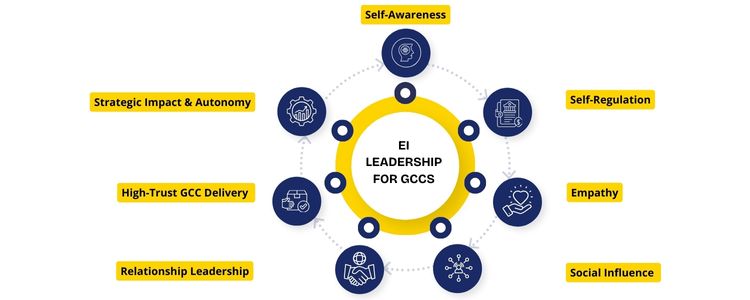
Initiatives Being Pursued by GCCs For Further Enhancement.
Future GCC Leader of 2030
Conclusion

frequently asked questions (FAQs)
1.Who are the Pharma GCC development leaders in India?
2.Which economic benefits do Pharma GCCs have?
3.Which technologies are influencing Pharma GCC operations nowadays?
4.What is the role of AI in Pharma GCC processes?
5.How will Pharma GCCs look in five years to come?

Aditi








Error: Contact form not found. Error: Contact form not found.Subscribe to our Newsletter
Subscribe to our Newsletter