Recent Posts







Global Capability Centres (GCCs) are no longer back-office engines; they are strategic centres that need to demonstrate that each rupee invested is generating innovation and competitive advantage. India now has far in excess of 1,900 GCCs and almost 1.9 million professionals; this will increase significantly by 2030 when GCCs will no longer be cost centres but innovation-led centres. Zero-Based Budgeting (ZBB) is the only budgeting method that will be relevant to global capability centers transformation: ZBB will create a necessity to construct budgets with first principles in mind, redistributing funds of the legacy inertia into quantifiable, high-impact projects like automation, AI productisation and capability building. Over the next five years, GCCs that view budgeting as a strategic tool rather than a financial exercise will reap rewards. The GCC ecosystem of India has brought in billions in revenues in 2024 and is going on to the shared service optimisation, development of products, R&D and data services.
Annual roll-forward budgets reward history in addition to not showing future impact. In GCCs this is manifested as: The Solution: Bloated operation budgets that do not result in any quantifiable business delivery.
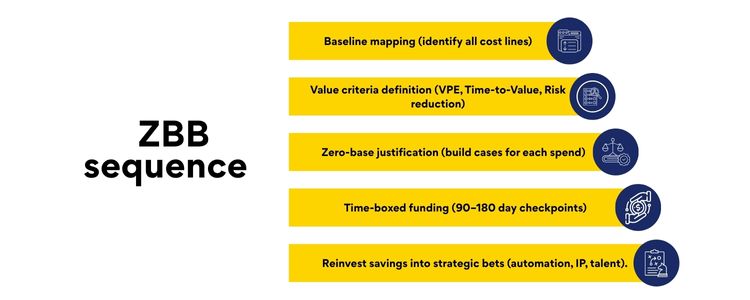
A ZBB implies gcc cost optimisations to recalculate in relation to the outcome measures (value-per-employee, time-to-value and ROI on automation). It is conditional, time-boxed funding: micro-grants on experiment pools with 90-day greenlights; elastic capacity micro-spend on platform and cloud based on throughput KPI; training budgets are rationalised by redeployment strategies and productivity lift.
ZBB transfers cost savings into investable capital as opposed to arbitrary reductions. In the case of GCCs, the economic benefits are obvious: Since GCCs have an increasing presence in the economy and the states are willing to promote growth in GCCs through policies, the macro tailwinds enhance the ROI of ZBB.
The financial model will isolate passive GCCs, and future-ready centres will be Zero-Based Budgeting. Budgets being custom-crafted, GCCs realise economic benefits, accelerated innovation, better margin profiles and investment back towards global-scale IP. ZBB is more than just a technique for GCC leaders and CFOs who will be creating budgets in their upcoming planning cycles; it’s a means of transforming cost discipline into strategic power.
Hyderabad, Bangalore and Pune have become significant pharma innovation centres with global delivery centres of major biotechnological and pharmaceutical firms such as Novartis, Pfizer, AstraZeneca and GSK. They offer an economic benefit of calculation, a variety of scientific and technical human resources, and speedy time-to-market. On average, businesses reduce between 25-40 percent of the operational costs and increase the rate of innovation. The next-generation operations of Pharma GCC focus on advanced molecular modelling, AI/ML-based drug discovery, cloud supercomputing, and data integration platforms, as well as quantum-ready simulations. Pharma GCCs use AI to screen molecules, predict the efficacy of drugs, optimise clinical trials and aid in making data-driven decisions, resulting in smarter, faster and safer drug pipelines. Pharma GCCs will be global innovation ecosystems that are a combination of computational chemistry, generative AI, and quantum computing. They will turn into the hubs linking data science, discovery and regulatory intelligence in the global arena. Aditi, with a strong background in forensic science and biotechnology, brings an innovative scientific perspective to her work. Her expertise spans research, analytics, and strategic advisory in consulting and GCC environments. She has published numerous research papers and articles. A versatile writer in both technical and creative domains, Aditi excels at translating complex subjects into compelling insights. Which she aligns seamlessly with consulting, advisory domain, and GCC operations. Her ability to bridge science, business, and storytelling positions her as a strategic thinker who can drive data-informed decision-making.
Why Conventional Budgeting is Failing GCCs.
What ZBB Appears To Be Regarding A GCC
Strategic Pillars
Pillar
Legacy Approach
ZBB Approach (Future-driven)
Allocation logic
Carry-forward budgets
Start over; invest in performance.
Vendor management
Multi-year retainers
Performance SLA modular contracts.
Innovation funding
Last in line
The initial seeding was through experiment pools.
Talent & skilling
Headcount budget
Capacity funding based on skills (redeployable)
Cloud & infra
Fixed provisioning
Elastic, KPI-linked spend
Economic Benefits
Priorities of Implementation
Conclusion

frequently asked questions (FAQs)
1.Who are the Pharma GCC development leaders in India?
2.Which economic benefits do Pharma GCCs have?
3.Which technologies are influencing Pharma GCC operations nowadays?
4.What is the role of AI in Pharma GCC processes?
5.How will Pharma GCCs look in five years to come?

Aditi









Error: Contact form not found. Error: Contact form not found.Subscribe to our Newsletter
Subscribe to our Newsletter