Recent Posts






One Monday a mid-sized Global Capability Centre (GCC) in Bengaluru awoke to an emergency client request: a large European bank had been assured that some of its customer information would not leave the EU following a transfer inquiry by one of its regulators. In a single night, the centre’s CISO, who is in charge of data architecture and programme development, had to transform legal subtext into an engineering roadmap and pitch it to a multinational development team. That is the new reality: GCCs are not merely cost centres; they are worldwide data custodians, the decisions of which influence compliance, competitiveness and economic value.
The GCCs in India are expanding swiftly and climbing the value chain. According to the most recent survey, the GCC’s direct economic output is estimated to be between USD $64 and USD $76 billion, and further rapid growth is anticipated throughout the decade. The industry projections show that GCCs in India will increase significantly by the year 2030, which will strengthen the position of India as a cross-border and innovation hub. This expansion brings about obvious economic benefits: pooled talent makes operating costs per engineer lower and time to market with digital products faster. GCCs help national exports and local jobs and become centres of excellence in AI, cybersecurity and data engineering, which lead to enterprise productivity. However, there is an economic good side now, with a governance cost, such as data residency, data privacy, and international data transfer policies, having an impact on architecture, vendor selection, and business conditions.
Every persona needs to transform legal text into technical controls and quantifiable governance.
The concepts of data residency (where data is stored), data sovereignty (state control over data) and data localisation (legal requirement to store data within a state) are different, yet overlapping. GCCs are multi-jurisdictional: multinational client data, multi-region clouds and third-party SaaS. This generates cross-border data flow challenges that are persistent.
These trends reduce rework, reduce regulation, protect revenue streams, and turn governance into a source rather than an expense.
Courts and regulators are not idle; the EU transfer rules (and diligence since Schrems II) continue to be a constant limit on transfers to non-adequate jurisdictions, and new regulatory efforts have demonstrated greater attention to transfers under new national regimes. Regulators revealed in 2025 that 144 nations now have data protection laws, bringing compliance to a worldwide level. Veto bargaining of transfers with India’s major trading partners is still influenced by DPDP reforms and the following regulations.
GCCs will be transformed into Global Data Stewardship Centres. Investments in vendor governance, privacy engineering, and transfer architecture will not be permitted. Those GCCs that learn to use residency-conscious architectures and federated AI will gain more world mandates, less legal friction, and larger GCC market shares estimated at $100bn+ by 2030.
Data residency and privacy are not confined to compliance items any longer; they can be strategic tools that define the location and nature of a GCC competence. In practical terms, it involves legalising residency strategies, engineering them to meet the law, and centralising management with empowering local teams. The initial GCCs to regard governance as a product will transform regulatory complexity into economic benefit that is long-lived.
Hyderabad, Bangalore and Pune have become significant pharma innovation centres with global delivery centres of major biotechnological and pharmaceutical firms such as Novartis, Pfizer, AstraZeneca and GSK. They offer an economic benefit of calculation, a variety of scientific and technical human resources, and speedy time-to-market. On average, businesses reduce between 25-40 percent of the operational costs and increase the rate of innovation. The next-generation operations of Pharma GCC focus on advanced molecular modelling, AI/ML-based drug discovery, cloud supercomputing, and data integration platforms, as well as quantum-ready simulations. Pharma GCCs use AI to screen molecules, predict the efficacy of drugs, optimise clinical trials and aid in making data-driven decisions, resulting in smarter, faster and safer drug pipelines. Pharma GCCs will be global innovation ecosystems that are a combination of computational chemistry, generative AI, and quantum computing. They will turn into the hubs linking data science, discovery and regulatory intelligence in the global arena. Aditi, with a strong background in forensic science and biotechnology, brings an innovative scientific perspective to her work. Her expertise spans research, analytics, and strategic advisory in consulting and GCC environments. She has published numerous research papers and articles. A versatile writer in both technical and creative domains, Aditi excels at translating complex subjects into compelling insights. Which she aligns seamlessly with consulting, advisory domain, and GCC operations. Her ability to bridge science, business, and storytelling positions her as a strategic thinker who can drive data-informed decision-making.
Introduction
Who Goes Through The Agony?
GCC's Interpretation of Data Residency.
The Five Biggest Governance Problems.
Where GCCs Struggle Most
Challenge Area
What it means
Why GCCs struggle
Enterprise impact
Residency
Physical/virtual storage location
Multi-region cloud & SaaS
Rework, penalties, failure of service.
Privacy
Rights, approval and legality.
Multiple overlapping laws
Legal exposure, brand risk
Cross-Border Transfers
Movement of personal data
Lack of transfer mechanisms
Contractual blocks, transfer bans.
Governance
Policy + enforcement
Decentralised teams
Lack of fragmented control, audit failures
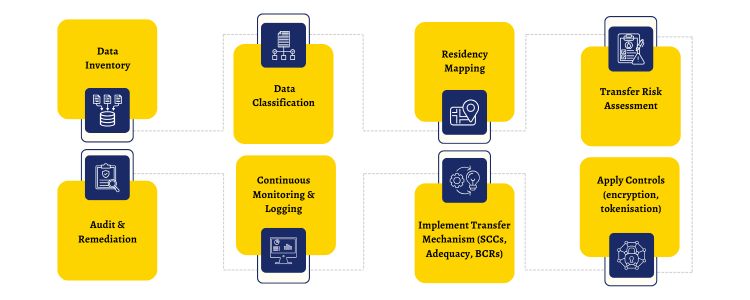
Responses of Leading GCCs.
Current Events That Matter
The Strategic Imperative
Conclusion

frequently asked questions (FAQs)
1.Who are the Pharma GCC development leaders in India?
2.Which economic benefits do Pharma GCCs have?
3.Which technologies are influencing Pharma GCC operations nowadays?
4.What is the role of AI in Pharma GCC processes?
5.How will Pharma GCCs look in five years to come?

Aditi










Error: Contact form not found. Error: Contact form not found.Subscribe to our Newsletter
Subscribe to our Newsletter