Recent Posts






The Global Capability Centre (GCC) of a mid-sized bank in Bengaluru started as a small experiment: a four-person pod that was testing an AI model to estimate supply-chain emissions. In nine months, the pod created a deployable carbon dashboard, reduced energy costs in a test area, and became the focal point of a formal internal accelerator. That pathway experiment to enterprise product explains why GCCs need to integrate innovation velocity hand in hand with green requirements now.
Most of the GCCs are based in India, and it is the most rapidly expanding centre of the enterprise capability base; new industry estimates indicate that today the GCC base in India is approximately 1,900 and an expansion of over 2,400 is expected to be realised by 2030 as the sector expands. This expansion is aligned with the forecasts that the Indian GCC market is expected to grow to approximately US$ 100-110 billion in the year 2030 due to software exports, enhanced value-added services and productisation. Meanwhile, the sustainability agenda is becoming more and more restrictive due to regulatory pressure and corporate governance. The rules, like the Corporate Sustainability Reporting Directive (CSRD) in the EU have raised the benchmark on disclosing emissions and climate change planning, although recent policymaking processes have indicated changing demands so that the parent companies now hope more of the GCCs develop auditable and enterprise-scale sustainability solutions.
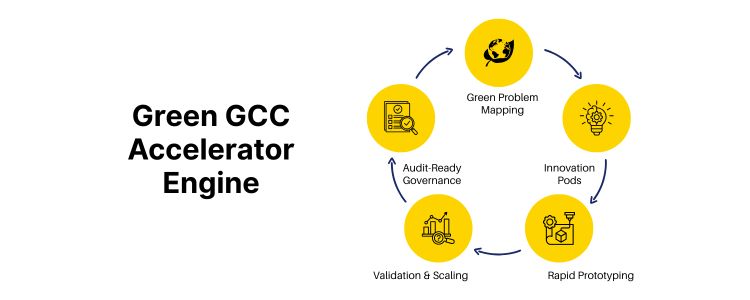
GCC startup accelerators are small time-boxed programmes, which gather cross-functional teams including product managers, data scientists, sustainability leads, and engineers to solve particular business challenges using startup rigour. These accelerators in combination with a Green GCC Framework have three simultaneous results: quick prototype development, quantifiable carbon emission, and a route to worldwide expansion of business divisions.
These five pillars constitute the backbone of an operating accelerator, such that every PoC has to be scored on technical novelty, business value, and size of carbon impact.
Internal accelerators result in lower power costs through optimisation, lower cloud costs through right-sizing, and lower purchase costs through supplier consolidation, all of which translate more effectively into tangible savings. In the event that GCC-made goods are sold to other business units or outside markets, they also access other revenue streams. In the current environment, investors and other stakeholders value these efficiencies more than ever because they increase margins and lower enterprise carbon intensity. The enormous economic potential of commercialising GCC innovation is emphasised by reports that project the GCC industry to grow to a market worth more than $100 billion.
By 2030, GCCs will not be evaluated based on headcount and FTE efficiency but on the number of scaled products they make and the reduction of carbon that the products allow. Businesses that incorporate internal accelerators into a Green GCC Framework will be able to take advantage of the new economic value of productisation and global market expansion in addition to being able to comply and meet stakeholder expectations. The formula for GCC leaders and parent companies is simple: they need to institutionalise the accelerator model, base funding on carbon & commercial KPIs, and make Green GCCs the key drivers to sustainability and growth.
The Green GCC Framework redefines carbon neutrality as a design rather than retrofitting. In the case of Global Capability Centres, it is a change that opens up direct economic value and regulatory and investor trustworthiness and creates a culture that is purpose-orientated, which attracts talent. Carbon neutrality by design is the strategic requirement that cannot be ignored in a market where the GCC footprint and strategic relevance of India are still increasing and where leaders and followers are not the same.
Hyderabad, Bangalore and Pune have become significant pharma innovation centres with global delivery centres of major biotechnological and pharmaceutical firms such as Novartis, Pfizer, AstraZeneca and GSK. They offer an economic benefit of calculation, a variety of scientific and technical human resources, and speedy time-to-market. On average, businesses reduce between 25-40 percent of the operational costs and increase the rate of innovation. The next-generation operations of Pharma GCC focus on advanced molecular modelling, AI/ML-based drug discovery, cloud supercomputing, and data integration platforms, as well as quantum-ready simulations. Pharma GCCs use AI to screen molecules, predict the efficacy of drugs, optimise clinical trials and aid in making data-driven decisions, resulting in smarter, faster and safer drug pipelines. Pharma GCCs will be global innovation ecosystems that are a combination of computational chemistry, generative AI, and quantum computing. They will turn into the hubs linking data science, discovery and regulatory intelligence in the global arena. Aditi, with a strong background in forensic science and biotechnology, brings an innovative scientific perspective to her work. Her expertise spans research, analytics, and strategic advisory in consulting and GCC environments. She has published numerous research papers and articles. A versatile writer in both technical and creative domains, Aditi excels at translating complex subjects into compelling insights. Which she aligns seamlessly with consulting, advisory domain, and GCC operations. Her ability to bridge science, business, and storytelling positions her as a strategic thinker who can drive data-informed decision-making.
Why Now: Scale, Economics and Regulation
Internal Promotion of Green Innovation
The Green GCC Framework has 5 Pillars
Accelerator Operation in GCCs
Economic Benefits
GCC Accelerators' Value
Value Area
Typical Outcome
Sustainability innovation
Low-carbon features, supplier emission trackers, and carbon dashboards.
Cost reduction
Reduced energy usage & cloud costs, purchasing efficiencies.
Talent & capability
Green-tech skills, product managers, data engineers
Market expansion
Internal and external products, which are scalable.
Compliance readiness
Audit-ready disclosures and verifiable emissions data
Prospect and Action Plan
Conclusion
frequently asked questions (FAQs)
1.Who are the Pharma GCC development leaders in India?
2.Which economic benefits do Pharma GCCs have?
3.Which technologies are influencing Pharma GCC operations nowadays?
4.What is the role of AI in Pharma GCC processes?
5.How will Pharma GCCs look in five years to come?

Aditi










Error: Contact form not found. Error: Contact form not found.Subscribe to our Newsletter
Subscribe to our Newsletter
Insights / News
Quick Links