Recent Posts







The Global Capability Center (GCC) has become a center for strategic development of multinational companies. These centers, especially in India, are advancing innovation, digital changes, analysis, and enterprise-wide operations. However, as they mature, the global captive centers often face rising costs that reduce the price provided originally. In this context, cost adaptation becomes not only important but also necessary. This is beyond the cost cut and focuses on ensuring that each investment made in GCC provides measurable business results. Cost adaptation in high-performing GCC means aligning people, technology, and operations in a way that promotes productivity, innovation, and agility while maintaining control over expenses. This includes the use of intelligent automation, strategic workforce planning, lean governance, and advanced data-managed decision-making. In the future, the role of the GCC will become more important. By 2027, Gartner estimates that 75% of all digital services of the enterprises will be distributed through global centers such as India. Thus, GCC will have to convert from cost centers to value epicenters. The future will depend on the constant measurements of the structures adapted, cloud design, AI-capable operations, ESG-handled strategies, and cost-to-price results. In the future, cost optimization will not be a one-time practice but a continuous discipline supported by data, governance, and automation. This blog shares actionable strategies, challenges to escape, and real examples of how leading organizations are pushing long-term value through smart cost optimization.
More than 1,800 GCCs are in India, according to Nasscom, and this number is steadily increasing. While India offers cost benefits, a report recently showed that 68% of GCC, after the initial 2-3 years, struggle to meet the goals of long-term cost efficiency. It is mainly due to scale-operated complexity, rising digital talent costs, unnecessary technical stacks, and poor operating governance. Cost adaptation is not only about cutting the budget; It is about connecting the cost with the price again. High-performing GCCs invest strategically to achieve at least automation, skill development, digital infrastructure, and centralized governance.
Understanding where the cost is centered helps identify areas of improvement. The basic factors of the cost of GCCs are as follows:
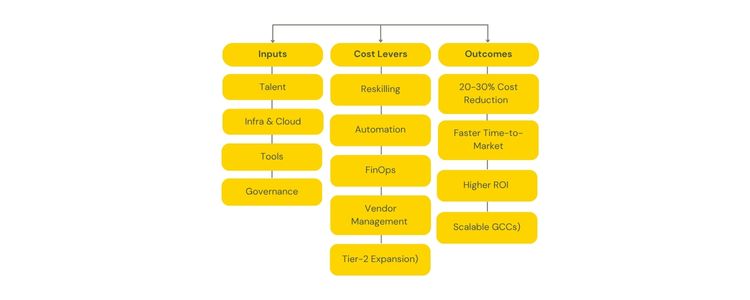
1. Strategic Workforce Planning 2. Automation and Hyperautomation 3. Cloud Cost Adaptation 4. Take Advantage of Tier-2 Cities 5. Center for Centralized Operations and Lean Governance 6. Elimination of Excess Equipment 7. Agile delivery and product mentality
Here is a simple structure that we use to help global customers to achieve cost efficiency without renouncing innovation. A successful cost efficiency or optimization for GCC’s contains three layers: Instead of taking a one-time initiative, this structure was given by GCCs. The operation should be embedded in the DNA of GCCs, which should be supported by regular reviews, real-time data, and continuous innovation.
The US-based BFSI GCC transferred 40% of its roles to Tier-2 cities, decreasing the talent cost by 30% and saving more than Rs 80 crore annually. Their average attrition declined by 18%, and they reported high engagement and stability in operation. A global e-commerce player handled more than 65% of repeating questions using intelligent automation in his customer operating GCC, decreasing the response time by 40% and saving $10M annually. A healthcare GCC in Bangalore implemented integrated data platforms in teams, consolidating unnecessary equipment and saving 35% in licensing costs, improving analytics quality.
The GCC ecosystem is moving from “labor arbitration” to “price arbitration.” Future cost adaptation strategies will be AI-first, cloud-element, and stable. GCC will adopt forecasting analysis to predict the cost trends, use autonomous operations for service distribution, and be more closely associated with global ESG and compliance mandates. The GCC will also focus on creating modifiable products such as data platforms and AI models within its Indian centers. This change will convert cost centers into profit and innovation centers, which will define the objective and power of GCC in global enterprises.
The cost is not about cutting the adaptation corners; It is about making durable, scalable value. For GCC in India, the next decade will define how efficiently they manage talent, technology, and change. Enterprises should adopt an intelligent cost mindset, which combines financial discipline with innovation agility. The real winners will be those who will create a GCC that is not only cost-effective but also flexible, visionary, and results-oriented.
In Inductus GCC, we form a lean, intelligent GCC with global firms that become stronger as they grow. Let us help you unlock the next wave of value through strategic cost optimization.
Cost cuts often focus on reducing expenditure at the risk of quality loss. Cost adaptation ensures that each rupee spent provides value using better operations, automation, and strategic plans. Finops enables real-time tracking and governance of cloud costs. This helps the GCC to avoid overproving, adapt cloud use, and align expenses with business goals. Over-re-operations, removing essential equipment quickly, ignoring employee burnouts, and failing to establish governance can cause disabilities and high long-term costs. Future cost strategies will be AI-based, ESG-compliant, cloud-element, and data-operating. The GCC will also turn away from the cost centers to innovation centers, making a milestone solution. The main metrics include time-to-time for FTE cost per FTE, automation ROI, SAAS usage rates, attrition rates, and deliverables. They help track efficiency and business effects Aditi, with a strong background in forensic science and biotechnology, brings an innovative scientific perspective to her work. Her expertise spans research, analytics, and strategic advisory in consulting and GCC environments. She has published numerous research papers and articles. A versatile writer in both technical and creative domains, Aditi excels at translating complex subjects into compelling insights. Which she aligns seamlessly with consulting, advisory domain, and GCC operations. Her ability to bridge science, business, and storytelling positions her as a strategic thinker who can drive data-informed decision-making.
Why is Cost Adaptation Important?
Cost Driver in GCC Operation
Cost Adaptation Strategies For GCCs
Cost Efficiency for the GCCs
Live Examples
Metrics That Matter: Measuring Cost Efficiency
Metric
Description
Benchmark/Goal
Cost per FTE
Total cost divided by number of FTEs
Reduce 5-10% YoY
Automation ROI
Cost saved via automation tools
20-40% cost reduction
SaaS Spend Utilization
Active vs licensed users
>85% utilization
Cloud Cost per Service
Cost per digital product/service
FinOps monitored
Attrition Rate
Monthly/Annual talent churn
<15% for Tier-2 GCCs
Challenges
Future Approach
Conclusion

frequently asked questions (FAQs)
1.What is the difference between cost cuts and cost adaptation?
2.How can Finops support cost optimization in GCC?
3.Which common mistakes should be avoided during GCC cost optimization?
4.Which future trends will shape GCC cost optimization?
5.How do you measure the success of cost optimization in GCC?

Aditi










Error: Contact form not found. Error: Contact form not found.Subscribe to our Newsletter
Subscribe to our Newsletter
Insights / News
Quick Links