Recent Posts





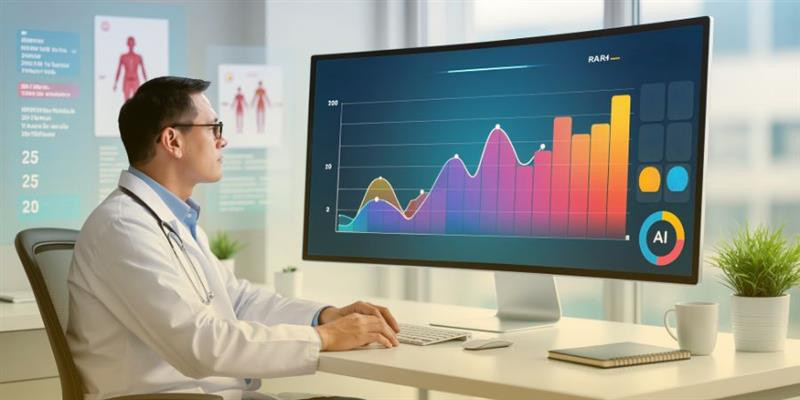
In one of the healthcare Global Capability Centres (GCC) in Bengaluru, an interdisciplinary team refines an AI model to identify the risk of post-operative infection. Data privacy specialists make sure that the records of the same patients don’t cross safe and legal boundaries. This snapshot reflects the new requirements featured by healthcare leaders: AI in healthcare will speed up results, and data governance will be ironclad and maintain trust. Polling of the industry recently reveals that the C-suite health leaders are making productivity and operational efficiency in 2025, which is exactly what Healthcare GCCs are created to achieve.
Healthcare is experiencing a data explosion. Health systems and other devices generate roughly one-third of the entire world’s data, and healthcare data is expanding faster than most other industries. AI model training, remote monitoring, and precision medicine initiatives are all being driven by this trend. Simultaneously, the market of AI-in-healthcare is growing at a high rate: the clinical AI market is estimated by industry sources to be worth tens of billions nowadays, with a projected CAGR in the high-single-digit range over a span of the decade. These twin forces, including the availability of abundant data and the accelerating AI investment are the technical and economic factors that have contributed to the emergence of GCC healthcare hubs.
GCCs are comprised of domain talent, scale, cost arbitrage and regulatory expertise to provide three core values:
(2000–2010) Operational Efficiency: Healthcare GCCs started as a back-office center to bill claims and enter data to save on costs and enhance the efficiency of the process. 2010–2020 – Data & Analytics Expansion: As the EHR systems have emerged, GCCs have moved toward data analytics, healthcare informatics, and population health research to underpin improved clinical and business decisions. 2020–2025 – AI and Governance Era: GCCs became the hubs of innovation and propelled clinical AI, genomics, and data governance in healthcare and guaranteed the adherence to HIPAA, GDPR, and the DPDP Act in India. After 2025 Intelligent and Ethical GCCs: This will involve the GCCs taking the lead in GenAI, predictive healthcare, and cloud interoperability, striking a balance between patient privacy and ethical use of data and digital innovation.
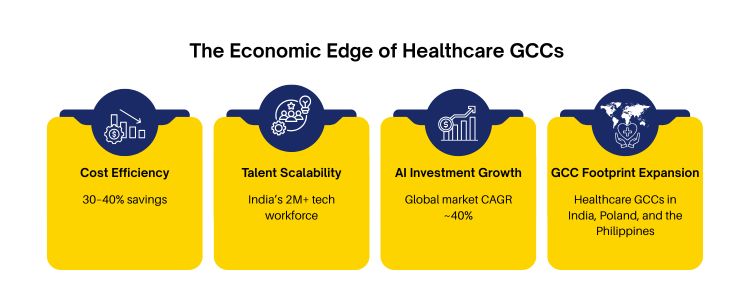
These are the economic gains as to why GCC footprints are increasing globally as well as why healthcare companies are still increasing capability centres in India and other centres.
Five near-term changes to expect include more widespread use of generative and foundation models, optimised to clinical data; more use of digital twins as an individualised-care tool; more regulation of clinical AI performance and bias; the use of blockchain or consent ledger patterns to facilitate visibility of patient consent; and geographic dispersion of GCCs as companies look to resilience and time-zone diversification.
Healthcare GCCs are simultaneously driving two imperatives: technical (transforming the huge, unstructured clinical data into useful AI) and ethical (maintaining patient privacy and trust). Healthcare organisations now need to figure out how to model GCCs so that they become catalysts for safe innovation and financial gains rather than whether or not to implement them.
Hyderabad, Bangalore and Pune have become significant pharma innovation centres with global delivery centres of major biotechnological and pharmaceutical firms such as Novartis, Pfizer, AstraZeneca and GSK. They offer an economic benefit of calculation, a variety of scientific and technical human resources, and speedy time-to-market. On average, businesses reduce between 25-40 percent of the operational costs and increase the rate of innovation. The next-generation operations of Pharma GCC focus on advanced molecular modelling, AI/ML-based drug discovery, cloud supercomputing, and data integration platforms, as well as quantum-ready simulations. Pharma GCCs use AI to screen molecules, predict the efficacy of drugs, optimise clinical trials and aid in making data-driven decisions, resulting in smarter, faster and safer drug pipelines. Pharma GCCs will be global innovation ecosystems that are a combination of computational chemistry, generative AI, and quantum computing. They will turn into the hubs linking data science, discovery and regulatory intelligence in the global arena. Aditi, with a strong background in forensic science and biotechnology, brings an innovative scientific perspective to her work. Her expertise spans research, analytics, and strategic advisory in consulting and GCC environments. She has published numerous research papers and articles. A versatile writer in both technical and creative domains, Aditi excels at translating complex subjects into compelling insights. Which she aligns seamlessly with consulting, advisory domain, and GCC operations. Her ability to bridge science, business, and storytelling positions her as a strategic thinker who can drive data-informed decision-making.
The Scale Of The Opportunity
Why Healthcare GCCs?
Evolution: Back Office to Clinical Core.
Essential Pillars.
Economic Benefits
What Comes Next
Conclusion
frequently asked questions (FAQs)
1.Who are the Pharma GCC development leaders in India?
2.Which economic benefits do Pharma GCCs have?
3.Which technologies are influencing Pharma GCC operations nowadays?
4.What is the role of AI in Pharma GCC processes?
5.How will Pharma GCCs look in five years to come?

Aditi









Error: Contact form not found. Error: Contact form not found.Subscribe to our Newsletter
Subscribe to our Newsletter
Insights / News
Quick Links