Recent Posts






At 09:12, on a Monday morning, a Global Capability Centre (GCC) in Bengaluru automatically changes the lighting and HVAC (Heating, Ventilation, and Air Conditioning) based on a change in daylight and occupancy. Workloads are moved to cloud zones on renewable-powered infrastructure; a carbon dashboard will show an immediate reduction in the centre’s footprint per hour. This is not an idea, but the working reality of the next generation of GCCs. There are now 1,900+ GCCs operating in India with an annual revenue of approximately USD 64.6 billion, and the ecosystem is growing faster with companies integrating sustainability into location and operational decisions.
The pressure of regulations, investor attention, and employee requirements are all coming together. Every two out of three big businesses possess a public climate commitment, and corporations are getting rated by viable delivery rather than promises. GCCs are shifting towards strategic low-carbon delivery centres that reduce parent-company scope 3 emissions while providing a quantifiable economic benefit. Incorporating carbon neutrality into design as opposed to adding it afterwards creates quicker payback, better ESG ratings and operations that are immune to change.
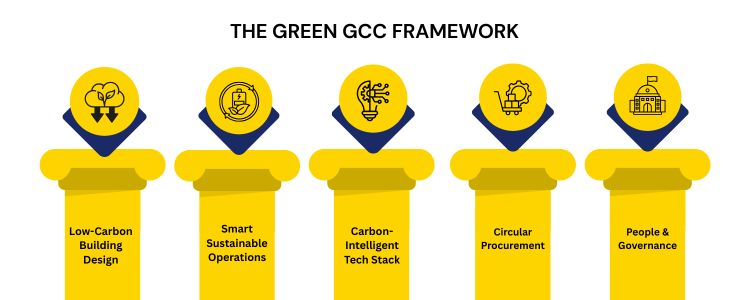
The following framework will change sustainability from a checkbox feature into a design concept that dictates site selection, design, IT and culture. Using embedded carbon, lower embodied carbon materials, orienting buildings to capture daylight, and using highly efficient facades with rooftop solar and electric vehicle charging. Low-carbon options are established during the blueprint stage, which significantly reduces lifecycle emissions. The sensors of IoT, occupancy-based HVAC, and predictive maintenance reduce the energy consumption. According to research, the implementation of automation and intelligent HVAC controls can reduce heating and cooling energy consumption by 20-40% depending on the conditions, resulting in direct cost savings. Install carbon-conscious deployment tools, plan non-essential loads during renewable union windows, and implement green cloud strategies. The maximum usage of the server and the optimal workload lead to a smaller digital carbon footprint and reduced cloud expenditure. Combine devices that can be repaired, implement e-waste collection, and focus on vendors whose supply chain emissions are transparent. Circular developments increase procurement resilience and reduce Scope 3 exposure. Design green KPIs, foster carbon literacy through onboarding, and reward the operational units depending on the real emission reductions. A carbon-neutral culture facilitates low-carbon behaviours.
The economic rationale is quite simple. Green procurement and asset longevity reduce OPEX; energy optimisation and automation reduce OPEX; total cost of ownership reduces OPEX; and a higher ESG score lowers capital costs and improves investor access. GCCs are expanding in size, and the demand for output and service projections will be accompanied by an increase in regulatory disclosure requirements; companies that do this now turn compliance into a competitive advantage. Current industry forecasts also indicate that India’s GCC ecosystem will expand to at least 2,400 centres by 2030, increasing the cumulative effects of green design decisions.
The data-infrastructure boom in India (massive data centres) increases both opportunity and sustainability risk: as capacity grows, resources (power and water) become scarcer, making low-carbon GCC design even more critical. Meanwhile, GCCs are diversifying into new roles (AI, R&D, productisation) and will increasingly serve as the parent organisation’s operational COE in terms of sustainability.
For the next 5 years, the top GCCs will stop being evaluated by delivery metrics but will be rated by the intensity of carbon per output. Carbon-linked OKRs, green SLAs with parent units, and GCCs producing tradable sustainability value, such as verified emission reductions and renewable energy certificates (RECs) at the campus scale, are to be expected. The GCCs that have the capacity to endure will be the ones who made low-carbon decisions during the time the masterplans were being drawn.
The Green GCC Framework redefines carbon neutrality as a design rather than retrofitting. In the case of Global Capability Centres, it is a change that opens up direct economic value and regulatory and investor trustworthiness and creates a culture that is purpose-orientated, which attracts talent. Carbon neutrality by design is the strategic requirement that cannot be ignored in a market where the GCC footprint and strategic relevance of India are still increasing and where leaders and followers are not the same.
Hyderabad, Bangalore and Pune have become significant pharma innovation centres with global delivery centres of major biotechnological and pharmaceutical firms such as Novartis, Pfizer, AstraZeneca and GSK. They offer an economic benefit of calculation, a variety of scientific and technical human resources, and speedy time-to-market. On average, businesses reduce between 25-40 percent of the operational costs and increase the rate of innovation. The next-generation operations of Pharma GCC focus on advanced molecular modelling, AI/ML-based drug discovery, cloud supercomputing, and data integration platforms, as well as quantum-ready simulations. Pharma GCCs use AI to screen molecules, predict the efficacy of drugs, optimise clinical trials and aid in making data-driven decisions, resulting in smarter, faster and safer drug pipelines. Pharma GCCs will be global innovation ecosystems that are a combination of computational chemistry, generative AI, and quantum computing. They will turn into the hubs linking data science, discovery and regulatory intelligence in the global arena. Aditi, with a strong background in forensic science and biotechnology, brings an innovative scientific perspective to her work. Her expertise spans research, analytics, and strategic advisory in consulting and GCC environments. She has published numerous research papers and articles. A versatile writer in both technical and creative domains, Aditi excels at translating complex subjects into compelling insights. Which she aligns seamlessly with consulting, advisory domain, and GCC operations. Her ability to bridge science, business, and storytelling positions her as a strategic thinker who can drive data-informed decision-making.
The Relevance of Carbon Neutral by Design Today.
Green GCC Framework
Green GCC Economic Benefits.
Strategic Initiatives
Action Area
What to do now
Outcome
Site & Infra
Focus on renewable acquisition, rooftop solar, and low-embodied carbon materials.
Lower lifecycle emissions
Building Ops
Occupancy sensors, HVAC and lighting BAS, and predictive maintenance are deployed.
20–40% energy reduction
IT & Cloud
Assign work to green windows for carbon-conscious orchestration.
Reduced digital carbon intensity.
Supply Chain
Green-procurement provisions, e-waste.
Scope 3 exposure reduced
People & Reporting
Green KPIs, transparent carbon accounting
Credibility of investor + behavioural change
The Current Situation And Short-Term Trends.
A Future Perspective
Conclusion
frequently asked questions (FAQs)
1.Who are the Pharma GCC development leaders in India?
2.Which economic benefits do Pharma GCCs have?
3.Which technologies are influencing Pharma GCC operations nowadays?
4.What is the role of AI in Pharma GCC processes?
5.How will Pharma GCCs look in five years to come?

Aditi









Error: Contact form not found. Error: Contact form not found.Subscribe to our Newsletter
Subscribe to our Newsletter
Insights / News
Quick Links