Recent Posts






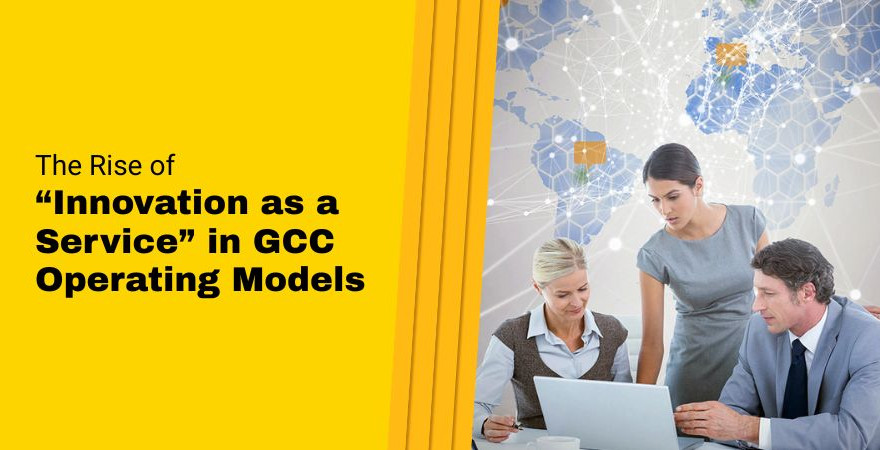
One of the multinational product leaders stopped mid-call when a Bangalore innovation pod showed three viable prototypes that had been constructed within eight days. What started as a discussion about cost and efficiency became a strategic reconsideration: the Global Capability Centre (GCC) in the centre of that demo ceased to be a support unit. It was a 24×7 innovation engine providing Innovation as a Service (IaaS) to the enterprise. This change is not anecdotal; it is the paradigm shift in the way organisations organise capability, talent and capital in the next ten years. The GCC market in India has shifted strongly towards capability arbitrage rather than a low-cost one. Industry reporting has pegged the GCC revenue of India at around USD 64.6 billion in 2023-24, almost a 40 percent increase on the previous year, with the GCC base estimated at 1,900+ centres, with recruitment spurts and ambitious expansion strategies in leading cities of innovation. The GCC recruitments made India the top addition in the tech sector in FY25, with a greater addition of more than 100,000 new jobs, strengthening the increasing strategic presence of the GCCs. These dynamics hold the business case of innovating on demand by means of GCCs.
Innovation as a Service: This is a repeatable operating model where GCCs offer scoped, outcome-driven innovation services (problem intake, rapid prototyping, validation, and IP creation) to global business units as an internal service. The model substitutes episodic projects with a pipeline that is continuously running a layer of service that commoditises speed, repeatability and quantifiable business impact. This is the new edge of digital transformation in the GCC and a logical extension of centres that already bring together technical depth and proximity in domains.
LaaS is an unavoidable result of a series of converging forces:
An operational IaaS model includes six aspects: The flywheel consists of the following steps: intake, sprint, prototype, validation, scaling, and IP reuse. The flywheel powers velocity and the cumulative ability.
Real-world use cases are already yielding tangible results: fraud detection models prototyped in weeks, retail inventory automation pilots that reduce shrinkage, and digital twins in manufacturing that reduce time-to-market. Every successful pilot reduces the cost of future experimentation and improves the assets of reusable platforms, thereby improving the marginal economics of subsequent projects.
Cultural shifts, new funding models, governance that strikes a balance between enterprise alignment and autonomy, and specialised skills to move delivery teams into innovation roles are all necessary for adoption. However, policy stimuli, increased GCC funds for transformation and enhanced infrastructure reduce the entry barrier.
GCCs are coming out of back-office centres, becoming managed innovation services and internal venture studios. Businesses will realise value disproportionately through their GCC networks if they approach innovation as a service, where it is a predictable, financed, and repeatable competency. The future business will not be concerned with whether to outsource innovation; it will be concerned with what GCC will offer as the quickest, safest, and least expensive path to tried concepts and worldwide magnitude.
Hyderabad, Bangalore and Pune have become significant pharma innovation centres with global delivery centres of major biotechnological and pharmaceutical firms such as Novartis, Pfizer, AstraZeneca and GSK. They offer an economic benefit of calculation, a variety of scientific and technical human resources, and speedy time-to-market. On average, businesses reduce between 25-40 percent of the operational costs and increase the rate of innovation. The next-generation operations of Pharma GCC focus on advanced molecular modelling, AI/ML-based drug discovery, cloud supercomputing, and data integration platforms, as well as quantum-ready simulations. Pharma GCCs use AI to screen molecules, predict the efficacy of drugs, optimise clinical trials and aid in making data-driven decisions, resulting in smarter, faster and safer drug pipelines. Pharma GCCs will be global innovation ecosystems that are a combination of computational chemistry, generative AI, and quantum computing. They will turn into the hubs linking data science, discovery and regulatory intelligence in the global arena. Aditi, with a strong background in forensic science and biotechnology, brings an innovative scientific perspective to her work. Her expertise spans research, analytics, and strategic advisory in consulting and GCC environments. She has published numerous research papers and articles. A versatile writer in both technical and creative domains, Aditi excels at translating complex subjects into compelling insights. Which she aligns seamlessly with consulting, advisory domain, and GCC operations. Her ability to bridge science, business, and storytelling positions her as a strategic thinker who can drive data-informed decision-making.
What is Innovation As A Service in GCCs?
Economic Benefits
Essential Features of a GCC.

Traditional GCC and IaaS GCC
Dimension
Traditional GCC
IaaS-Enabled GCC
Primary mandate
Cost & delivery
Capability & innovation
Pace
Linear, predictable
Sprint-based, iterative
Output
Process efficiencies
Prototypes, IP, new revenue streams
Metrics
Cost savings
Speed of innovation and business value.
Talent
Execution-focused
Cross-skilled innovators
Applications and Financial Results.
Challenges And the Path Ahead
Conclusion

frequently asked questions (FAQs)
1.Who are the Pharma GCC development leaders in India?
2.Which economic benefits do Pharma GCCs have?
3.Which technologies are influencing Pharma GCC operations nowadays?
4.What is the role of AI in Pharma GCC processes?
5.How will Pharma GCCs look in five years to come?

Aditi








Error: Contact form not found. Error: Contact form not found.Subscribe to our Newsletter
Subscribe to our Newsletter
Insights / News
Quick Links