Recent Posts





The acceleration to virtualise telecom networks is no longer an offing plan; it is a worldwide switch that has already achieved propagated profits. 5G connections and cloud-native implementations are expected to constitute a significant section of the market by 2025, which is a fact that makes the business case of having specific innovation hubs indisputable. Telcom Global Capability Centres (GCCs), sometimes referred to as Offshore Delivery Centres or Telecom Innovation Centres, have developed out of the cost-orientated, engineering-based units to become strategic R&D drivers. They are the pioneers on the workstreams of cloud-native core development, Open RAN engineering, edge compute solutions and AI-driven automation, all core to 5G/6G network virtualisation.
Network virtualisation separates network operation from hardware-specific vendors and hosts it in software containers that can be operated on cloud platforms. Quick scaling, network slicing of unique services, and programmable operations that reduce capital intensity and accelerate time-to-market with new services are all made possible by this shift. As mobile networks increase data volumes and applications with high latency, virtualisation becomes economically and operationally necessary.
Telecom GCCs offer the expertise, cloud ability and fluid engineering power that the global operators need at scale. Typical functions include: The innovation cycle is shortened by their production: concept, prototype, simulation, live trial, global scale, repeated within the GCC until rollouts are operator-wide.
India-based R&D and innovation centres targeted at network cloud and Open RAN workstreams have been publicly extended by several foreign suppliers and operators; national 6G initiatives and operator migrations to 5G standalone architectures give GCC requirements momentum and scale. Telecom investments are still based on the broader mobile economy; mobile technologies now account for a sizable share of global GDP, demonstrating the strategic significance of telecoms.
Virtualisation will grow to include sensing networks, distributed intelligence, and support for massive XR/metaverse experiences as 6G research becomes a reality. GCCs will develop into digital innovation ecosystems that incorporate edge AI, sustainability engineering, and quantum readiness. Operators who incorporate GCCs into their strategic R&D will be quicker, more cost-effective, and provide more innovative services.
Telecom Global Capability Centres are not optional back offices any more; they are vital innovation drivers towards 5G/6G network virtualisation. GCCs will provide the technical agility and economic benefits needed in the coming decade of telecom innovation by bringing together scale talent, cloud engineering and operator domain expertise. An investment or partnership with Telecom GCC Innovation Centres is a potent lever of sorts for operators and vendors planning a 6G path. It is the one that transforms ambition into realised, profitable networks.
Hyderabad, Bangalore and Pune have become significant pharma innovation centres with global delivery centres of major biotechnological and pharmaceutical firms such as Novartis, Pfizer, AstraZeneca and GSK. They offer an economic benefit of calculation, a variety of scientific and technical human resources, and speedy time-to-market. On average, businesses reduce between 25-40 percent of the operational costs and increase the rate of innovation. The next-generation operations of Pharma GCC focus on advanced molecular modelling, AI/ML-based drug discovery, cloud supercomputing, and data integration platforms, as well as quantum-ready simulations. Pharma GCCs use AI to screen molecules, predict the efficacy of drugs, optimise clinical trials and aid in making data-driven decisions, resulting in smarter, faster and safer drug pipelines. Pharma GCCs will be global innovation ecosystems that are a combination of computational chemistry, generative AI, and quantum computing. They will turn into the hubs linking data science, discovery and regulatory intelligence in the global arena. Aditi, with a strong background in forensic science and biotechnology, brings an innovative scientific perspective to her work. Her expertise spans research, analytics, and strategic advisory in consulting and GCC environments. She has published numerous research papers and articles. A versatile writer in both technical and creative domains, Aditi excels at translating complex subjects into compelling insights. Which she aligns seamlessly with consulting, advisory domain, and GCC operations. Her ability to bridge science, business, and storytelling positions her as a strategic thinker who can drive data-informed decision-making.
The Significance of Network Virtualisation in These Days
What Telecom GCC Innovation Centres Do.
Facts That Define The Opportunity.
Economic Benefits.
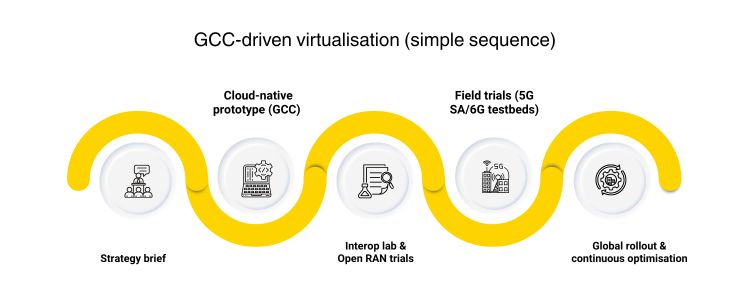
How GCCs Enable Network Virtualisation
Innovation Area
GCC Function
Outcome
Cloud-native core
Containerised CNF development & CI/CD
Rapid scale & multivendor agility
Open RAN
Software RAN modules & interoperability testing.
Reduce vendor lock-in with vendor-agnostic RAN.
Automation & AI
Predictive maintenance, automated coordination
Less downtime, savings of OPEX.
Edge computing
Lightweight orchestration and app enablement
Ultra-low latency services
Security & compliance
Hardening and audit of virtual network
Good faith cloud implementations.
Current Events and Momentum
Future Perspective
Summary

frequently asked questions (FAQs)
1.Who are the Pharma GCC development leaders in India?
2.Which economic benefits do Pharma GCCs have?
3.Which technologies are influencing Pharma GCC operations nowadays?
4.What is the role of AI in Pharma GCC processes?
5.How will Pharma GCCs look in five years to come?

Aditi







Error: Contact form not found. Error: Contact form not found.Subscribe to our Newsletter
Subscribe to our Newsletter
Insights / News
Quick Links