Recent Posts


The bilateral relationship between India and South Korea has undergone a seismic transformation over the past two decades. It has evolved from a cultural camaraderie to a comprehensive partnership rooted in technology collaboration, economic dynamism, and political stability. Therefore, trade, defense, and infrastructure have grown widely, especially under the Special Strategic Partnership. South Korea’s globally renowned prowess in semiconductors and electronics along with smart manufacturing finds a natural partner in India’s expansive market and demographic dividend. In this spirit of mutual growth, Indian cities are rapidly emerging as nerve centers for South Korean enterprises to set up global capability centers. These serve as a digital twin of their parent companies following a mirror-like service model. Major South Korean conglomerates like LG, Hyundai, and Samsung have leveraged India’s best-in-class talent, digital-first capabilities, and competitive cost structures to build futuristic GCCs beyond just traditional sourcing. This article gives a detailed insight on how GCCs in India bridge the culture gap to enhance innovation to ensure unprecedented growth in the global landscape.
There are truly a few significant challenges that demand constant innovation and strategic risk management to survive and thrive among the intense global competition. Read below.
Chaebols are family-controlled conglomerates in South Korea that dominate the country’s economy. The term ‘chaebol’ translates into ‘wealth clan’ which are massive business groups with subsidiaries across multiple industries like finance, automotive, construction, and electronics. As of May 2024, five of the largest chaebols accounted for more than 52% of the total revenue of 82 major business groups of South Korea. These are interlinked via complex cross-shareholding instead of a straightforward corporate structure. They differ from standard businesses in terms of ownership and control, market influence, government ties, and succession. Competition from Chaebols significantly shapes the broader ecosystem of Korean businesses. For instance, there are several challenges including market saturation by giants, talent drain, price war, innovation disruptions, and supply chain dependency. Therefore, the South Korean government has been proactively trying to balance economic power, one of the approaches being collaboration with global capability centers in India.
China poses a strong challenge in sectors like shipbuilding, consumer electronics, technology, and manufacturing. Rapid ascent in smartphones, AI, and semiconductors cause a showdown. Other factors are manufacturing supremacy, global trade dominance, brand vs volume, and EV and batteries which are challenging Korea’s premium positioning in the world. To stay competitive, South Korean companies are turning towards GCCs in India to stay ahead in terms of R&D, talent, innovation, and round-the-clock productivity. It is a strategic move to buffer against the China effect and achieve diplomatic leverage in certain regions.
Geopolitical tensions, ranging from global security dynamics to regional disputes pose a significant threat for South Korean businesses. This is especially true for the ones operating in the unpredictable international markets like exports. Further, tensions on the Southern peninsula remain a constant undercurrent requiring businesses to consider geopolitical risk into risk management frameworks and operational resilience. In response to these complex dynamics, South Korean companies are diversifying investment footprints and supply chain by looking at India. Global capability centers here mitigates both political risks and boosts innovation capacity and operational agility. Further, there is a growing emphasis on public-private partnerships and economic initiatives to protect trade interests.
The one-stop solution to the above discussed issues is to set up a GCC for South Korean MNCs in India. They serve as a powerful innovation engine helping them transcend from a conventional operation model to a futuristic center defined by creativity, agility, and technological leadership. By strategically establishing a GCC with a consulting and advisory partner by your side, South Korean companies get direct access to a tech savvy talent pool that is proficient in digital transformation, product engineering, AI, data science, predictive analytics, and ML. They categorically drive localized innovation tailored to global markets along with piloting emerging technologies in a high-impact and low-risk environment. So, whether a South Korean company requires innovation hubs, R&D clusters, and/or agile product labs, Indian GCCs are able to cater to evolving needs of the MNCs. In an era where innovation is the currency of competitiveness, GCCs are not just a tactical advantage, they are a strong and strategic imperative for South Korean companies that wish to lead the global stage.
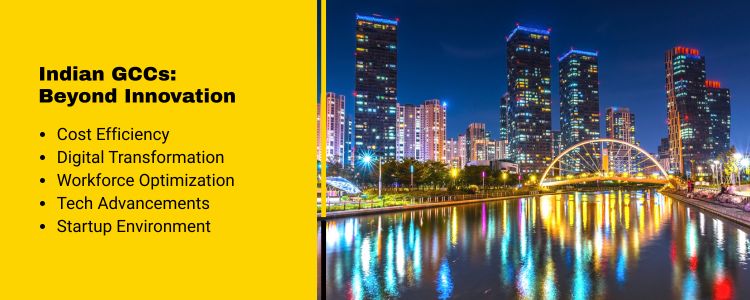
Indian GCCs or offshore development centers are innovation hotspots enabling faster, smarter, and cost-efficient transformation. By tapping into the nation’s agile infrastructure and deep tech talent, MNCs, not only in Korea, but all across the world are enhancing R&D, digital evolution, and product development. Below is a quick overview for a better understanding.
Several countries in South Korea have a significant GCC presence in India leveraging the country’s technology, talent, and infrastructural prowess. Here’s a list of companies and the Indian cities that host their global capability centers : Establishing GCC means to empower Korean companies to innovate faster, lead boldly, and operate smarter. Therefore, you must consider maximizing this potential since global capability centers are no longer a tactical advantage but a necessity.
In a nutshell, Indian global capability centers have become an indispensable catalyst of innovation for South Korean multinationals. Far beyond back office operations, these centers are now driving the wheels of strategic transformation thus encouraging companies to make their mark on the world map. To start setting up GCCs in India for South Korean firms, consider partnering with India’s leading GCC enabler, Inductus GCC. Our BOT, COPO, and COPO-Digital Twin Integrated Service Model evolve seamlessly with your vision while lowering operational costs by a whopping 60-70%. We ensure that each model is executed with innovation and precision thus helping you harness the full potential of your GCC in India.
The future of Japanese GCCs in India is altogether poised for exponential growth. As both nations deepen their economic and diplomatic ties, we can expect a surge in collaborative initiatives across semiconductors, advanced analytics, and automotive engineering. The global capability centers in India will evolve beyond support hubs into nerve centers of innovation thus propelling Japanese enterprises into the next era of global leadership.

What are the Primary Challenges of South Korean Businesses?
Chaebols Disruptions
Impact of Chinese Competition
Effect of Geopolitical Tensions

Indian GCCs: The Smartest Innovation in the Shifting World
How are GCCs Driving Innovation for South Korean Countries?
Korean Companies with GCCs in India
Conclusion




Error: Contact form not found. Error: Contact form not found.Subscribe to our Newsletter
Subscribe to our Newsletter