Recent Posts





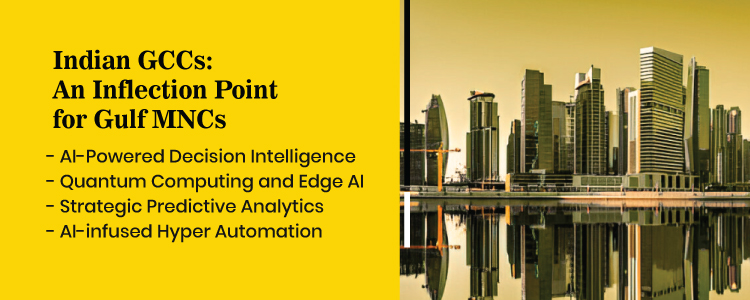
The economic corridors between the India and Gulf nations have deepened over time. A new era of strategic independence is taking shape which is not just built on centuries-old trade ties but on talent, technology, and transformative business models. With Gulf Cooperation Council (GCCs) countries rapidly accelerating diversification through Vision 2030, industrial expansion, and digital infrastructure upgrades, India has emerged as a natural partner which offers scalability, skillset, and speed through its powerful global capability centers. Indian global capability centers bring together their agility in innovation and strategic ambition of Gulf enterprises across UAE, Saudi, Kuwait, Bahrain, Qatar, and Oman to elevate the business ecosystem. When integrated thoughtfully into a business strategy, GCCs help ensure workforce readiness, technological consistency, and regulatory compliance. These are digital innovation centers that can act like strategic extensions of their parent HQs in the Gulf nation driving operational excellence, cross-border innovation, and digital revolution. To truly understand the potential of the Indo-Gulf equation, we must explore how Indian GCCs are undergoing a seismic shift from operational hubs to powerhouses which reshape collaboration while enhancing growth and long-standing business success.
Far from being support units, Indian GCCs have evolved into digital transformation enablers. For gulf countries seeking long-term agility, scalability, and competitive edge, India offers an unparalleled value proposition. Read on.
One of the powerful pillars of India-Saudi business is deep-rooted cultural compatibility. Both nations share mutual respect, collaborative emphasis on long-term business partnerships, and relationship-centric business practices. Altogether, this becomes a strategic asset for Gulf enterprises, especially Saudi, to establish GCCs in India. It ensures seamless communication, trust, and mutual understanding which are non-negotiable for success. As gulf countries expand their global footprint, India is all set to offer both technology and talent along with a workforce that resonates with the cultural pulse of the Gulf region.
Digital disruption is foundational rather than optional.Gulf corporations that are actively pursuing digitization as a key strategy for economic diversification and growth can leverage India’s innovation ecosystem through its global capability centers. This is because India’s IT sector is valued at $282.6billion in FY 2025 with a workforce of 5.8 million professionals which continues to be a strategic global partner in technology and digital transformation. GCCs further act as digital nerve centers driving predictive analytics, cloud migration, and platform engineering which offers Gulf MNCs a sharp edge in the global market. So, whether it is building a fintech platform or automating oil logistics, Indian GCCs are fulfilling Gulf ambitions in a promising manner.
India is home to one of the largest reservoirs of youngest, largest, and tech-savvy workforces. With millions of trained professionals in cloud, cybersecurity, AI, and IT, global capability centers in India provide immediate access to highly qualified talent to Gulf countries. They are available at a fraction of the cost of Western countries and ensure strong industry-academic alliance to boost R&D, skills upgrades, and corporate readiness. Further, India’s workforce is multilingual and globally aware which makes cross-border collaboration seamless. Thus, Gulf MNCs can confidently scale with cultural synergy and efficiency.
Cost arbitrage is a compelling factor in India and a driver for Gulf MNCs to position their GCCs here. The nation offers process innovation, scalable infrastructure, and world-class service delivery in a budget. Moreover, COPO Model and COPO-Digital Twin Integrated Service Model by Inductus GCC offers a 60-70% lower operational expenses. Further, COPO Model also ensures reduced capex and 90-days readiness without having to spend a fortune. Gulf MNCs can achieve faster and leaner operations though Indian digital captive centers or GCCs. They can also optimize resource allocation and help companies invest in core operations, innovation, and customer engagement.
India and the Gulf countries have a remarkable time zone alignment. With only 1.5 to 2.5 hours difference, we offer the Gulf nations the rare ability to collaborate in almost real-time to ensure seamless collaboration, quicker decision-making, and round-the-clock productivity. There is no fatigue of cross-continental time lags and overall Indian global capability centers function as a true strategic extension of their Gulf counterparts. The proximity typically ensures IT support, smooth business processes, and critical operations continuity to boost agility, control, and coordination. In today’s fast moving economy, businesses in the Middle East can leverage India’s skilled talent pool and operational excellence due to this time zone harmony. India’s GCCs have become an indispensable strategic asset for Gulf MNCs like Saudi Aramco and Qatar Airways. Therefore, it is a good idea to consider a global capability center here to accelerate the growth of your organization and acquire a global name.
As the Gulf nations chart new economic visions, India continues to solidify its position as a global powerhouse of innovation and talent. Global capability centers have emerged as the foundation of this dynamic partnership far beyond cost efficiency, operational resilience, and technological advancements. This is further laced with cultural synergy and time zone benefits which builds a truly symbiotic relationship.
The most strategic way to get started is to partner with India’s leading GCC enabler, Inductus GCC. We combine COPO’s structured governance and cooperation with Digital Twin’s AI-driven optimization to deliver a globally benchmarked service to the Gulf MNCs. Each model is executed with precision, innovation, and strategic foresight helping you unlock the full potential of your global capability center in India.
Empowering Gulf MNCs with Indian GCCs
Cultural Compatibility
Digital Transformation
Skilled Talent Pool
Cost Optimization

Time Zone Advantage
Conclusion










Error: Contact form not found. Error: Contact form not found.Subscribe to our Newsletter
Subscribe to our Newsletter
Insights / News
Quick Links