Recent Posts






Healthcare has always been a people-driven industry. But behind every new treatment, connected medical device, digital health platform and pharmaceutical breakthrough lies a growing need for technology, data and specialized expertise. For healthcare companies operating across multiple countries, developing these capabilities has become an important business priority. They need teams that can support product development, manage complex data, strengthen digital infrastructure and improve the way their global operations work together. This is where the role of Global Capability Centers (GCCs) is evolving. India, which has developed a strong technology and business services ecosystem, is increasingly relevant to this shift. Healthcare organizations are looking beyond traditional support operations and considering how India-based teams can contribute to engineering, analytics, research support and digital innovation. For mid-sized healthcare businesses in particular, the opportunity is worth examining closely. The right operating model can provide access to specialized capabilities without requiring every function to be developed independently in the company’s home market. The question is no longer simply where work can be performed. It is where a business can build the capabilities it needs for the future.
Traditionally, many global capability centers focused on functions such as IT support, finance, human resources and routine business operations. These activities continue to matter, but the scope of GCCs has expanded considerably. Healthcare and life sciences organizations are increasingly exploring technology development, data platforms, clinical development support, regulatory operations and other specialized functions. A February 2026 KPMG discussion paper on healthcare and life sciences GCCs in India describes this broader shift towards innovation, product engineering, research and development, and capabilities that contribute more directly to the parent organization’s business. This evolution matters because healthcare companies face challenges that cannot be addressed through operational efficiency alone. They must develop new products, respond to changing technology, manage complex regulatory requirements and make better use of information. A well-designed GCC can provide a dedicated environment for developing these capabilities while remaining connected to the company’s global strategy. Rather than functioning as a separate support unit, it can become an integrated part of the organization’s technology and business operations.
India’s GCC ecosystem has matured beyond traditional delivery models. The Economic Survey 2025–26 highlights how GCCs have expanded into product development, engineering, analytics, cybersecurity and AI-enabled functions. It also notes the growing participation of specialized and innovation-focused mid-market companies. For healthcare organizations, several aspects of this ecosystem are particularly relevant. Healthcare technology is a broad field. It includes software engineering, cloud infrastructure, data management, cybersecurity, digital product development and the integration of complex enterprise systems. Finding and retaining the right mix of skills can be challenging, particularly for a mid-sized company that needs to grow without expanding every function in its home market. An India-based GCC can provide a dedicated team aligned with the company’s technology priorities. For example, a digital health business may need engineers to develop its patient platform, data specialists to improve its analytics capabilities, and cloud professionals to support the reliability of its applications. A medical technology company may have different requirements, including connected-device software, embedded engineering or product testing. The value lies in building a team around the company’s actual needs rather than treating recruitment as an end in itself. Healthcare organizations work with information across research, clinical systems, medical devices, patient services and business operations. The challenge is not simply collecting this information. It is developing the infrastructure and expertise required to manage it securely and use it effectively. India-based teams can support data engineering, business intelligence, reporting, analytics platforms and appropriate AI-enabled applications. For pharmaceutical and life sciences companies, this may also include clinical data management, statistical programming and technology supporting research activities. These capabilities require clear governance. Healthcare information can be sensitive, and its use must comply with the relevant privacy, security and regulatory requirements. When designed responsibly, a GCC can help an organization develop data capabilities that support better operational decisions, more efficient research processes and continued product development. Digital health is creating new demands across the healthcare value chain. Patient-facing applications, connected devices, telehealth platforms and digital clinical workflows all require reliable software, infrastructure and ongoing development. India’s digital health ecosystem has also received attention through public initiatives and industry-led technology development. The Indian government’s January 2025 overview of healthcare digitalization highlighted electronic health records, telemedicine, AI-enabled diagnostics and the importance of interoperability and data governance. For international healthcare businesses, this creates opportunities to establish teams that develop, maintain and improve digital products. A GCC could support application development, system integration, platform modernization, cloud operations or cybersecurity, depending on the company’s business model. AI may offer additional possibilities in areas such as administrative automation, information processing and analytics. However, healthcare AI requires careful validation, appropriate oversight and clear accountability, especially where clinical decisions or patient safety could be affected. The objective should be to build technology that solves a defined business problem, not to adopt new tools simply because they are available.
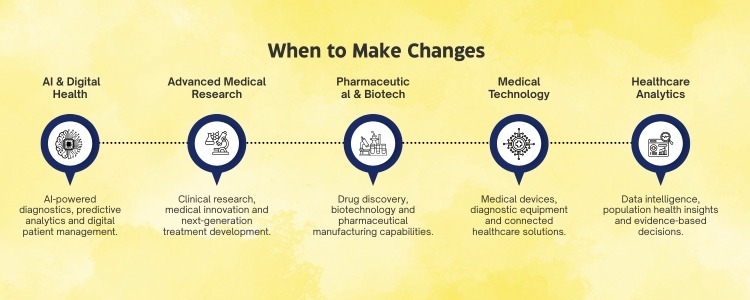
The opportunity is not limited to hospitals or pharmaceutical multinationals. Different parts of the healthcare ecosystem have different reasons to develop capabilities in India. Healthcare technology companies may need product engineers, cloud specialists and data teams to develop and maintain their platforms. Pharmaceutical and life sciences businesses may explore clinical data management, research technology, regulatory support, analytics and specialized digital capabilities. Medical device companies may require software engineering, connected-device technology, product development and cybersecurity expertise. Healthcare service providers and health systems may consider selected finance, IT, revenue-cycle, reporting and administrative functions, subject to their operating requirements and applicable regulations. Healthcare data and analytics businesses may need data engineering, platform development and analytical capabilities to support their products and customers. The important distinction is that these opportunities are not interchangeable. A pharmaceutical company and a digital health software provider may both benefit from a GCC, but their talent requirements, governance obligations and operating models can be very different. The starting point should always be a clear understanding of the business.
Cost efficiency remains a consideration when companies assess international expansion. However, it should not be the only measure of a GCC’s value. A centre that delivers lower operating costs but lacks clear ownership, skilled leadership or integration with the parent business may struggle to produce sustainable results. The more important question is what the center enables the organization to do. Can it shorten product development cycles? Can it provide specialized skills that are difficult to recruit in the home market? Can it improve data capabilities, strengthen technology operations or support the launch of new products? These are the questions that should shape the business case. Companies should also consider the complete cost of establishing and operating a centre, including recruitment, infrastructure, technology, management, compliance and ongoing development. Any expected savings should be based on the company’s actual requirements rather than generic industry estimates. For mid-sized healthcare businesses, a focused operation with clearly defined responsibilities may offer a more practical starting point than a large, multi-function setup.
Establishing a GCC involves more than selecting an office location and hiring employees. The company needs to decide what the centre will do, how it will operate and how it will remain accountable to global leadership. A phased approach can help make these decisions more manageable. Start with a Defined Business Requirement The first step is to identify the capability the organization needs to build. It may be a product engineering team, a data analytics function, a cloud operations team or a selected business process. Defining the scope early helps establish the required skills, technology access, reporting structure and measures of success. Choose an Operating Model That Fits There is no single operating model that works for every company. Some businesses prefer to establish and manage their own Indian entity. Others may consider a partner-led approach that allows them to develop an operation with support from an experienced local partner. Three models that may be relevant, depending on the circumstances, are: The appropriate choice depends on the desired level of ownership, internal management capacity, implementation requirements and long-term plans. These operating arrangements should be distinguished from the legal structure used to conduct business in India. Companies should obtain qualified legal and tax advice before selecting their structure and entering into agreements. Establish Governance before Scaling Healthcare companies must pay particular attention to data access, cybersecurity, intellectual property, operational accountability and compliance. The company should establish clear responsibilities between its headquarters, India team and any operating partner. Performance measures should be agreed upon before launch. These might include delivery quality, hiring milestones, service levels, development timelines and total operating cost. Once the operation demonstrates reliable performance, additional functions can be introduced according to business priorities. This approach creates room for growth without assuming that a larger centre is automatically a better one.
For a healthcare company considering India, identifying an opportunity is only the first part of the process. The next step is determining how to turn that opportunity into an operational model that fits the business. Inductus supports global businesses exploring and establishing GCCs in India through its published BOT, COPO and FLEXI operating models. Its Discover–Design–Build–Scale framework provides a structured way to approach the journey. Discover: Assess the business objective, proposed functions, talent requirements, location considerations, cost structure and potential risks. Design: Define the operating model, scope, responsibilities, governance and implementation plan. Build: Coordinate the establishment of the agreed operation, including relevant talent, infrastructure and operational requirements. Scale: Plan the expansion of capabilities as business needs evolve and the initial operation demonstrates its value. For healthcare organizations, this means starting with the capabilities they genuinely need rather than assuming that every company requires the same type of GCC. The appropriate scope of support will depend on the company’s requirements, the services agreed upon and the applicable legal and regulatory framework. The broader objective is to help businesses approach India expansion with a clear plan, appropriate operating arrangements and a foundation for long-term growth.
The next phase of healthcare GCC development will depend on how effectively organizations combine specialized talent, technology, governance and business ownership. AI and digital health will continue to create new possibilities, but technology alone will not determine success. Companies will also need strong processes, reliable infrastructure, appropriate oversight and teams that understand the objectives they are expected to deliver. For some healthcare businesses, this journey may begin with a small engineering team. For others, it may start with data analytics, research technology or selected global operations. Over time, these capabilities can grow into a centre that contributes more directly to product development, innovation and the company’s global priorities. India offers a compelling environment in which to explore that possibility. The real opportunity, however, lies in building the right capabilities for the right reasons. At Inductus, we believe that a successful GCC begins with a clear business purpose and an operating model designed to support it. For healthcare organizations evaluating their next phase of growth, a thoughtful approach to India can be the first step towards building capabilities that deliver value well beyond day-to-day operations.
I write where strategy meets storytelling. As a passionate writer and literary enthusiast, I craft GCC-focused content that transforms industry insights into compelling narratives. Drawn to global business ecosystems, I enjoy turning research, innovation, and ideas into content that informs, connects, and inspires. With an analytical mind and a creative soul, I bring curiosity, collaboration, and a sharp eye for detail to every project. Adaptable and growth-driven, I believe the right words do more than communicate – they leave an impression.
The Changing Role of Healthcare GCCs
Why India Deserves a Closer Look
Which Healthcare Businesses Can Benefit?
Moving Beyond Cost: Building Long-Term Value
How Should a Healthcare Company Approach Its GCC Journey?
How Inductus Can Support Healthcare GCC Development
Looking Ahead: Healthcare GCCs as Strategic Capabilities


Pratibha Soni









Error: Contact form not found. Error: Contact form not found.Subscribe to our Newsletter
Subscribe to our Newsletter