Recent Posts





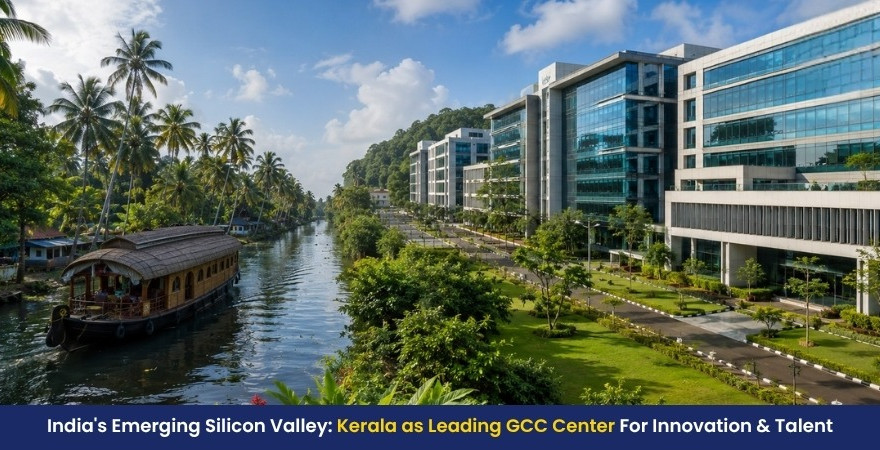
How Kerala’s IT parks, ports, and policy push are building a genuine alternative GCC hub for global enterprise Kerala has long been known to the world as “God’s Own Country,” a land of backwaters, spice trade, and postcard beaches. But behind that tourism-first image, the state has spent over three decades quietly building a second identity, one rooted in silicon rather than sand. With a literacy rate that consistently ranks among the highest in India, and a head start dating back to 1990 with Technopark in Thiruvananthapuram, India’s first IT park, Kerala didn’t stumble into technology; it planned for it. Today, that groundwork is converging into something bigger: a genuine, government-backed push to make Kerala one of India’s leading Global Capability Center (GCC) destinations, built on geography, talent, skilled professionals, and an innovation-first mindset.
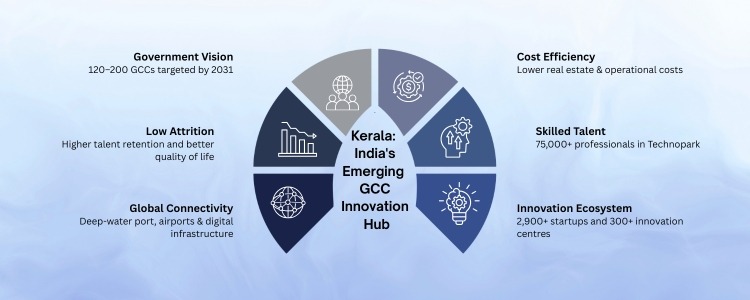
For years, GCCs entering India defaulted to the usual suspects: Bangalore, Hyderabad, and Pune. But rising real estate costs, intense talent poaching, and infrastructure strain in these saturated hubs have pushed global enterprises to look seriously at tier-2 alternatives. Kerala’s IT corridors, Technopark (Thiruvananthapuram), Infopark (Kochi), and Cyberpark (Kozhikode), have stepped into that gap. A Colliers India report on emerging investment destinations named all three as rising GCC hubs, citing land availability, infrastructure quality, and connectivity as key draws. Technopark alone now houses over 490 companies employing more than 75,000 professionals, while a separate industry study—including one by Inductus—pointed to Thiruvananthapuram’s low attrition rates and proactive state policy as core enablers. The scale of ambition is real: Kerala’s own Vision 2031 document, released by Chief Minister Pinarayi Vijayan in October 2025, set a target of 120 GCCs and roughly 2 lakh jobs, while a separate industries department roadmap raised that bar to 200 GCCs by 2031. Here’s how the state stacks up against India’s established GCC hubs:
A Global Capability Center is fundamentally different from a traditional outsourcing setup. Rather than a third party performing narrow, transactional tasks, a GCC is an in-house extension of a global company, handling technology development, R&D, finance, or analytics functions that are core, not peripheral, to the parent business. This distinction matters for understanding why Kerala’s pitch is resonating. At the ‘Kerala GCC Outlook 2026’ conclave, Industries Minister P.K. Kunhalikutty released the state’s GCC Feasibility Report, framing Kerala’s ambition explicitly: to become the country’s most preferred GCC destination, not just another IT-services outpost. Backing that ambition is real infrastructure momentum—Technopark signed a fresh MoU with GCC advisory firm Collabera. Nationally, India already hosts over 2100 GCCs per Inductus data, with roughly half of Fortune Global 500 companies running GCC operations here, a share projected to climb to 70% by 2030. Kerala’s task now is capturing a meaningfully larger share of that national curve.
Geographic Factors Kerala’s advantage starts with geography. Kochi, Thiruvananthapuram, and Kozhikode offer metro-adjacent infrastructure without metro-level congestion, letting GCCs access urban talent pools at a fraction of Bangalore or Mumbai real estate costs. The state’s coastline adds a logistics dimension too: the Vizhinjam International Seaport, inaugurated in May 2025, is now India’s first deep-water container transshipment port, positioned just 10 nautical miles from the primary shipping route linking Europe, the Gulf, and the Far East. Add direct international connectivity through Thiruvananthapuram and Kochi’s international airports, and Kerala’s geographic case builds itself. Talented Youth Kerala’s education numbers are unusual for India; near-universal literacy and strong gender parity in schooling have long fed a large, steady pipeline of engineering and computer science graduates from the state’s universities. Historically, much of that talent left for Bangalore, the Gulf, or further abroad, in search of opportunity. The GCC push flips that script: by bringing high-value technology and R&D roles home, Kerala is positioning itself for what officials are increasingly calling a reverse brain drain, pulling skilled professionals back to build careers close to home. Qualified Professionals Beyond general IT staffing, Kerala’s specialized institutions give it a deeper bench. The Indian Institute of Space Science and Technology (IIST) in Thiruvananthapuram; NIT Calicut; CUSAT; and ISRO’s own Vikram Sarabhai Space Centre together produce a talent pool trained in aerospace, deep tech, and advanced engineering—not just support-function IT skills. For GCCs looking to house genuine R&D and product engineering work rather than back-office processing, that distinction is exactly what makes Kerala’s talent pitch credible rather than aspirational. Innovation First Strategy Kerala’s administrative culture backs up its talent story. The Kerala Startup Mission (KSUM), founded in 2006, now supports more than 2,900 registered startups across 40-plus incubators and over 300 innovation centers statewide, one of India’s oldest and most structured state-run startup ecosystems. Kerala was also among the earliest Indian states to invest heavily in e-governance and digital infrastructure, groundwork that continues through initiatives like the Kerala Fibre Optic Network (KFON), aimed at improving statewide connectivity for exactly the kind of GCC operations the state is now courting.
Kerala isn’t trying to out-scale Bangalore, and it doesn’t need to. Its pitch is different: a talent-dense, cost-efficient, quality-of-life-forward alternative for GCCs that want deep engineering capability without the churn and congestion of India’s saturated hubs. The comparison to Silicon Valley, then, isn’t marketing gloss; it’s a trajectory. Between the state’s Vision 2031 targets, a newly operational deep-water port, an expanding startup ecosystem, and fresh MoUs signed at Technopark and Infopark through 2025 and 2026, the pieces are visibly falling into place. Whether Kerala reaches its stated goal of 120 to 200 GCCs by 2031 remains to be seen, but the direction of travel is no longer in question.
I write where strategy meets storytelling. As a passionate writer and literary enthusiast, I craft GCC-focused content that transforms industry insights into compelling narratives. Drawn to global business ecosystems, I enjoy turning research, innovation, and ideas into content that informs, connects, and inspires. With an analytical mind and a creative soul, I bring curiosity, collaboration, and a sharp eye for detail to every project. Adaptable and growth-driven, I believe the right words do more than communicate – they leave an impression.
Kerala: Microcosm of Innovation, Talent, and Tech
Emerging Alternative to Silicon Valley: How Kerala Becomes New & Upgraded Hotspot
Parameter
Kerala (Kochi / Trivandrum / Kozhikode)
Bangalore
Hyderabad
Pune
Trend
Cost of Operations
Comparatively lower real estate & talent cost
High and rising
Moderate to high
High
Kerala favors cost efficiency
Talent Attrition
Lower churn, cited as a core enabler in state studies
High, intense poaching
Moderate to high
Moderate to high
Kerala favors retention
English Proficiency
Consistently high across the workforce
High
High
High
Broadly comparable
Quality of Life
Low congestion, high livability, coastal access
Congested, strained infrastructure
Improving, moderate density
Dense, high cost of living
Kerala favors livability
Infrastructure Maturity
Established parks (Technopark, Infopark, Cyberpark) + new port and fibre network
Mature, near saturation
Mature, expanding
Mature
Bangalore leads on scale, Kerala on headroom
Government Incentives
Active Vision 2031 push, dedicated GCC feasibility roadmap
Established policy, less GCC-specific urgency
Strong state IT policy
Established policy
Kerala’s push is newer and more targeted
Role & Relevance of Global Capability Centers Surrounding Kerala as Leading Destination for GCCs
Kerala as Center of Innovation & Talent

Conclusion

Pratibha Soni










Error: Contact form not found. Error: Contact form not found.Subscribe to our Newsletter
Subscribe to our Newsletter
