Recent Posts







Every core banking system was built for a world where customers checked balances once a day and transactions settled overnight. That world is gone. Account holders now expect real-time transfers, instant credit decisions, and uninterrupted digital access, yet many banks still run critical workloads on architecture designed decades before mobile banking existed. This gap is forcing a harder question than most headlines ask. It isn’t which vendor wins the cloud wars; it’s what actually makes a cloud platform fit for core banking workloads. Identifying the best cloud platform for banking starts not with a brand name, but with the fundamentals of modernization itself.
Core banking modernization is the shift from monolithic, on-premise cores handling nightly batch settlement to modular, API-first, cloud-native architectures built for continuous, real-time processing. The urgency behind this shift is structural, not stylistic. Real-time payment rails and ISO 20022 messaging standards demand systems that process instantly, not overnight. Open banking mandates require secure, standardized data-sharing through APIs. Embedded finance is pushing banking capabilities into non-banking platforms. And tightening cyber and regulatory scrutiny means resilience can no longer be an afterthought layered onto legacy systems. This is where banking technology modernization splits into two very different paths. Lift-and-shift migration simply moves an old monolithic core onto cloud servers, retaining its rigidity. Genuine cloud-native re-platforming rebuilds the core around microservices, containerization, and event-driven processing. The difference between these two paths determines whether a bank actually modernizes or simply relocates its legacy constraints.
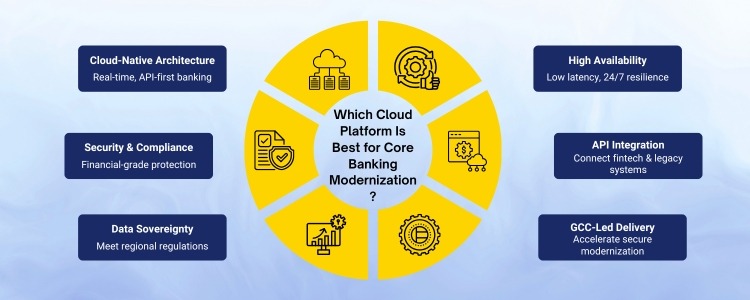
Because BFSI workloads carry regulatory and reputational weight that most industries don’t, platform selection needs a decision framework, not a feature checklist.
Global Capability Centers have become the execution layer where banking cloud modernization actually gets delivered. Rather than outsourcing migration to external vendors, banks now run dedicated engineering pods inside their own GCCs, embedding compliance-as-code directly into deployment pipelines and maintaining continuous site reliability engineering coverage for core banking uptime. This structural shift compresses innovation cycles because engineering, compliance, and business teams operate inside the same delivery loop instead of across contractual handoffs. Firms like Inductus Group support this GCC-led delivery model by helping banks structure the operating frameworks, talent pods, and governance layers that make in-house cloud modernization sustainable rather than a one-time project.
Banking digital transformation is redefining what “modernized” even means. Cloud is no longer just infrastructure that hosts a bank’s core; it has become the innovation layer that determines what a bank can build. This shift plays out across three connected stages. This progression shows why modernization can’t be reduced to a single migration event. Each stage builds infrastructure that the next stage depends on.
There is no universal best cloud platform for banking. The right platform is whichever one aligns sovereignty, compliance, resilience, and API maturity with a bank’s specific regulatory geography and stage of modernization. What ultimately determines outcomes isn’t which provider a bank chooses but how deliberately the migration is architected, governed, and sustained over time. This is where GCC-led delivery models, supported by partners such as Inductus Group, reduce execution risk by embedding modernization directly into a bank’s own operating structure. Core banking modernization was never a one-time migration to complete and forget. It is a continuous capability that banks will need to keep building for as long as customer expectations keep evolving.
I write where strategy meets storytelling. As a passionate writer and literary enthusiast, I craft GCC-focused content that transforms industry insights into compelling narratives. Drawn to global business ecosystems, I enjoy turning research, innovation, and ideas into content that informs, connects, and inspires. With an analytical mind and a creative soul, I bring curiosity, collaboration, and a sharp eye for detail to every project. Adaptable and growth-driven, I believe the right words do more than communicate – they leave an impression.
Understanding Core Banking Modernization
Key Characteristics of Best Cloud Platform for Banking (BFSI Sector)
Fundamentals of Banking Technology Modernization in the GCC Universe
How Digital Transformation Innovates Core Banking Modernization?

Conclusion

Pratibha Soni









Error: Contact form not found. Error: Contact form not found.Subscribe to our Newsletter
Subscribe to our Newsletter