Recent Posts





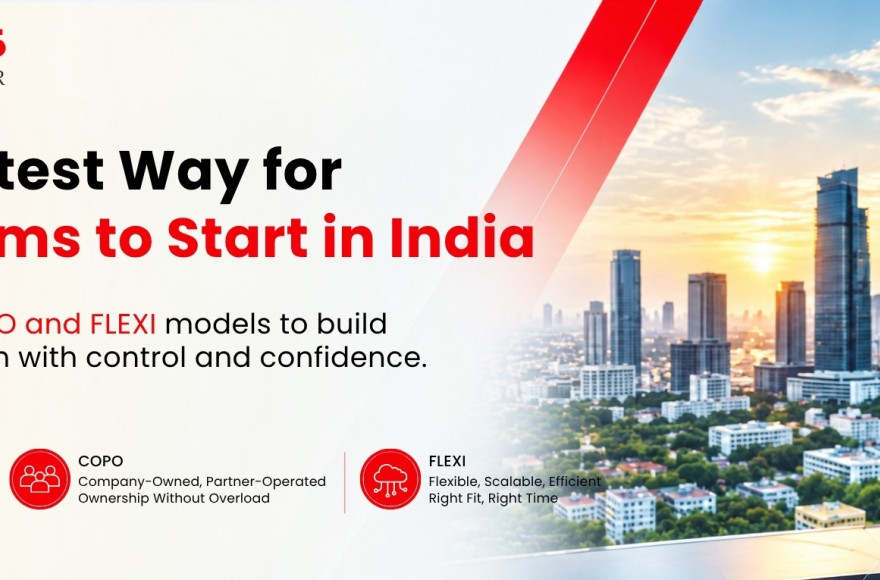
A global mid-sized company considering India faces a practical question: how can it establish a reliable local operation without committing too much capital, hiring too quickly, or creating a management burden for its headquarters? Opening a legal entity, recruiting employees, securing infrastructure, and establishing compliance processes all require careful coordination. For a company entering India for the first time, these responsibilities can distract leadership from its main business. The answer is not always to build a fully owned office immediately. A better approach is to define the business objective, select the right operating model, and build local capabilities in stages. This allows leadership to assess operational performance before making larger commitments.
For many global mid-sized companies, the most practical approach is to start with a clearly defined business function and a local operating partner, then expand as results justify further investment. A partner-led model can help establish talent, infrastructure, and operating processes while the company retains the level of ownership and control appropriate to its goals.
Mid-sized companies often need capabilities that larger competitors already have: technology teams, finance operations, customer support, research, analytics, and specialist talent. Building every capability in the home market can limit flexibility and increase operating costs. India can offer access to a broad talent market and an established business services ecosystem. However, the value depends on the function being established, the skills required, the city selected, and the quality of management. For example, a software company might begin with a product engineering team. A financial services firm might establish reporting, compliance support, or technology operations, subject to applicable regulatory requirements. A manufacturing business could start with engineering, procurement support, or shared services. The objective should be to create a capability that supports the global business, rather than simply moving work to another country. Inductus Group states on its official website that it was established in 2007 and has served more than 300 clients. Its published profile also describes a workforce of 1,500+ professionals. These company-reported details provide background on the group’s experience in consulting, outsourcing, and related services.
There is no single best structure for every company. The right choice depends on how quickly the operation must begin, how much control headquarters needs, and whether the company intends to own and manage the operation independently over the long term. These models are not interchangeable with legal entity types. A foreign company may consider structures such as an Indian subsidiary, an LLP where permitted, or an eligible branch, liaison, or project office. The appropriate structure depends on the intended activities and applicable rules. Invest India’s Navigating India’s Legal and Regulatory Framework at a Glance 2025–26 describes these broad entity options and highlights that foreign companies’ operating structures have different characteristics. The practical distinction is simple: choose the legal structure for the business you intend to conduct, and choose the operating model for how you want that business to run.
A useful approach is the Function-First, Commitment-Later Rule: validate the work, ownership requirements, and operating economics before committing to a large permanent setup. Use the following roadmap to put that principle into practice. Step 1: Define the business outcome. Start with one clear objective. Is the company trying to expand product development, improve finance operations, build an analytics capability, or establish a regional support team? Define what success looks like. Measures might include service quality, delivery time, hiring milestones, productivity, and total operating cost. Step 2: Select the first function. Identify work that can be transferred or established in India without disrupting the existing business. Document the processes, required skills, technology access, decision rights, and dependencies on headquarters. Avoid moving an entire department before understanding how its work is performed. Step 3: Compare the operating models Evaluate an independent entity, BOT, COPO, and a customized arrangement against ownership, operational control, speed, internal management capacity, and long-term cost. Request a transparent cost model covering recruitment, salaries, infrastructure, technology, management fees, compliance, transition, and potential exit or transfer costs. Inductus estimates should be treated as estimates rather than guaranteed savings; compare them against your own operating assumptions. Step 4: Establish governance and compliance Determine the appropriate legal structure, responsibilities, reporting arrangements, contracts, data controls, and intellectual property protections. Assess applicable employment, tax, foreign investment, and industry-specific requirements. Confirm the proposed structure and its legal and tax implications with qualified Indian counsel and tax advisers before implementation. Step 5: Launch a controlled operation Start with a defined scope, accountable leadership, documented procedures, and agreed performance measures. Review delivery quality, hiring effectiveness, operational costs, and coordination with headquarters. Step 6: Scale using evidence Expand the team or add functions when the initial operation demonstrates reliable performance. Review whether the existing operating model still fits or whether the company should move towards greater internal ownership. The roadmap is designed to reduce avoidable commitments, not to suggest that every India setup can be completed within a fixed number of days. Timelines depend on the function, hiring needs, legal structure, approvals, and implementation complexity.
Choosing a structure before defining the work: A legal entity or GCC model should follow the business objective, not precede it. Hiring before documenting processes: Unclear responsibilities can lead to duplicated work, slow decisions, and disappointing productivity. Comparing salaries instead of total operating costs: Recruitment, management, infrastructure, technology, compliance, and transition expenses also affect the business case. Underestimating local requirements: Employment obligations, tax treatment, foreign investment rules, contracts, and data protection need appropriate professional review. Giving a partner an unclear mandate: Define ownership, service levels, escalation routes, access controls, reporting, and exit or transfer provisions in writing. The central lesson is to treat India as an operating capability that needs sound governance, not simply as a lower-cost location.
Inductus helps global businesses plan and establish Global Capability Centers in India through its published operating models: BOT, COPO, and FLEXI. The choice depends on the company’s desired ownership, internal management capacity, and need for operational flexibility. Its Discover–Design–Build–Scale framework provides a structured way to assess the business case, define the operating model, establish the centre, and expand its capabilities. Inductus describes the Discover stage as covering the GCC mandate, functions, cost structures, regulatory considerations, location, and risk assessment. (Inductus, official website, accessed October 2026.) For a mid-sized company, the value of this approach lies in aligning the setup with a defined business need and planning for future growth from the beginning. The company should still evaluate the proposed scope, commercial terms, governance arrangements, and expected outcomes before selecting a partner.
The most practical route to business expansion in India is to begin with a defined function, choose an operating model that matches your ownership goals, and scale when performance supports it. A thoughtful entry plan helps mid-sized companies balance control, investment, and operational responsibility.
I write where strategy meets storytelling. As a passionate writer and literary enthusiast, I craft GCC-focused content that transforms industry insights into compelling narratives. Drawn to global business ecosystems, I enjoy turning research, innovation, and ideas into content that informs, connects, and inspires. With an analytical mind and a creative soul, I bring curiosity, collaboration, and a sharp eye for detail to every project. Adaptable and growth-driven, I believe the right words do more than communicate – they leave an impression.
What Is the Most Practical Way to Start Operations in India?
Why Does India Expansion Matter for Mid-Sized Companies?
Which India Entry Model Is Right for Your Business?
Entry approach
How it works
Best suited for
Main trade-off
Independent entity
The company establishes and manages its own Indian operation.
Firms seeking direct control and a long-term presence.
Greater responsibility for setup, hiring, and compliance.
Build-Operate-Transfer (BOT)
A partner builds and operates the center before transferring it under agreed terms.
Companies planning to own a mature operation after an initial operating period.
Transfer conditions, costs, and timelines require careful planning.
Company-Owned, Partner-Operated (COPO)
The company retains ownership while a partner manages agreed operational responsibilities.
Firms wanting ownership without managing every local activity directly.
Continued dependence on the operating partner.
FLEXI, or customized model
Services and operational support are tailored to the company’s requirements.
Firms testing a function or needing adaptable support.
Scope, accountability, and future scaling must be clearly defined.
How Should a Company Plan Its First Steps in India?
What Mistakes Should Companies Avoid When Expanding Into India
How Can Inductus Support Your India Expansion?
Conclusion


Pratibha Soni






Error: Contact form not found. Error: Contact form not found.Subscribe to our Newsletter
Subscribe to our Newsletter