Recent Posts







“What’s the best GCC operating model?” gets answered the same generic way across the internet: three bullet points, a recycled table, and a shrug of “it depends.” For IT companies, that shrug isn’t good enough. An IT GCC doesn’t just relocate headcount; it moves proprietary code, live client environments, and entire R&D roadmaps into a new jurisdiction. Choose the wrong operating model, and you’re not managing inefficiency; you’re managing exposure. This piece cuts through the noise: Captive, Build-Operate-Transfer (BOT), Hybrid, and Managed Services are compared on real parameters, not vague ones, to identify the best GCC operating model for IT enterprises, mapped clearly to company size and risk appetite.
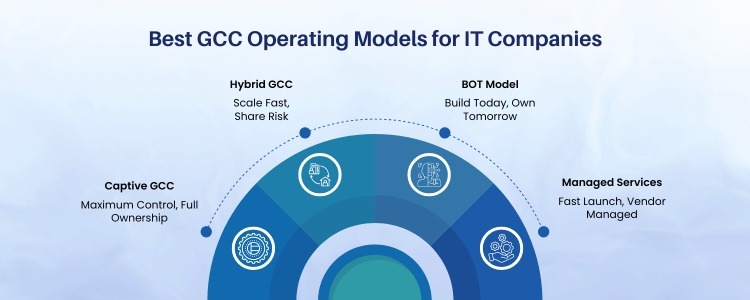
Four structures dominate the GCC landscape in India today, and each answers a different question about ownership.
On paper, every model claims a seat at the table. Judged on the parameters that actually matter for IT enterprises- ownership, control, cost structure, time-to-scale, IP security, and long-term fit- the picture narrows fast, as the comparison below shows. Across every parameter that matters to a product-led or IP-heavy IT enterprise, two models, Captive and Hybrid, consistently outperform BOT and Managed Services
For IT companies specifically, captive and hybrid models outrank BOT and managed services, and the reasoning isn’t opinion; it’s structural. IT work is inherently IP-heavy: proprietary code, client data, live production environments, and active R&D pipelines all move through a GCC daily. Models built on lower ownership and shared governance, BOT during its interim phase, and managed services throughout carry materially higher IP leakage risk simply because control sits outside the enterprise. Industry data reflects this shift: well over half of enterprises operating GCCs today run some form of blended, in-house-led model, precisely because pure outsourcing no longer satisfies rising governance and security expectations. Where “best” splits further is by scale: large IT enterprises with capital and long time horizons lean captive; mid-size scalers still proving their India thesis lean hybrid.
Both models serve IT companies well, but they serve different stages of the same ambition. Captive suits enterprises ready to commit permanently; hybrid suits those scaling deliberately, without full exposure yet.
There’s no universal “best” GCC operating model, only the model that matches where an enterprise actually stands. Captive rewards those playing the long game, with deep pockets and proprietary IP worth protecting at all costs. Hybrid rewards those who want agility without surrendering control while they scale. Either way, the real risk isn’t choosing between them; it’s choosing without expert guidance and discovering the mismatch only after capital and credibility are already committed. Get the model right before you build; the center you launch should be the one you never have to rebuild three years in.
I write where strategy meets storytelling. As a passionate writer and literary enthusiast, I craft GCC-focused content that transforms industry insights into compelling narratives. Drawn to global business ecosystems, I enjoy turning research, innovation, and ideas into content that informs, connects, and inspires. With an analytical mind and a creative soul, I bring curiosity, collaboration, and a sharp eye for detail to every project. Adaptable and growth-driven, I believe the right words do more than communicate – they leave an impression.
Types of Global Capability Centers’ Operating Models
Comparative Analysis of the Highest Rated Models
Parameter
Captive
BOT
Hybrid
Managed Services
Ownership
100% Enterprise
Partner → Enterprise (phased)
Shared (Enterprise-led)
Third-Party Vendor
Control Level
Maximum
Low, rising over time
High
Low
Setup Cost
High
Moderate
Moderate
Low
Time to Scale
Slower (12–18 months)
Faster (6–12 months)
Fast
Fastest
IP Security
Strongest
Moderate (until transfer)
Strong
Weakest
Best Fit For
Large, IP-heavy IT enterprises
First-time market entrants
Mid-size IT scalers
Short-term / pilot projects
Which GCC operating model is best for IT companies?
Characteristics That Make Captive & Hybrid GCC Models Best for IT Companies

Conclusion: Opt for the Best, from the Best!

Pratibha Soni










Error: Contact form not found. Error: Contact form not found.Subscribe to our Newsletter
Subscribe to our Newsletter