Recent Posts






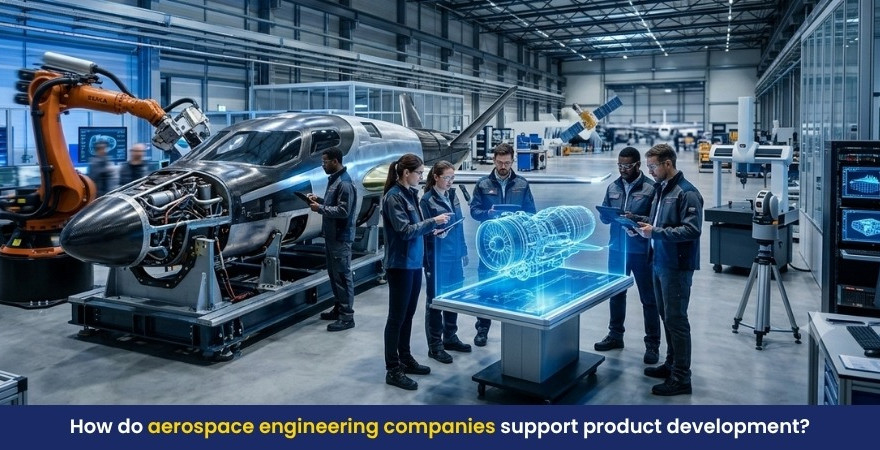
A modern commercial aircraft is built from hundreds of thousands of individual parts, each required to perform flawlessly across decades of service and thousands of pressurization cycles. Certifying a single new aircraft type can take the better part of a decade before it carries a passenger. That complexity sits behind every aerospace program today, even as pressure builds to electrify propulsion, cut emissions, and bring autonomous systems to market faster. No single engineering team, however large, can carry that weight alone, which is precisely the gap aerospace engineering companies were built to close. This piece looks at how that support actually works, from early-stage design through to production.
Product development in aerospace carries a different weight than most other industries, for three reasons. Every component must satisfy airworthiness and regulatory certification requirements with no real equivalent in consumer manufacturing. Tolerance for failure sits at essentially zero; a flaw that would trigger a product recall elsewhere can ground an entire fleet, or worse. And aerospace products are built for multi-decade service lives, so development doesn’t end at launch; it continues through years of upgrades and obsolescence management. Within that reality, the process typically moves through feasibility studies, requirements definition, detailed design and simulation, physical prototyping, rigorous testing, and certification, all before production even begins. Aerospace engineering companies don’t simply supplement this work; they embed specialized, cross-disciplinary expertise in aerodynamics, propulsion, materials science, avionics, and systems engineering directly into each phase. That embedded expertise, delivered through structured aerospace engineering services, is often what separates a program that stays on schedule and budget from one that doesn’t.
Aerospace R&D rarely moves in a straight line, but it follows a recognizable arc, one that makes it far easier to see where specialized aerospace R&D services typically plug in. The table below breaks that arc into six broad phases. In practice, these phases overlap more than the table suggests, since concurrent engineering runs design, simulation, and manufacturing planning in parallel rather than in strict sequence.
Across that lifecycle, a recognizable set of services tends to recur, and most programs need all of them working in concert rather than sourced piecemeal. Delivered together, they form a full spectrum of aerospace product development services that few in-house teams hold deep expertise across all at once.
This is where global capability centers have quietly become one of the aerospace industry’s most important engineering partners. Once viewed mainly as back-office cost centers, GCCs have evolved into genuine engineering delivery hubs, home to structural analysts, avionics engineers, and simulation specialists working on live programs rather than routine support functions. That shift matters for a few concrete reasons. Distributed, multi-time-zone teams allow design, simulation, and testing to continue almost around the clock, measurably compressing time-to-market on programs where every month of delay carries real cost. GCCs also increasingly function as centers of excellence for simulation and digital engineering, supporting global programs remotely without requiring every specialist to sit inside a single headquarters. Just as importantly, they give aerospace engineering companies a way to scale capacity up or down as programs demand, without the fixed overhead of building large in-house teams from scratch for every initiative. Access to talent is arguably the biggest driver of all. Regions with deep STEM ecosystems, India, Eastern Europe, and Southeast Asia among them, have become critical sources of aerospace engineering talent at a moment when the industry faces a genuine shortage of experienced engineers. GCCs sit squarely at the center of that solution.
Aerospace product development has simply grown too complex, too regulated, and too capital-intensive for any single team to own from end to end. Aerospace engineering companies, increasingly delivered through global capability centers, close that gap by supplying deep technical expertise, scalable talent, and digital engineering capability across the entire lifecycle. As programs grow more distributed by design, that collaborative model looks less like a workaround and more like the industry’s new default.
I write where strategy meets storytelling. As a passionate writer and literary enthusiast, I craft GCC-focused content that transforms industry insights into compelling narratives. Drawn to global business ecosystems, I enjoy turning research, innovation, and ideas into content that informs, connects, and inspires. With an analytical mind and a creative soul, I bring curiosity, collaboration, and a sharp eye for detail to every project. Adaptable and growth-driven, I believe the right words do more than communicate – they leave an impression.
Understanding Product Development in Aerospace Engineering Companies
From Foundation to Execution: Timeline of Aerospace Engineering R&D
Phase
Typical Focus
Key Activities
Where External Engineering Support Adds Value
Concept & Feasibility
Early-stage exploration
Ideation, requirement gathering, feasibility and trade studies
Rapid access to specialized technical judgment before major investment
Detailed Design & Simulation
Iterative refinement
CAD modeling, CAE/FEA/CFD simulation, digital twins
High-capacity simulation talent and tooling
Prototyping & Testing
Validation
Physical and virtual prototyping, structural and environmental testing
Dedicated test engineering capacity
Certification & Compliance
Regulatory approval
Documentation and airworthiness submissions
Deep regulatory and compliance expertise
Manufacturing Engineering
Production readiness
Production planning, tooling design, design-for-manufacturing
Manufacturing engineering at scale
In-Service Support
Long-term sustainment
Obsolescence management, upgrades, MRO engineering
Ongoing lifecycle engineering capacity
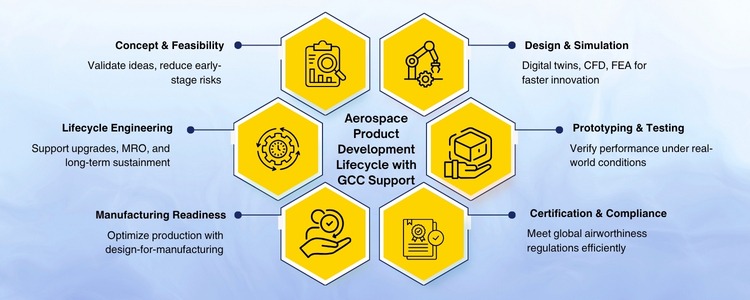
Services Provided & Required in Aerospace Product Development
How Global Capability Centers Play a Major Role in Aerospace R&D Engineering
Conclusion

Pratibha Soni








Error: Contact form not found. Error: Contact form not found.Subscribe to our Newsletter
Subscribe to our Newsletter