Recent Posts






Technology has become central to how businesses operate, compete and grow. From developing digital products and managing cloud infrastructure to protecting sensitive information and using artificial intelligence, organisations increasingly depend on reliable technology capabilities. However, building and maintaining these capabilities internally is not always straightforward. The demand for specialised skills continues to evolve, technology investments can be substantial, and businesses must respond quickly to changing customer expectations and market conditions. This is why many organisations are rethinking how they manage their technology operations. IT outsourcing has evolved beyond the traditional practice of assigning routine technical tasks to an external provider. It is increasingly being considered as a strategic approach to accessing specialised expertise, strengthening operational capabilities and supporting long-term business objectives. When structured correctly, IT outsourcing can help organisations build flexible technology operations while maintaining appropriate control over security, quality, performance and intellectual property.
The technology landscape is changing faster than many organisations can adapt their internal operating structures. Businesses need to modernise existing systems, develop new digital solutions and maintain the infrastructure that supports their operations. Several factors are driving this shift. 1. Growing Technology Complexity Organisations now work with interconnected systems involving cloud platforms, enterprise applications, data environments, cybersecurity tools and AI-powered solutions. Managing these environments requires a combination of technical expertise and continuous operational oversight. For many businesses, maintaining every required capability internally can become difficult and resource-intensive. 2. Increasing Demand for Specialised Talent The need for professionals with expertise in artificial intelligence, machine learning, cloud engineering, cybersecurity, data science and software development continues to grow. The challenge is not simply finding technology professionals. It is finding people with the right experience for specific technical requirements and retaining them over time. India’s cybersecurity talent landscape illustrates this challenge. A 2025–26 report by the Data Security Council of India and SANS Institute found that 73% of surveyed enterprises reported limited availability of skilled cybersecurity candidates. The report also highlighted difficulties in recruiting professionals with practical, hands-on capabilities. 3. Balancing Investment with Operational Efficiency Technology leaders must balance innovation with the cost of maintaining existing systems. Internal teams often need to divide their attention between daily support, infrastructure management, product development and strategic projects. An appropriate outsourcing arrangement can provide additional capabilities and operational support, allowing internal teams to concentrate on business-critical priorities.
IT outsourcing refers to engaging an external service provider to deliver specific technology functions, manage defined IT operations or support broader technology objectives. Traditionally, organisations often considered outsourcing primarily as a way to reduce operating costs. That remains one possible benefit, but the business case has become broader. According to KPMG’s Managed Services Outlook Survey 2026, managed services are a strategic focus for 99% of surveyed organisations. The survey also highlights the growing importance of AI, cybersecurity and technology expertise in managed service relationships. This reflects a wider shift in how businesses evaluate external technology support. They increasingly look for capabilities that can contribute to innovation, resilience and operational improvement, rather than simply completing assigned tasks. A well-designed IT outsourcing relationship can offer three important advantages: The value of outsourcing ultimately depends on selecting the right scope, delivery model and service partner.
IT outsourcing can support a wide range of technology functions. The right combination depends on an organisation’s business model, internal capabilities and technology roadmap. 1. Software Development and Product Engineering Businesses can engage external technology teams to develop, test, maintain and improve software applications. This may include web and mobile application development, enterprise platforms, product engineering, API development and application modernisation. 2. Artificial Intelligence, Machine Learning and Data Engineering AI and data capabilities are becoming increasingly important across industries. Organisations may require support with machine learning models, data pipelines, analytics platforms, business intelligence, automation and AI solution development. External specialists can help build and maintain these capabilities while internal teams retain oversight of business objectives and technology direction. 3. Cloud Infrastructure and DevOps Cloud environments require continuous management, monitoring, optimisation and security. Businesses may outsource cloud migration, infrastructure management, DevOps engineering, platform operations and cloud cost optimisation. 4. Cybersecurity and Information Security Cybersecurity services may include security monitoring, vulnerability assessments, identity and access management, incident response support, compliance monitoring and security operations. These services require clearly defined responsibilities, appropriate access controls and continuous oversight. 5. Quality Assurance and Application Maintenance Software quality and system reliability are essential for business continuity. Organisations can use dedicated teams for manual and automated testing, performance testing, application support, bug resolution and ongoing maintenance. 6. IT Helpdesk and Technical Support Businesses can outsource defined levels of IT support, including service desk operations, troubleshooting, end-user support, infrastructure assistance and incident management. The scope should be designed around business requirements, service hours, escalation procedures and agreed service levels.
Not every organisation requires the same outsourcing arrangement. Some need support for a defined project, while others require a dedicated team or a long-term operating structure. The choice should depend on the level of control required, the expected duration of the engagement, the complexity of the work and the organisation’s long-term plans.
Security and governance should be considered from the beginning of any outsourcing engagement. Transferring work to an external provider does not remove an organisation’s responsibility to protect its systems, information and customers. A reliable outsourcing arrangement should address the following areas. Data Protection and Information Security Define how sensitive information will be accessed, stored, processed and transferred. Review the provider’s security practices, access controls, incident response procedures and relevant certifications. Intellectual Property and Ownership Contracts should clearly establish ownership of source code, software, technical documentation, data, work products and other intellectual property developed during the engagement. The client should retain the rights and control agreed in the contract, including appropriate access to systems, repositories and project documentation. Service-Level Agreements and Performance Governance Clearly defined Service-Level Agreements (SLAs), Key Performance Indicators (KPIs) and reporting processes help both parties measure delivery. Depending on the engagement, performance measures may include system availability, response times, resolution rates, delivery milestones, defect rates, security incidents and customer satisfaction. Business Continuity and Operational Risk Organisations should evaluate business continuity plans, disaster recovery arrangements, backup procedures, escalation processes and dependency on individual providers or locations. As technology outsourcing becomes more closely connected to critical business operations, resilience and governance must be built into the operating model rather than treated as administrative requirements.
India has developed into a significant global destination for technology services, engineering capabilities and digital operations. Its role has expanded beyond traditional offshore support to include product development, cloud engineering, AI, analytics, cybersecurity and enterprise technology functions. The Reserve Bank of India’s survey on computer software and IT-enabled services exports reported that India’s software services exports, excluding sales through overseas commercial presence, increased by 8.2% year-on-year to approximately US$221.4 billion in 2025–26. Several factors contribute to India’s importance in global technology delivery: For international businesses, India can serve not only as a delivery location but also as a strategic extension of their technology and operational capabilities.
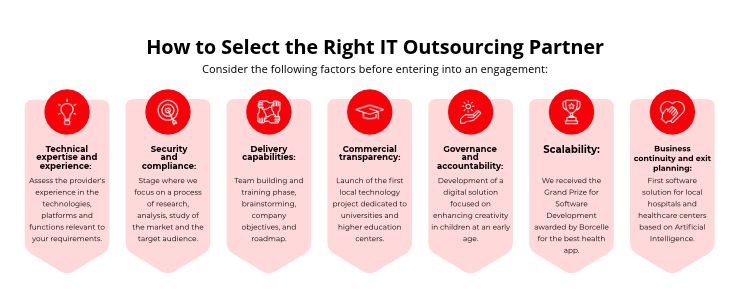
Choosing an outsourcing partner is a business decision that can influence technology performance, information security and long-term operational flexibility. Organisations should evaluate potential providers beyond their quoted prices. Consider the following factors before entering into an engagement: A strong outsourcing relationship should be built around clear expectations, measurable outcomes and shared accountability.
The future of IT outsourcing will be shaped by artificial intelligence, automation, cloud technologies and increasingly specialised delivery models. AI is changing how technology services are designed and delivered. Activities such as software testing, code assistance, data analysis, monitoring and routine support can increasingly benefit from intelligent automation. At the same time, these developments create new requirements for AI governance, data quality, human oversight and cybersecurity. This does not mean that technology teams become less important. Instead, the nature of their work continues to evolve. Organisations will need professionals who can design, integrate, monitor and govern increasingly complex technology environments. Hybrid operating models are also likely to remain important. Businesses may combine internal technology leadership, dedicated offshore teams, managed services and specialist external providers. This allows them to retain control over strategic decisions while accessing capabilities that support execution and scale. The most effective model will be one that connects technology delivery with measurable business outcomes.
IT outsourcing is no longer simply a way to transfer technical tasks or reduce operating expenses. It can be a strategic approach to accessing specialised talent, improving technology operations, strengthening resilience and supporting business growth. However, the benefits depend on making informed decisions about the functions to outsource, the operating model to adopt and the partner responsible for delivery. Security, governance, performance measurement and ownership must remain central throughout the engagement. For organisations exploring long-term technology capabilities in India, the opportunity extends beyond building an external delivery team. It can involve establishing a dedicated India-based capability that supports product engineering, digital transformation and wider business operations. At Inductus Group, we help global organisations establish and manage dedicated teams and operational capabilities in India. Our support spans location strategy, talent acquisition, infrastructure, entity establishment, legal and regulatory compliance, HR, finance and ongoing operations management. Through engagement structures such as Build-Operate-Transfer (BOT), Company-Owned Partner-Operated (COPO) and Offshore Development Centre (ODC) models, we help organisations explore an operating structure aligned with their requirements and long-term objectives. The objective is simple: to help businesses build technology capabilities that are scalable, well-governed and ready for the future.
I write where strategy meets storytelling. As a passionate writer and literary enthusiast, I craft GCC-focused content that transforms industry insights into compelling narratives. Drawn to global business ecosystems, I enjoy turning research, innovation, and ideas into content that informs, connects, and inspires. With an analytical mind and a creative soul, I bring curiosity, collaboration, and a sharp eye for detail to every project. Adaptable and growth-driven, I believe the right words do more than communicate – they leave an impression.
Why Businesses Are Rethinking Their IT Operating Models
Understanding IT Outsourcing Beyond Cost Reduction
Key Technology Functions Businesses Can Outsource
Choosing the Right IT Outsourcing Model
Building Secure and Resilient Technology Operations
Why India Is an Important Destination for IT Outsourcing
How to Select the Right IT Outsourcing Partner
The Future of IT Outsourcing: AI, Automation and Hybrid Teams
Conclusion: Building Technology Capabilities for Long-Term Growth


Pratibha Soni









Error: Contact form not found. Error: Contact form not found.Subscribe to our Newsletter
Subscribe to our Newsletter