Recent Posts






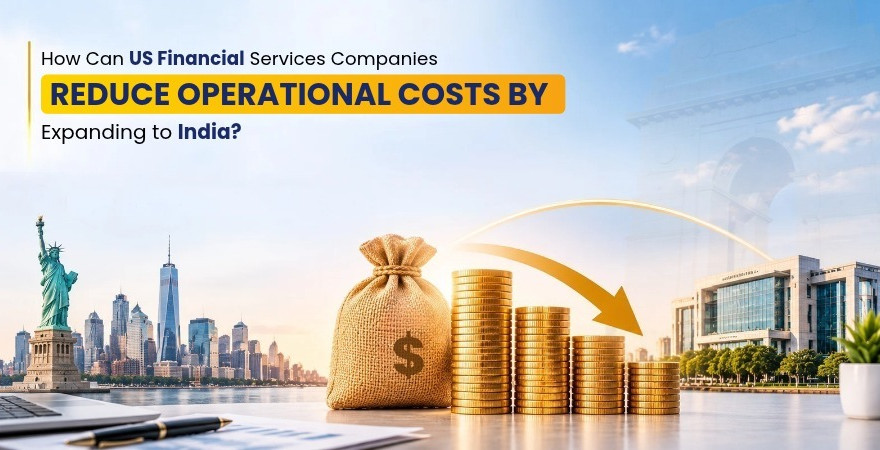
US financial services companies face a difficult operating decision. Their technology, compliance, reporting, and customer support costs continue to require investment, but expanding teams in the United States can make it harder to protect margins. For mid-sized firms, the challenge is even greater. They need skilled professionals and reliable operations without taking on the cost of building large departments at home. India offers another operating option. Through a Global Capability Centre (GCC), US financial institutions can establish dedicated teams in India while retaining strategic direction, governance, and oversight. The important question is not simply whether India is cheaper. It is which functions should move, how they should be managed, and what controls must remain in place.
US financial services companies can reduce operating costs by establishing an India GCC for suitable technology, finance operations, analytics, research, and business support functions. This gives them access to skilled talent, flexible operating models, and centralized processes while maintaining US-led governance, data security, and regulatory oversight.
Large financial institutions have traditionally used offshore operations to support global business. Mid-sized companies can also benefit, particularly when hiring costs, technology investment, and operational workloads limit their ability to grow. There are four important advantages. The opportunity is not limited to reducing salaries. It is about building a cost structure that supports long-term business performance.
The strongest opportunity comes from choosing the right functions and operating structure. For example, a US-based financial services company may retain investment decisions, regulatory accountability, and client relationships in the United States while establishing dedicated technology, analytics, and operational support teams in India. Potential GCC functions include
The right model depends on investment capacity, control requirements, operating maturity and expansion objectives. An honest trade-off: India expansion requires upfront planning, management oversight, technology integration, and regulatory controls. Savings are not automatic. A poorly designed offshore operation can increase coordination costs and operational risk. Inductus GCC offers BOT, COPO, and FLEXI models to support different expansion requirements. inductusgcc.com
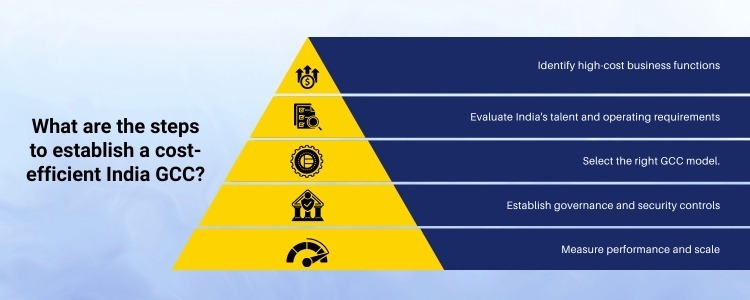
A successful expansion should follow a structured implementation plan rather than beginning with recruitment. Here is a practical five-step approach. Step 1: Identify high-cost business functions Review the existing US operating structure. Identify repetitive, technology-intensive, and process-driven activities that can be supported from India. Calculate current costs, including salaries, recruitment, technology, infrastructure, and vendor expenditure. Step 2: Evaluate India’s talent and operating requirements Identify the skills required for financial operations, software engineering, analytics, and technology support. Assess talent availability, location, compensation expectations, and recruitment timelines. Step 3: Select the right GCC model. Decide whether BOT, COPO, or FLEXI best supports the company’s ownership, investment, and operational requirements. Step 4: Establish governance and security controls Define access permissions, data handling, cybersecurity standards, business continuity, audit rights, and service-level agreements. For regulated financial entities, outsourcing does not remove the institution’s responsibility for appropriate oversight. SEBI’s August 2024 Cybersecurity and Cyber Resilience Framework provides relevant requirements for covered Indian securities-market entities. The RBI’s 2025 Handbook also discusses confidentiality, service-provider safeguards, and business continuity. Securities and Exchange Board of India Step 5: Measure performance and scale Start with a defined operational scope. Track cost per process, turnaround time, productivity, error rates, and service quality. Expand only when the initial team demonstrates reliable performance.
An original rule of thumb for financial services leaders: Move a process only when its cost case, control framework, and performance measures are clear. This prevents companies from prioritizing short-term savings over operational reliability.
India expansion can become expensive when companies overlook the practical requirements of operating across two countries. Common mistakes include: For example, the US Internal Revenue Service’s Section 482 transfer-pricing rules address transactions between commonly controlled entities. (IRS, Transfer Pricing guidance.) Internal Revenue Service Companies should confirm their proposed structure and activities with qualified Indian legal, tax and regulatory counsel before implementation.
Inductus GCC, part of Inductus Group, supports global businesses evaluating and establishing their India operations. Founded in 2007, Inductus Group is headquartered in Noida and reports a workforce of 1,500+ professionals and experience serving 300+ clients. Strategic Advisory & Consulting Services Its approach follows four stages: Companies can explore BOT, COPO, and FLEXI models depending on their investment, ownership, and operational preferences. Inductus estimates should be evaluated against each company’s actual operating scope and cost baseline. No fixed savings percentage should be assumed without a company-specific assessment. Explore Inductus GCC to understand its India expansion services.
I write where strategy meets storytelling. As a passionate writer and literary enthusiast, I craft GCC-focused content that transforms industry insights into compelling narratives. Drawn to global business ecosystems, I enjoy turning research, innovation, and ideas into content that informs, connects, and inspires. With an analytical mind and a creative soul, I bring curiosity, collaboration, and a sharp eye for detail to every project. Adaptable and growth-driven, I believe the right words do more than communicate – they leave an impression.
The short answer: How can US financial companies reduce operational costs in India?
Why should mid-sized US financial companies consider expanding to India?
How does expanding to India reduce operational costs?
Which India expansion model is right for your company?
Expansion approach
How it works
Best suited for
Build your own GCC
Establish and manage an independent Indian entity
Companies seeking direct ownership and long-term control
BOT (Build-Operate-Transfer)
A partner builds and operates the GCC before transferring it
Companies seeking a structured market entry
COPO (Company-Owned, Partner-Operated)
The company owns the centre while a partner manages agreed operations
Firms seeking ownership with operational support
FLEXI
Customized operational support based on business requirements
Companies testing or gradually expanding their India presence
What are the steps to establish a cost-efficient India GCC?
The Inductus Control-First Expansion Rule
What mistakes should US financial companies avoid?
How can Inductus GCC help US financial companies expand into India?


Pratibha Soni









Error: Contact form not found. Error: Contact form not found.Subscribe to our Newsletter
Subscribe to our Newsletter