Recent Posts






Most conversations about 5G still circle back to speed, faster downloads, lower latency, and more bars on a phone. That framing misses the real story. The transformation reshaping enterprises today isn’t happening in the radio spectrum; it’s happening one layer up, in the orchestration engines, APIs, and virtualized cores that make the network programmable. 5G network software development is what turns a faster pipe into a platform enterprises can actually build on. Spectrum got 5G into the conversation; software is what’s actually accelerating enterprise digital transformation.
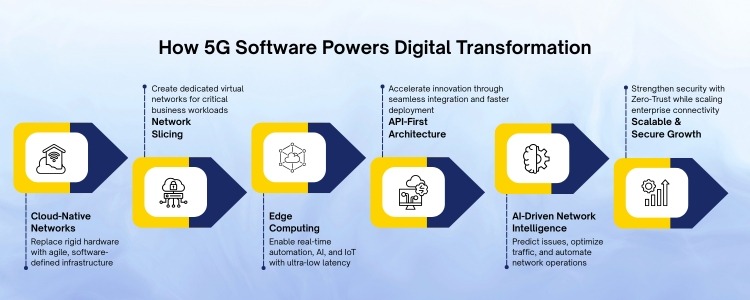
5G’s real disruption isn’t a speed bump; it’s an architectural rewrite, a shift from rigid, hardware-bound cores to software-defined, cloud-native infrastructure that enterprises can reconfigure on demand. Four enablers make this possible: Network Functions Virtualization (NFV), freeing network functions from dedicated hardware; Software-Defined Networking (SDN), centralizing and automating traffic control; network slicing, carving one physical network into multiple virtual ones tuned to specific workloads; and API-first design, letting enterprises spin up custom network behavior programmatically. Together, these form the backbone of enterprise 5G solutions and modern 5G application development. The numbers back the argument: the 5G core network market is projected to grow from $3.47 billion in 2025 to $4.23 billion in 2026, with software-as-a-service innovation cited as the key trend improving efficiency and scalability.
Enterprise-grade 5G software design demands attention across multiple technical layers at once; a single-point solution doesn’t hold up once it hits production. Individually, each layer solves a narrow problem. Together, they’re the connective tissue holding enterprise 5G software solutions together.
The proof is in the numbers, and it’s compounding fast.
The larger strategic umbrella here is digital transformation. 5G software development is one accelerator among many converging forces that are changing how enterprises operate, compete, and build. Four forces come to the surface.
Look three to five years out, and connectivity itself stops being the differentiator; the software layer becomes the real battleground for competitive advantage. Enterprise private network spend is forecast to climb from $5.7 billion in 2026 to $29.7 billion by 2030, and software and services within the 5G ecosystem are growing faster than hardware, expanding at roughly a 49% CAGR. Budgets will keep shifting away from radios and towers toward custom software and platform investment. Manufacturing, healthcare, and logistics are positioned to absorb this value first, where real-time data and low-latency automation translate directly into margin. Custom 5G software development is becoming a boardroom decision, not an IT line item.
The network is the foundation, but software is what turns connectivity into transformation. 5G network software development isn’t a feature enterprises bolt on later; it’s the layer that decides whether the underlying 5G investment pays off at all. As this next phase unfolds, readiness, not adoption, will be the real differentiator for the enterprises that pull ahead.
I write where strategy meets storytelling. As a passionate writer and literary enthusiast, I craft GCC-focused content that transforms industry insights into compelling narratives. Drawn to global business ecosystems, I enjoy turning research, innovation, and ideas into content that informs, connects, and inspires. With an analytical mind and a creative soul, I bring curiosity, collaboration, and a sharp eye for detail to every project. Adaptable and growth-driven, I believe the right words do more than communicate – they leave an impression.
Era of 5G Network: Understanding Software Development Enablers
Key Areas of Technical & IT Focus in Network Software Design
Technical Focus Area
What It Does
Digital Transformation Impact
Network Functions Virtualization (NFV)
Decouples functions from hardware
Faster scaling, lower cost
Software-Defined Networking (SDN)
Centralized, programmable traffic control
Real-time reconfiguration
Network Slicing
Dedicated virtual networks per use case
Performance tailored to critical workloads
Edge Computing Integration
Low-latency, localized processing
Real-time automation and IoT at scale
API & Microservices Architecture
Modular, faster deployment cycles
Accelerated innovation and integration
Zero-Trust Security Frameworks
Built-in protection for distributed networks
Reduced risk across a wider attack surface
How 5G Network Software Development Ignited Digital Transformation
Digital Transformation: Central & Core Ideal of 21st Century
Business Impact Via Digital Transformation: Future Predictions

Conclusion

Pratibha Soni










Error: Contact form not found. Error: Contact form not found.Subscribe to our Newsletter
Subscribe to our Newsletter