Recent Posts






Most GCCs don’t stall because of the wrong city or a thin talent pool; those problems are largely solved in 2026. They stall because the operating model was borrowed instead of designed. Enterprises see a competitor’s Bengaluru or Pune setup, copy the structure, and assume it will translate to their own business. It rarely does. A GCC operating model isn’t a template; it’s a direct reflection of a parent company’s control appetite, cost posture, and growth stage. Get this right, and the center becomes a genuine strategic asset. Get it wrong, and even a well-funded GCC quietly turns into a cost center within two years. This is where a real Global Capability Center strategy has to start, not with location, but with structure.
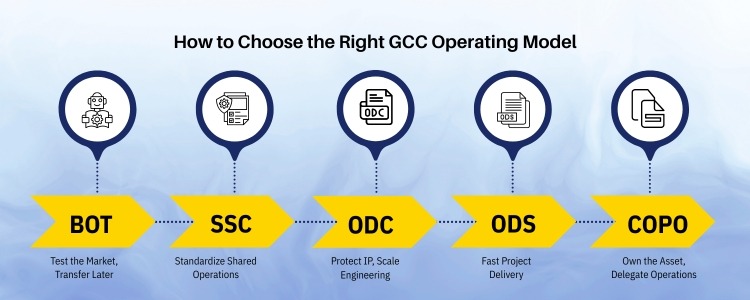
Before locking in a GCC setup model, it helps to see the five structures side by side rather than as isolated definitions; most comparisons stop at what each model means and skip the part that actually matters: who controls what, and who owns the exit. (Build- Operate- Transfer) (Shared Services Center) (Offshore Development Center) (Offshore Delivery Center) (Company Owned Partner Operated) A quick note on ODS: unlike the other four, it isn’t a formally standardized term the way BOT, SSC, ODC, and COPO are across GCC models. It typically refers to a lighter, staff-augmentation-adjacent delivery arrangement with narrower IP ownership than a full ODC, useful for scoped project delivery rather than a long-term dedicated build.
Designing the model is a sequence of decisions, not a single choice.
The frameworks above get you to a structure. A few things determine whether that structure actually works: The “your” in this heading is deliberate: the right model is calibrated to this company’s risk tolerance and growth stage, not to what worked for a competitor.
There’s no universally “best” GCC operating model, only the one matched to a company’s control appetite, cost strategy, and growth stage, with room to evolve as the center matures. The enterprises getting real value from their GCCs in 2026 aren’t the ones with the most sophisticated org chart on day one; they’re the ones who treated the operating model as a decision worth designing, not defaulting into.
I write where strategy meets storytelling. As a passionate writer and literary enthusiast, I craft GCC-focused content that transforms industry insights into compelling narratives. Drawn to global business ecosystems, I enjoy turning research, innovation, and ideas into content that informs, connects, and inspires. With an analytical mind and a creative soul, I bring curiosity, collaboration, and a sharp eye for detail to every project. Adaptable and growth-driven, I believe the right words do more than communicate – they leave an impression.
Table of Desirable Operating Models for Global Capability Centers
Model
Ownership Structure
Control Level
IP & Data Ownership
Cost Structure
Best Fit
BOT
Vendor builds and operates; transfers to parent after an agreed term (typically 18–36 months)
Low early, full post-transfer
Transfers to parent at handover—must be contractually defined upfront
OpEx-heavy initially, shifts to an owned asset post-transfer
Testing a new market before committing to full ownership
SSC
Parent-owned, centralized function serving multiple business units
Medium, process-standardized
Parent-owned
OpEx, efficiency-driven, standardized processes
Consolidating high-volume transactional functions (finance, HR, procurement)
ODC
Dedicated, parent-exclusive engineering or tech extension
High
Parent-owned or contractually protected
Mixed — CapEx for infrastructure, OpEx for the team
Product or engineering mandates needing dedicated, IP-sensitive teams
ODS
Lighter, project-scoped delivery arrangement, staff-augmentation-adjacent
Low to medium
Narrower than ODC; often partner-influenced
OpEx, faster to stand up
Scoped project delivery without a long-term dedicated build
COPO
The parent owns the entity, IP, data, and employees; partner manages daily operations
High strategic control, delegated operational control
Fully parent-owned from inception
Lower CapEx burden, predictable OpEx
Owning the asset without in-house operational management complexity
Steps for Designing an Operating Model for Global Capability Center
Things To Keep in Mind While Designing “Your” Operating Model for GCC
Precautions & Risks Mitigation
Conclusion

Pratibha Soni







Error: Contact form not found. Error: Contact form not found.Subscribe to our Newsletter
Subscribe to our Newsletter