Recent Posts







By 2026, the question in most boardrooms has quietly changed. It is no longer “should we offshore?” That debate settled years ago. The real challenge is filtering through hundreds of vendors who all claim the same certifications, the same round-the-clock support, and the same promise of “seamless collaboration.” Choosing the right offshore delivery center partner has stopped being a search for capability and become a search for fit, technical, financial, and cultural. This piece is built as a decision filter, not another feature list, so you walk away with a framework you can actually apply to a shortlist.
An offshore delivery center once meant a cost-arbitrage setup, a facility absorbing overflow work at a lower price point. That definition no longer holds. In 2026, an offshore delivery center functions as an embedded innovation unit, running dedicated AI/ML pods, platform engineering teams, and full product squads that operate as an extension of the client’s core team rather than a detached vendor. This is what separates an ODC from a generic IT outsourcing services vendor, which typically delivers project-based work with limited ownership, and from a captive global delivery center or GCC, which the client builds and runs entirely in-house. An ODC sits between the two: dedicated resources and deep integration, managed by a specialized partner. Getting this distinction right is the first filter, because the wrong category of partner sets up the wrong operating model from day one.
Most comparisons stop at a services menu, development, QA, and infrastructure without connecting each line item to the business problem it actually solves. That framing misses the point. Buyers evaluating offshore IT services are not purchasing a service; they are purchasing a business outcome tied to that service, whether that is faster time-to-market, cost predictability, or scalability without direct hiring risk. The table below maps each core offering from a modern offshore delivery center to the problem it addresses and the measurable advantage it produces, so the comparison stays grounded in business impact rather than vague claims of “improved efficiency.”
The challenges that actually stall ODC partnerships rarely make it into vendor pitch decks. Misaligned governance is the most common: when accountability between client and partner is not explicitly defined, small issues go unresolved until they compound into missed sprints. Knowledge silos follow close behind; delivery centers that over-rely on two or three senior resources create a single point of failure the moment someone rotates off. Scope creep from vague statements of work quietly inflates cost and timeline without a formal change being logged. And slow escalation paths mean a problem that should be resolved in hours instead sits unaddressed for days, eroding trust on both sides of the partnership. Ways to Tackle these Challenges
Choosing the right offshore delivery center partner in 2026 is a governance decision as much as a technical one. Certifications and service menus get a vendor onto the shortlist; clear accountability, pricing transparency, and delivery model flexibility are what keep the partnership working past the first quarter. The right partner should feel like risk reduction, not just cost reduction, and that distinction is worth building an entire evaluation process around.
I write where strategy meets storytelling. As a passionate writer and literary enthusiast, I craft GCC-focused content that transforms industry insights into compelling narratives. Drawn to global business ecosystems, I enjoy turning research, innovation, and ideas into content that informs, connects, and inspires. With an analytical mind and a creative soul, I bring curiosity, collaboration, and a sharp eye for detail to every project. Adaptable and growth-driven, I believe the right words do more than communicate – they leave an impression.
What are offshore delivery centers in 2026?
Step-by-Step Guide to Choose Right Offshore Delivery Partner
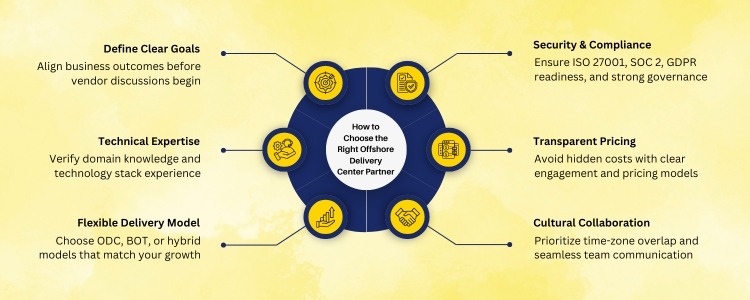
Table of Services and Advantages Offered by Offshore Delivery Centers
Service Offered
What It Solves For
Business Advantage
Software Development & QA
Feature velocity bottlenecks, testing coverage gaps
Faster release cycles, dedicated sprint capacity without in-house hiring risk
Cloud & Infrastructure Management
Uptime pressure, rising infra overhead
Predictable SLAs, 24/7 monitoring, lower total cost of ownership
AI & Data Engineering Pods
In-house AI talent scarcity
Faster model deployment, access to niche skill pools on demand
Back-Office & F&A Support
Manual processing, compliance overhead
Process standardization, audit-ready documentation, lower operating cost
Dedicated Innovation / R&D Units
Innovation stalled by day-to-day delivery load
Parallel-track R&D without disrupting core delivery commitments
Key Challenges that Destroy Momentum

Conclusion

Pratibha Soni








Error: Contact form not found. Error: Contact form not found.Subscribe to our Newsletter
Subscribe to our Newsletter