Recent Posts







For a multinational enterprise, a Global Capability Center (GCC) is no longer just a delivery unit; it is the nerve center where finance data, healthcare records, proprietary code, and R&D pipelines converge. This concentration of critical information makes cybersecurity a boardroom priority rather than a background IT function. Yet most conversations around GCC security stop at compliance checklists, missing the deeper question every leadership team eventually faces: how do you actually choose the right cybersecurity partner for a GCC? This piece breaks down what that decision involves, from regulatory alignment to governance structure, with a practical, fact-based framework.
GCCs sit at the intersection of multiple regulatory regimes at once. An Indian GCC serving a European parent must reconcile India’s Digital Personal Data Protection (DPDP) Act, 2023, with the EU’s GDPR; one serving a healthcare client inherits HIPAA obligations; and one supporting a BFSI parent must align with SEBI and RBI data-handling norms. This layered compliance exposure is unique to the GCC model. Add to this the fact that GCCs routinely handle intellectual property, source code, and financial systems, precisely the assets that state-sponsored actors and cybercriminal groups target. A breach inside a GCC doesn’t stay local; it becomes a reputational event for the parent company globally. And as GCCs lean on external vendors and delivery partners, their own supply chain becomes an extended attack surface that must be actively managed.
Most conversations frame GCCs purely as a risk to be contained. The more accurate, and more useful, framing is that GCCs are structurally well-positioned to strengthen a global organization’s cybersecurity posture, not just absorb its risk. Setting up in hubs like India gives multinationals access to a deep, certified security talent pool of professionals trained in CISSP, CEH, and ISO 27001 lead auditing, at a scale and cost that would be difficult to replicate in-house at headquarters. Because a GCC’s security architecture is frequently built from the ground up rather than retrofitted onto decades-old legacy systems, it becomes an ideal environment to pilot zero-trust architecture, unified identity and access management (IAM), and centralized Security Operations Center (SOC) models before they’re rolled out enterprise-wide. In this sense, a well-chosen cybersecurity partner doesn’t just protect the GCC; they turn it into a security innovation hub for the entire organization.
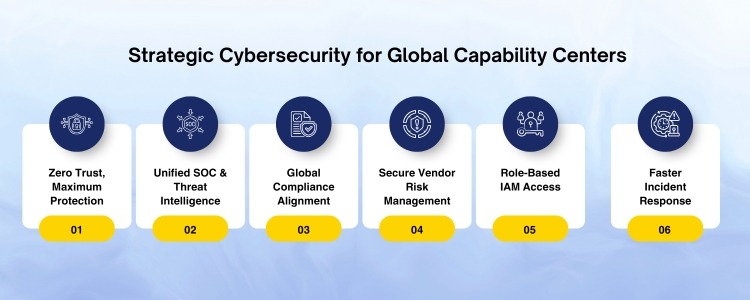
The value a GCC delivers on security depends heavily on how the partnership itself is structured. The strategies below represent the areas where the right cybersecurity consulting for GCC engagements typically focuses first. None of these strategies work well in isolation; they function as a system, where compliance mapping informs access design, and access design in turn shapes how incidents get detected and escalated.
Choosing a partner also means accepting a new category of risk that doesn’t exist in a fully in-house security model. The goal isn’t to avoid these risks; that isn’t realistic, but to mitigate them deliberately through contract and governance design. Every partnership widens the circle of people who can touch proprietary data, source code, client records, and financial systems. The mitigation isn’t just an NDA on paper; it’s tiered, role-based access controls, data loss prevention (DLP) tooling, and a strict need-to-know policy enforced at the system level, not just the contract level. When a partner’s security protocols start to override the client’s own decision-making, governance becomes blurred, and that ambiguity is itself a risk. This is addressed with a clearly defined governance charter, joint security steering committees, and contract clauses that explicitly preserve the client’s final authority over security decisions, even when the partner executes day-to-day operations. Migrating or integrating databases into a partner’s systems creates a genuine window of exposure, integrity loss, compatibility mismatches, and vulnerabilities that surface only mid-transfer. Phased migration, sandbox testing before go-live, and full audit trails at every stage reduce this exposure significantly. Delays in patching, incident reporting, or response escalation can quietly turn a manageable issue into a major breach. This is where SLAs stop being a formality; contractually bound response times, clear escalation matrices, and shared real-time monitoring dashboards ensure both parties are working off the same clock.
Cybersecurity for a GCC was never meant to be a one-sided responsibility; it works best as a shared discipline between the parent company and the delivery partner. Choosing the right partner comes down to more than certifications on a slide: it requires governance clarity, genuine compliance alignment, and proven incident response maturity. As global organizations lean further into the GCC model, the centers that get security right won’t just protect data; they’ll become the strategic security backbone the rest of the enterprise builds on.
I write where strategy meets storytelling. As a passionate writer and literary enthusiast, I craft GCC-focused content that transforms industry insights into compelling narratives. Drawn to global business ecosystems, I enjoy turning research, innovation, and ideas into content that informs, connects, and inspires. With an analytical mind and a creative soul, I bring curiosity, collaboration, and a sharp eye for detail to every project. Adaptable and growth-driven, I believe the right words do more than communicate – they leave an impression.
Why Is Cybersecurity an Utmost Priority for Multinational Companies?
How Global Capability Centers Are the Right Choice for Cybersecurity Setup
Ways to Strengthen Cybersecurity via Partnering with Global Capability Centers
Strategy
What It Involves
Why It Matters
Zero Trust Architecture Integration
Continuous verification of every user and device, rather than one-time perimeter authentication
Limits lateral movement if any single credential is compromised
Shared SOC & Threat Intelligence
A security operations model synced in real time with the parent company’s global monitoring
Ensures threats are detected and escalated on one unified timeline
Localized Compliance Mapping
Aligning host-country regulation with the parent company’s home-market obligations
Prevents regulatory gaps that create legal and financial exposure
Joint Vendor Risk Assessment
Extending due diligence to the GCC’s own sub-vendors and contractors
Closes third-party blind spots before they become breach points
Unified IAM & Least-Privilege Access
Role-based access tied to a single global directory
Reduces unnecessary data exposure across teams and geographies
Co-Developed Incident Response Playbooks
Joint escalation protocols between the GCC and HQ security teams
Cuts response time when an incident actually occurs
Risks and Risk-Mitigation While Partnering
Conclusion


Pratibha Soni









Error: Contact form not found. Error: Contact form not found.Subscribe to our Newsletter
Subscribe to our Newsletter