Recent Posts






India has become the most active destination for European companies building in-house offshore delivery operations. The growth is not driven by a single factor. It is the result of a combination of engineering talent supply, cost structure, regulatory frameworks, and a track record built by over 1,800 offshore development centers already operating across the country. This article highlights the factors that make India the automatic destination for Europeans when setting up offshore operations and the considerations that management teams should take into account when choosing India as the destination.
India hosts over 1,800+ offshore development centers run by multinational companies. These centers have employed about 2.1+ million people, contributing USD 64+ billion per year to the Indian economy. These centers generate almost 55% of the total IT and technology services revenues in India. However, these centers are not exclusive to U.S. technology companies. Multinational corporations from Europe based in industries like manufacturing, banking, engineering, health care, and consumer goods have invested heavily in Indian operations within the last decade. Some examples include Bosch, Siemens, SAP, ABB, Philips, and Deutsche Bank, among other organizations that run Indian delivery centers well above support activities. The scale of existing operations matters for European companies evaluating entry. This is because the entire chain of operations regarding manpower, property, compliance services, and infrastructure is well-established. The need to start from scratch has been eliminated.
European companies considering their options for offshore sourcing destinations often pit India against the Philippines, Eastern Europe, and even Vietnam and Malaysia. Each country offers strengths in certain situations. India enjoys an inherent advantage in many factors that are crucial to European business operations.
India produces over 1.5 million engineering graduates annually. There is no other place in the world where one can find so many software engineers, data scientists, financial analysts, and operations experts concentrated in a single city, like Bengaluru, Hyderabad, Pune, Chennai, and Gurugram. Eastern European countries, despite being excellent in technical competencies, have a much smaller pool of talents compared to India. India’s biggest advantage is its scale and diversity of talent, allowing companies to hire across multiple functions without geographic limitations. For European companies building centers that require a mix of technical, analytical, and domain-specific skills, India provides the depth to hire across functions within a single location. English Proficiency India’s professional workforce operates in English at a level that is consistent with European business requirements. Translation layers are not necessary for executive communication, reporting, legal compliance, or documentation. For European leadership teams overseeing cross-border operations, this lessens friction. Strong English proficiency helps reduce communication gaps and improves efficiency in global operations. Time Zone Workability The time zone that India uses is called IST (Indian Standard Time). Its UTC is set to +5:30. Consequently, Indian working hours coincide with the afternoon period of the Europeans’ working schedule. For instance, the leadership of such companies as Royal Dutch Shell, Siemens AG, and IKEA, located in Amsterdam, Frankfurt, and Stockholm, respectively, will have an opportunity to work effectively with their Indian teams during their second working hours. India offers a balanced time zone advantage, enabling regular collaboration without disrupting normal work hours. Cost Structure While cost savings are important, the real value comes from high-quality talent at scale, not just lower expenses. To discuss which type of consulting engagement fits your organization’s current priorities, reach out to Nirnya Singh, Client Partner, at nirnya.singh@inductusgroup.com.
Regulatory frameworks specific to export-oriented services have been put in place in India. European companies setting up offshore development centers have two primary operating frameworks to consider. India’s SEZs, which operate under the SEZ Act, 2005, have many tax incentives for units that qualify. For example, any offshore development center set up under an SEZ will enjoy tax breaks on its income from exports for five years, after which there will be exemptions in future years. SEZ units also benefit from tax breaks on the importation of machinery and equipment used for production. Software Technology Parks of India The Software Technology Parks of India scheme is an alternative to SEZ registration for companies focused on software exports. Simplified export processes, specialized high-speed connectivity infrastructure, and single-window regulatory compliance clearance are all advantages for STPI-registered units. Since the program has been in place since 1991 and is run by a government agency, service providers and legal counsel are familiar with the administrative procedure. For European companies that do not require the full scope of SEZ benefits, STPI registration is a faster and administratively simpler route to establishing an export-oriented operation. The base corporate tax rate in India for domestic corporations is 22%, while any new manufacturing corporation can avail of a reduced rate of 15%. The tax rate for a foreign subsidiary would vary based on the business form that exists within India. In most cases, European firms create their own private limited company that is wholly owned by them within India and is subject to the domestic tax rate. However, when combined with SEZ/STPI concessions for the early years of operation, the effective tax rate is significantly reduced. India has double taxation avoidance treaties with all the European countries, such as Germany, France, the Netherlands, the UK, Sweden, and Switzerland. Double taxation avoidance treaties avoid the same income being taxed twice and also clarify the concept of withholding tax rates applicable to dividends, royalties, and service fees paid between the Indian subsidiary and the European parent.
The setup process for a wholly owned offshore development center in India follows a defined path, though timelines vary depending on the chosen structure and location. Entity incorporation Regulatory registrations Talent acquisition Infrastructure India provides an extremely effective setting for creating offshore development centers, allowing for European companies to gain operational readiness in 3–6 months. This is facilitated by an extensive and developed regulatory regime, which assures transparency and reduces risks involved in setting up the centers. In addition, adequate access to skilled personnel and versatile infrastructure allows firms to start with minimal staff and expand operations effectively as required.
India hosts over 1,800 offshore development centers employing 2.1 million professionals, generating USD 64 billion annually and accounting for 55 percent of India’s IT and technology services revenue. European companies are a significant part of that picture. The type of work being conducted in these centers has grown significantly beyond administrative tasks. Product design, data analysis, finance, and compliance work are conducted out of centers in India for parent companies based in Europe. Centers that have been in operation for at least three years usually have similar responsibilities to those handled by the European headquarters.
Captive or managed Captive centers involve direct employment via a wholly owned subsidiary. In the case of managed centers, a third party will take care of the services. Captive centers provide better control in the long run as well as cost-effectiveness. Managed centers require shorter periods to implement and lower initial commitment. Location: Bangalore dominates in technology expertise. Hyderabad is equally competent but with reduced real estate prices. Pune is more adept at engineering and manufacturing operations. Chennai excels in financial services and analysis. Gurugram and Noida serve companies seeking proximity to North India talent pools. The right location depends on the function being built and the talent profile required.
India goes beyond mere economics. It’s about having access to large pools of talent, a regulatory structure that allows for foreign firms’ participation, a legal system that is compatible with treaties between Europe and the Indian government, and an existing base of vendors, consultants, and infrastructural players that lowers the risk of entry. Those decisions are worth taking the time to get right. The setup itself, once the decisions are made, is a defined process with a clear timeline.
Companies can cut their costs by 30-50% due to the availability of high-quality but inexpensive labor from India. The low cost of property and infrastructure investments also adds to the efficiency of operations. A favorable currency position also assists multinational corporations in managing their expenditures and maximizing benefits. Most significantly, all these economies are achieved without sacrificing quality, innovation, or speed of delivery. India is home to a massive resource pool of skilled professionals in AI and data science, making innovation easier. Over 500 GCCs with an emphasis on AI are available for technologies such as machine learning and GenAI. These GCCs assist firms in developing their own proprietary platforms and IP. .Thus, Indian GCCs are crucial in the context of global AI innovation and transformation. India is expected to have 2,100-2,500 GCCs by 2030 due to high growth. These centers will become more important for international business, innovation, and product development. GCCs will be at the forefront of innovation, including AI, digitization, and decision-making. In general, they will make a significant contribution to India’s economy and international business. India boasts an enormous reservoir of STEM professionals, which allows firms to expand their workforce rapidly. It has a robust digital infrastructure, which fosters innovation and international business. Its cost efficiencies make it extremely effective as opposed to other international destinations. A developed environment in AI, cloud computing, and data science ensures constant innovation and development. Global Capability Centers (GCCs) in India are enterprise-owned hubs that deliver end-to-end services like product development, R&D, AI, and digital transformation. They go beyond traditional outsourcing to drive innovation and business strategy. With a keen analytical mindset and a passion for data-driven insights, Babita Gangwar brings expertise in research, analysis, and strategic evaluation. As a Research Analyst, she focuses on transforming complex data into actionable intelligence that supports informed decision-making. She collaborates across teams to deliver high-quality research outputs, ensuring accuracy, relevance, and impact. Her interests span market research, data analytics, and emerging industry trends. A detail-oriented professional, she actively contributes to knowledge development through reports, presentations, and research initiatives.
The Current State of Offshore Development in India
Why India Over Other Offshore Destinations
Engineering and Technical Talent
The total annual salary for an average software engineer in Bengaluru or Hyderabad ranges from USD 18,000 to USD 28,000, depending on their level of experience and specialization, inclusive of employer contribution. This amount would be four to five times higher in Germany, France, or Holland. However, even taking into account the extra costs involved in management, even European companies operating offshore development centers in India typically achieve significant cost reductions across the functions they move.
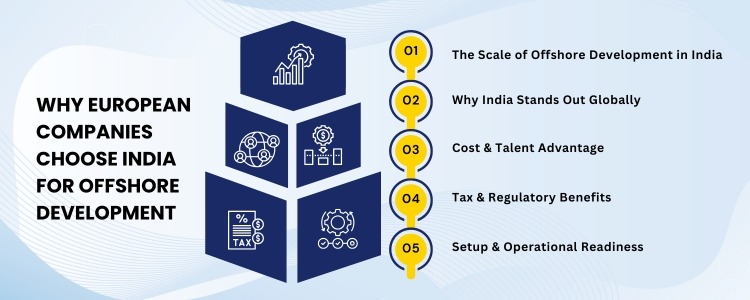
India's Tax and Regulatory Framework for Offshore Development Centers
Special Economic Zones
India’s major cities have set up SEZs that provide office infrastructure of international standard. Manyata Tech Park in Bangalore, HITEC City in Hyderabad, and Rajiv Gandhi Infotech Park in Pune are all located in SEZs and accommodate operations of several European companies. The office infrastructure provided by these SEZs is of Grade A standard in Europe.
Corporate Tax Rate
Setting Up an Offshore Development Center in India: What the Process Involves
What European Companies Are Running From Offshore Development Centers in India
Three Decisions Before Starting
Governance Centers with defined reporting lines to European business units and regular leadership engagement consistently outperform those left to run independently.Summary
If European firms have not set up their business in India yet, then it is more of what functions should be introduced first, where the firm should be based in India, and what kind of operational structure would fit the company’s corporate governance structure.

frequently asked questions (FAQs)
1.What cost advantages do GCCs in India offer?
2.How do GCCs in India support AI and innovation?
3.What is the future outlook for GCCs in India?
4.What makes India a top destination for GCC expansion?
5.What are Global Capability Centers (GCCs) in India?

Babita Gangwar









Error: Contact form not found. Error: Contact form not found.Subscribe to our Newsletter
Subscribe to our Newsletter