Recent Posts






Automation in shared service centers is no longer a pilot project item. By 2024, 72% of SSCs worldwide would implement at least one layer of process automation compared to just 38% back in 2019. For executives responsible for the operation and finance of multinational corporations, the issue is not whether to automate processes but rather which processes, in what order, and how much ROI can be expected. It is happening on a large scale at Global Capability Centers (GCCs), especially India, which has become the largest GCC center in the world. It is worth noting that the European companies themselves account for up to 400-600 such centers in India. In total, there is a market of more than $65B that is expected to grow to $100B, offering cost benefits of up to 60%.
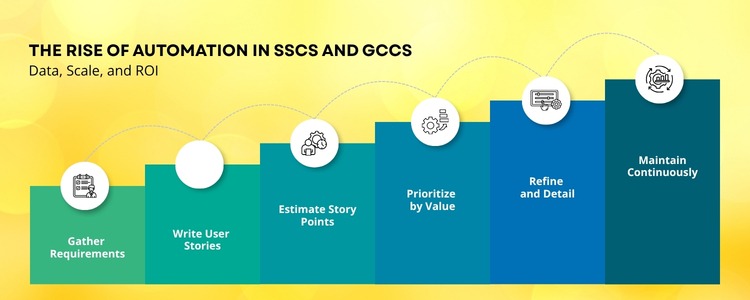
Automation affects different functions of the SSC differently. The most significant effect is observed when the transactions are large in number, consistent, and governed by rules. Finance and accounting always lead in this aspect. Payroll: error reduction at scale Month-end close: faster financial visibility Procurement: efficiency and workload reduction Automation in shared services works best when dealing with processes where there are high volumes of tasks governed by strict rules; finance and accounting are at the forefront of the effectiveness seen. Companies are experiencing clear benefits in terms of quicker turnaround times, large savings on costs, and reductions in errors within areas such as accounts payable, payroll, and month-end closing. The real advantage is not just savings but increased efficiency and better decision-making.
Automation of business processes: SSC deployments have gone through a number of different stages. The first stage dealt with rule-based tasks without the need for judgment, mostly through robotic process automation. Document intelligence and optical character recognition for unstructured inputs were introduced in the second phase. For tasks that previously required human assessment, the current phase introduces model-based processing. Key impact areas: “European adoption data: The 2024 European Finance Automation Survey found that 78% of European multinationals planned to expand automation investment in their SSCs over the following 24 months. The Gartner European SSC Automation Market estimate puts the regional market at €8.2 billion in 2023, with a projected value of €18.5 billion by 2028, representing a compound annual growth rate of 17.7%.”
In the case of European multinationals, automation in shared service centers takes place to a large extent via India’s Global Capability Centers (GCC). With 1,600+ GCCs that employ 1.66 million professionals, Europe-based firms constitute around 500 such centers, which make up 30% of India’s GCC capacity. European GCCs in India are large in scale, diverse in function, and heavily concentrated in a few key cities. They play a central role in driving automation and digital transformation across global operations.
The world’s largest concentration of shared services and capability center operations is found in the India GCC region. India is the standard delivery destination for finance, HR, procurement, and technology operations for European companies implementing SSC digital transformation programs. Financial and cost advantage: Automation amplifies cost advantage Margin performance: City-level concentration: India combines scale, cost advantage, and automation to deliver higher margins than any other GCC location. It remains the primary engine for global SSC transformation programs.
Automation of business processes, software licensing and implementation, process redesign and change management, and continuing maintenance and oversight are the three separate cost components of SSC investments. Businesses that routinely report longer payback periods and lower realized savings in comparison to their business case are those that underestimate the second component. According to the 2023 Shared Services Cost Benchmark, the median cost for a shared services center automation project involving five key financial activities was $3.8 million for companies having a yearly transaction volume of 1 million to 5 million, with the payback period being 2.1 years. The median investment for businesses with more than 5 million transactions per year is estimated at $7.4 million, with the payback period being reduced to 1.8 years.
The automation process within shared service centers has provided quantifiable and measurable returns in areas such as finance, payroll, purchasing, and human resources. There is sufficient information regarding the cost per unit, rate of errors, and processing time that makes the business case less dependent on modeling compared to five years ago. For organizations with headquarters in Europe, India is the key destination when implementing these initiatives due to the low labor costs coupled with the highest density of GCC experience. Firms that have successfully automated their second or third processes are beginning to automate model-based exceptions, which use artificial intelligence in shared services for headcount efficiency.
Companies can cut their costs by 30-50% due to the availability of high-quality but inexpensive labor from India. The low cost of property and infrastructure investments also adds to the efficiency of operations. A favorable currency position also assists multinational corporations in managing their expenditures and maximizing benefits. Most significantly, all these economies are achieved without sacrificing quality, innovation, or speed of delivery. India is home to a massive resource pool of skilled professionals in AI and data science, making innovation easier. Over 500 GCCs with an emphasis on AI are available for technologies such as machine learning and GenAI. These GCCs assist firms in developing their own proprietary platforms and IP. .Thus, Indian GCCs are crucial in the context of global AI innovation and transformation. India is expected to have 2,100-2,500 GCCs by 2030 due to high growth. These centers will become more important for international business, innovation, and product development. GCCs will be at the forefront of innovation, including AI, digitization, and decision-making. In general, they will make a significant contribution to India’s economy and international business. India boasts an enormous reservoir of STEM professionals, which allows firms to expand their workforce rapidly. It has a robust digital infrastructure, which fosters innovation and international business. Its cost efficiencies make it extremely effective as opposed to other international destinations. A developed environment in AI, cloud computing, and data science ensures constant innovation and development. Global Capability Centers (GCCs) in India are enterprise-owned hubs that deliver end-to-end services like product development, R&D, AI, and digital transformation. They go beyond traditional outsourcing to drive innovation and business strategy. With a keen analytical mindset and a passion for data-driven insights, Babita Gangwar brings expertise in research, analysis, and strategic evaluation. As a Research Analyst, she focuses on transforming complex data into actionable intelligence that supports informed decision-making. She collaborates across teams to deliver high-quality research outputs, ensuring accuracy, relevance, and impact. Her interests span market research, data analytics, and emerging industry trends. A detail-oriented professional, she actively contributes to knowledge development through reports, presentations, and research initiatives.
This blog covers what the data shows on automation adoption, the specific functions where SSC digital transformation delivers measurable results, the scale of Global Capability Center operations across Europe and India, and what the revenue and cost numbers look like for organizations that have moved past initial deployment.
72% SSCs with active automation, 2024
$64.4B India GCC revenue
1,800+ GCCs operating in India
40-60% Cost reduction in mature automated SSCs
1. Where automation in shared service centers delivers measurable results
Accounts Payable (AP): speed and cost transformation
→ ~$4.2 million annual savings
→ €800,000 to €2.1 million annual savings
2. AI in shared services and the next layer of process capability
The three domains where AI in shared services is most advanced are query resolution in HR shared services, anomaly detection in finance, and contract analysis in procurement SSCs. 41% of big corporate SSCs have implemented model-based review in at least one process, up from 12% in 2021, according to Gartner’s 2024 Finance and Shared Services Technology Report.
3. European GCCs in India: scale and concentration
Country
GCCs in India
Primary functions
Key India locations
United Kingdom
~220
Finance, IT, analytics
Bengaluru, Hyderabad, Pune
Germany
~150
Engineering, procurement, finance
Bengaluru, Chennai, Pune
France
~80
IT, finance, HR
Bengaluru, Mumbai, Hyderabad
Netherlands
~65
Finance, supply chain, HR
Bengaluru, Hyderabad
Sweden
~35
Engineering, finance
Bengaluru, Hyderabad
Switzerland
~30
Finance, pharma operations
Bengaluru, Mumbai
Denmark
~25
IT, logistics
Bengaluru, Chennai
Other European
~50
Varies by sector
Multiple cities
4. India GCC market: revenue, size, and financial output
Key metrics:
GCC revenue from India, FY2023
Projected GCC revenue from India, FY2030
Professionals employed in India GCCs, FY2024
India-based GCCs outperform on cost per output
5. What automation investment actually costs and returns
Summary:

frequently asked questions (FAQs)
1.What cost advantages do GCCs in India offer?
2.How do GCCs in India support AI and innovation?
3.What is the future outlook for GCCs in India?
4.What makes India a top destination for GCC expansion?
5.What are Global Capability Centers (GCCs) in India?

Babita Gangwar









Error: Contact form not found. Error: Contact form not found.Subscribe to our Newsletter
Subscribe to our Newsletter