Recent Posts







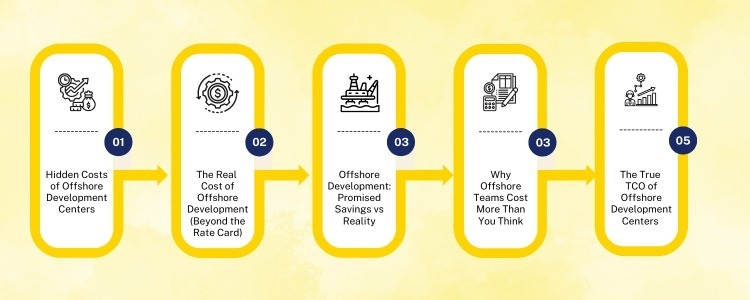
Offshore development centers are widely adopted to reduce technology delivery costs. Many companies extend into areas like India, Eastern Europe, and Latin America, estimating savings of 40 to 70 percent as compared to onshore staff. However, multiple studies show that these savings are frequently eroded or eliminated by hidden costs associated with offshore development, driving the true cost of offshore teams back near (or above) onshore levels. This guide outlines the cost structure of offshore development centers using up-to-date data and references. It focuses on determining cost drivers, measuring their effects, and giving a clear picture of the financial risks connected to offshore development models.
The blended daily or monthly rate per engineer is usually the primary metric used by corporations to assess the costs of offshore development centers. This rate frequently makes the business case 40–60% cheaper than an equal onshore resource. The ecosystem of costs only materializes once the engagement is live, and the spreadsheet rarely captures it. Before a single line of code is created, the fully loaded ODC price challenge begins. For mid-sized installations, the one-time capital expenditure for vendor selection, due diligence, contract negotiations, and onboarding typically ranges from $50,000 to $200,000. When the same study is undertaken for a second offshore center, the researchers hardly ever address these expenses and rarely appropriately amortize them in ROI models.
The rate card your vendor presents is the floor of your offshore development center costs—never the ceiling.
Managing an offshore team is not a passive exercise, and this is where ODC price issues become quite apparent. Dedicated onshore program management—typically one senior manager or architect for every eight to twelve offshore engineers—is necessary to effectively oversee distributed engineering teams. This alone can reduce the labor arbitrage your CFO built the model on by 15% to 25% at onshore compensation rates. The opportunity cost of your senior onshore engineers is one of the hidden costs of offshore development, in addition to committed program managers. When supporting an offshore team, requirements gathering, architectural review, code review, and escalation management typically take up 20–30% of a senior engineer’s bandwidth. When estimating the costs of offshore development centers, the majority of firms account for none of this.
Executive Insight Gartner research has consistently found that governance and management overhead adds between 15% and 30% to the true cost of offshore teams. Less than one in three businesses include governance and management overhead in their initial business case. The ODC appears more efficient than it actually is because the gap is covertly absorbed through internal staffing
There is a cost associated with asynchronous communication. The cumulative effect on delivery timeframes is substantial when a decision that would take 15 minutes in a co-located sprint review necessitates a 24-hour email cycle. There is a cost associated with asynchronous communication. The cumulative effect on delivery timeframes is substantial when a decision that would take 15 minutes in a co-located sprint review necessitates a 24-hour email cycle. The infrastructure investment needed to enable offshore collaboration at an organizational level is often underestimated by organizations. Depending on your security posture and tool stack, enterprise-grade project management tools, video conferencing equipment, secure VPN provisioning, and collaboration platform licenses add between $800 and $2,500 per offshore seat each year. That is a non-trivial line item that seldom shows up in the original offshore development center costs estimate for a 50-person ODC. The issue of timezone overlap comes next. In actuality, teams who are separated by more than six hours have a limited window of productive synchronous communication, usually two to three hours each day. In order to overcome this limitation, projects that need quick iteration cycles usually either accept slower velocity or extend the working hours of the onshore workforce. Each has an expense. Neither is free.
In the perspective of quality, the cost of offshore teams is rarely well measured. According to industry data, defect rates in offshore-developed code are, on average, 20–40% higher than equivalent onshore output. This is not because offshore engineers are less competent, but rather because requirements communication across linguistic and cultural barriers is actually more difficult, and feedback loops that identify problems early are more attenuated. Because rework is not visible in cost statistics, it is one of the most pernicious hidden expenses of offshore development. Development work includes the correction of defects. Scope complexity is used to justify sprint carryover. While the engineering division covertly bears the remediation costs locally, the ODC’s budget line appears clean. Technical debt incurred by offshore teams frequently remains hidden until it is brought to light by an architecture review or modernization project. By then, the initial cost savings have long since been depleted, and the cost of cleanup sometimes surpasses the initial arbitrage benefit many times over.
Pre-engagement analysis often underweights offshore development risks in the legal and regulatory dimension. Jurisdictions differ greatly in how they safeguard intellectual property. Even while enterprise-grade vendor contracts include IP assignment clauses, enforcing them across international borders remains costly and unpredictable. Maintaining an offshore development center has significant compliance costs for businesses in highly regulated industries, including financial services, healthcare, and defense adjacencies. There are significant restrictions on what work can be done overseas and under what circumstances due to data residency rules under frameworks like the EU AI Act, India’s Digital Personal Data Protection Act, and the GDPR. To guarantee that regulated data never comes into contact with offshore infrastructure, many firms are finding that the costs of offshore development centers now include a new line item: compliance architecture. This is not inexpensive, nor is it optional.
Effective offshore partnerships require periodic in-person engagement. Face-to-face interaction is beneficial for stakeholder relationship management, architecture alignment sessions, kickoff workshops, and quarterly business reviews. For mid-sized engagements, mature offshore relationships typically result in an annual travel expenditure of $30,000 to $100,000. This amount tends to increase rather than decrease as the partnership develops and the organization realizes that asynchronous communication alone is insufficient for strategic alignment. One of the ODC pricing issues that businesses find empirically as opposed to analytically is this one. According to the original idea, proximity will be replaced by communication tools. Contrary evidence is constantly provided by experience.
Offshore talent markets, particularly in India and Eastern Europe, are highly competitive. Compared to 10–15% for onshore teams at comparable seniority levels, annual turnover rates in offshore software development companies often range from 20% to 35%. The expenses of offshore development centers have substantial consequences that people consistently underestimate. When a senior developer leaves an offshore team, the team initiates a knowledge transfer procedure. In reality, achieving comparable productivity with a replacement typically takes three to six months. Code review cycles lengthen, delivery commitments drop, and your onshore team takes on more coaching time during this timeframe. When attrition is appropriately modeled, the actual cost of offshore teams is frequently 30–40% more than what the rate card indicates. A wave of attrition can cause delivery plans to be delayed by a full quarter for companies that have made significant investments in domain-specific training, product knowledge, architectural familiarity, or regulatory experience in offshore teams. Vendor presentations and the first business case hardly ever mention this offshore development risk.
Effective offshore partnerships require periodic in-person engagement. Face-to-face interaction is beneficial for stakeholder relationship management, architecture alignment sessions, kickoff workshops, and quarterly business reviews. For mid-sized engagements, mature offshore relationships typically result in an annual travel expenditure of $30,000 to $100,000. This amount tends to increase rather than decrease as the partnership develops and the organization realizes that asynchronous communication alone is insufficient for strategic alignment. This is one of the ODC pricing challenges that organizations discover empirically rather than analytically. According to the original idea, communication tools will replace proximity. Experience constantly provides contrary evidence.
The effective multiplier on offshore development center costs usually ranges from 1.8 to 2.5 times the reported labor rate when all of the aforementioned factors are combined, including management overhead, tooling, rework, attrition, legal, compliance, travel, and setup costs. When you carefully analyze the total cost of ownership, a blended engineering rate of $50 per hour actually becomes $90 to $125 per hour. Offshore development centers are still feasible despite this. In high-cost markets, there can still be a significant arbitrage in comparison to onshore rates at $90–$125 per hour when fully loaded. However, the risk profile is higher and the arbitrage is far less than what the initial business case recommended. Organizations that approach offshore development with a realistic, rather than an optimistic, assessment of the cost of offshore teams are the ones that succeed.
Before your next ODC renewal or expansion, commission an independent total cost of ownership analysis that captures all cost categories — not just the vendor invoice. The gap between what you think you are paying and what you are actually paying for offshore development is almost always larger than expected. Organizations that perform this analysis typically restructure their offshore strategy materially within twelve months. Before your next ODC expansion or renewal, commission a separate total cost of ownership analysis that includes all cost categories, not just the vendor invoice. For offshore development, the difference between what you believe you are paying and what you are actually paying is nearly always greater than anticipated. Within a year, companies who conduct this research usually significantly reorganize their offshore strategy.
The most advanced multinational corporations no longer view onshore vs. offshore as a straightforward cost choice. Rather, they are implementing intentional hybrid models that distribute work according to actual cost, degree of collaboration, and intellectual property sensitivity. Replacing optimistic cost assumptions with a full, reality-based view of offshore development center costs. What High-Performing Organizations Do Differently Leading businesses are using a few non-negotiable principles to steer the development of disciplined operational frameworks around offshore delivery:
Rigidly constructed and disciplinedly run, offshore development centers continue to add real value for multinational corporations. However, the hidden costs of offshore development have a way of turning promising business arguments into depressing realities—not because the model is flawed, but rather because it was lacking. Costs associated with offshore development centers are never limited to what is shown on the vendor invoice. Organizations who are prepared to consider the whole picture before committing and manage the entire cost structure with the same discipline they apply to any other major capital deployment are the ones that derive long-term value from offshore partnerships.
Hyderabad, Bangalore and Pune have become significant pharma innovation centres with global delivery centres of major biotechnological and pharmaceutical firms such as Novartis, Pfizer, AstraZeneca and GSK. They offer an economic benefit of calculation, a variety of scientific and technical human resources, and speedy time-to-market. On average, businesses reduce between 25-40 percent of the operational costs and increase the rate of innovation. The next-generation operations of Pharma GCC focus on advanced molecular modelling, AI/ML-based drug discovery, cloud supercomputing, and data integration platforms, as well as quantum-ready simulations. Pharma GCCs use AI to screen molecules, predict the efficacy of drugs, optimise clinical trials and aid in making data-driven decisions, resulting in smarter, faster and safer drug pipelines. Pharma GCCs will be global innovation ecosystems that are a combination of computational chemistry, generative AI, and quantum computing. They will turn into the hubs linking data science, discovery and regulatory intelligence in the global arena. With a keen analytical mindset and a passion for data-driven insights, Babita Gangwar brings expertise in research, analysis, and strategic evaluation. As a Research Analyst, she focuses on transforming complex data into actionable intelligence that supports informed decision-making. She collaborates across teams to deliver high-quality research outputs, ensuring accuracy, relevance, and impact. Her interests span market research, data analytics, and emerging industry trends. A detail-oriented professional, she actively contributes to knowledge development through reports, presentations, and research initiatives.
40–70% Projected savings when the ODC is proposed ↑ WHAT YOU’RE PROMISED
5–15% Net benefit after all costs are properly accounted for ↓ WHAT YOU ACTUALLY GET
30–40% Offshore costs routinely underestimated at planning stage ⚠ THE BLIND SPOT
The Illusion of the Headline Rate
Management Overhead: The Cost No One Budgets
Communication, Collaboration, and the Time Zone Tax
Quality Assurance, Rework, and Technical Debt
Offshore Development Risks
Legal, IP, and Compliance Exposure
The Travel Budget That Keeps Growing
Hidden Cost Components: A Realistic Breakdown
Cost Category
Typical Range (Annual)
Visibility in ODC Models
Management & Governance Overhead
15–25% of labor spend
Rarely captured
Communication & Tooling Infrastructure
$800–$2,500 per seat
Partially captured
Rework & Defect Remediation
8–18% of project budget
Rarely captured
Attrition & Knowledge Transfer
$40K–$180K per senior departure
Almost never captured
Legal, IP & Compliance
$80K–$250K over engagement life
Rarely captured
Setup, Transition & Onboarding
$80K–$250K over engagement life
Rarely captured
Travel & In-Person Alignment
$30K–$100K annually
Often underestimated
Attrition: The Budget Killer Nobody Tracks
The Travel Budget That Keeps Growing
Calculating the Real Total Cost of Ownership
Strategic Recommendation
How Leading MNCs Are Restructuring Their Approach
The Strategic Imperative: Clarity Over Optimism

frequently asked questions (FAQs)
1.Who are the Pharma GCC development leaders in India?
2.Which economic benefits do Pharma GCCs have?
3.Which technologies are influencing Pharma GCC operations nowadays?
4.What is the role of AI in Pharma GCC processes?
5.How will Pharma GCCs look in five years to come?

Babita Gangwar









Error: Contact form not found. Error: Contact form not found.Subscribe to our Newsletter
Subscribe to our Newsletter