Recent Posts







A captive center is basically a company’s own offshore or nearshore office that handles important work, whether that’s tech development, analytics, finance, customer service, engineering, or driving innovation. It’s not outsourcing; the business keeps everything under its own roof, so there’s more control over talent, processes, intellectual property, and culture. Setting up a great captive center takes some planning. You need the right location, solid leadership, the right digital tools, skilled people, strong compliance, and a long-term strategy for hiring and developing staff. But it’s more than just operational efficiency. These centers really push innovation and help companies grow worldwide. They create good jobs, boost skills, and contribute a lot to the local economy and technological progress.
India has become the go-to spot for global capability centers, drawing in big companies looking for scalability, innovation, and a pool of sharp talent. The country’s got a solid tech ecosystem, top-notch universities, a workforce fluent in multiple languages, and a business environment that actually works. It’s easy to see why everyone wants to set up shop here. You’ve got major cities like Delhi-NCR, Noida, Gurugram, Bengaluru, Hyderabad, Pune, Chennai, and Mumbai, each one buzzing with new investments from Fortune 500 giants. As digital transformation picks up pace and demand grows for AI, cloud engineering, cybersecurity, and analytics, India’s talent stands out. Companies don’t just fill positions; they build teams ready for the future. That kind of deep talent fuels business growth and keeps innovation humming.
Captive centers have really changed the way companies think about building their teams. It’s not just about plugging open positions anymore. Businesses now play the long game; they want to bring in people whose skills will help drive the company forward, not just today, but years down the line. Old-school hiring was all about solving immediate staffing problems. Now, talent acquisition covers a lot more ground: building a strong employer brand, planning for future needs, grooming people for leadership, helping employees grow, and mapping out where future talent will come from. Look at captive and offshore centers; they’re competing hard for talent. Sometimes, tracking down those hard-to-find specialists is just as tough as the actual hiring process. HR isn’t just there to process applicants either. These days, HR leaders help steer the business by creating talent strategies that last, focusing on strong, adaptable teams, not just quick hiring fixes.
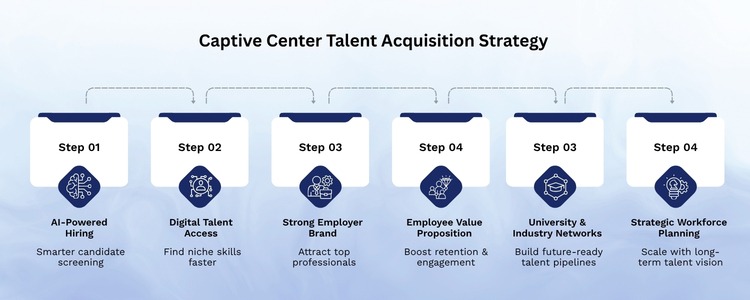
AI is changing the game in offshore talent acquisition. Now, companies don’t just sift through resumes using keyword filters; they tap into AI that digs deeper. These systems scan massive databases, spot strong candidates, and predict which hires will stick. Screening happens way faster, too. With contextual analysis, AI doesn’t just care about the buzzwords. It looks at a person’s experience, checks how relevant their skills are, and even flags leadership potential and whether they’ll fit in culturally. Machine learning helps recruiters by automating background checks and finding talent clusters across different regions. And for big operations like captive centers, AI takes care of the routine stuff, so recruiters can actually focus on strategy and make smarter decisions. The result is quicker hires, sharper matches, and a more personalized approach to talent acquisition. Digital recruitment has totally changed the game for how companies find talent. Now, hiring is all about skills; people show off their abilities in online marketplaces, professional networks, digital portfolios, and specialized platforms. Employers aren’t just scanning resumes anymore. They dig into validated skills, real project contributions, certifications, and actual work performance. Today’s tech tools make it easy for hiring teams to pinpoint experts in areas like cloud computing, AI, cybersecurity, product engineering, and data science. These platforms let you reach exactly the kind of professionals you need; no more wading through irrelevant applicants. It cuts out a lot of hassle. An employer brand is all about how people see your company as a place to work, whether they’re employees, job seekers, or just folks in the industry. Right now, reputation isn’t just nice to have; it’s crucial if you want to hire the right people. A strong employer brand doesn’t just toss out catchy slogans. It puts your values, leadership, growth paths, work-life balance, culture of innovation, and commitment to employee well-being right out front. In captive centers, especially, the employer brand can be the deciding factor for top professionals picking between offers. That’s why smart companies make sure their hiring messages actually match the reality of working there. Employer branding isn’t just marketing; it goes hand in hand with the real workforce experience. When you genuinely focus on employee satisfaction, word gets around. A clear Employee Value Proposition (EVP) is the backbone of any company that wants to grow and keep its team strong. Today’s professionals look past the paycheck; they want careers that offer growth, learning, direct connection with leadership, real purpose, flexibility, and a culture that feels right. Captive centers that put real effort into building a solid EVP see their people stick around longer and feel more engaged. That stability cuts down on costs tied to turnover, keeps valuable knowledge in-house, and helps the business run smoothly. When you’ve got a standout EVP, outsiders see the company in a better light, which boosts your brand and reputation. Firms that actually live up to their promises keep loyal employees, see less churn, and stay resilient when things get hectic or the market shifts. Recruiting for shared services and captive centers isn’t just about posting jobs and waiting for resumes anymore. Now, companies tap into entire ecosystems, from universities to startups to industry associations, to build sustainable talent pipelines. These partnerships do more than just feed candidates into the system; they give companies a seat at the table when it comes to shaping curriculum, spotting rising stars early, and closing the gaps between what schools teach and what the business really needs. They’re learning and developing future leaders. Captive centers that get involved in professional communities reach talent that traditional channels can’t touch, especially the kind of passive candidates who aren’t actively job hunting. At the core, it’s strong relationships with educators, innovators, and industry insiders that give companies the edge. That’s how you build a workforce that doesn’t just fill today’s needs but is ready for whatever’s next.
Business keeps changing, and the role of the captive center isn’t just about getting the job done anymore. Now, it’s a launchpad for real innovation and building the kind of expertise you just can’t fake. When companies double down on smart offshore hiring strategies, focus on a sharp talent sourcing framework, elevate their employer brand, and work closely with the broader ecosystem to grow talent, they set themselves up to win for the long haul. These days, it’s not about whether you can get good people in the door; the real question is whether you can keep building those specialized skills, keep your best talent engaged, and hold onto them as your business grows. In a world driven by knowledge, the true value of a captive center all comes down to its people.
I write where strategy meets storytelling. As a passionate writer and literary enthusiast, I craft GCC-focused content that transforms industry insights into compelling narratives. Drawn to global business ecosystems, I enjoy turning research, innovation, and ideas into content that informs, connects, and inspires. With an analytical mind and a creative soul, I bring curiosity, collaboration, and a sharp eye for detail to every project. Adaptable and growth-driven, I believe the right words do more than communicate – they leave an impression.
India: Leading Hub of Captive Centers—
Captive Centers Leading Towards New Era of Talent Acquisition-
Modern Talent Hunting with Offshore Talent Sourcing—

Conclusion-

Pratibha Soni









Error: Contact form not found. Error: Contact form not found.Subscribe to our Newsletter
Subscribe to our Newsletter