Recent Posts







Global businesses are no longer offshore just to cut costs; they offshore to build capability. An offshore development center has evolved from a low-cost coding unit into a strategic engineering arm that many companies now treat as core to their product roadmap. As competition for tech talent tightens and delivery timelines shrink, understanding what an offshore development center actually offers in 2026 has become essential reading for CXOs evaluating their next phase of growth. This blog breaks down what an ODC truly is today, the services it delivers, its measurable benefits, and how to set one up the right way.
An offshore development center (ODC) is a dedicated, wholly managed remote team that functions as a direct extension of a company’s in-house engineering department, not a third-party vendor executing isolated projects. This distinction matters. Staff augmentation fills temporary headcount gaps; traditional outsourcing hands project ownership to an external vendor; the Build-Operate-Transfer (BOT) model builds a team only to eventually transfer it back to the client. An ODC does none of this; it stays. By 2026, the model has matured further. Companies now expect their offshore development center to own entire product modules, hold IP jointly or fully with the parent organization, embed directly into agile sprints in real time, and work with AI-copilot development workflows rather than relying purely on headcount arbitrage. In short, a modern ODC isn’t a cost center; it’s an extension of company culture, product ownership, and intellectual property.
A modern global development center delivers far more than code. Custom software and product engineering remain the core, but the scope has widened considerably. QA and automated testing ensure release quality at speed. DevOps and cloud infrastructure management keep systems scalable and resilient. UI/UX and product design are increasingly offshored as companies seek design maturity alongside development capability. Data engineering and AI/ML model development are offshored not for cost, but because access to specialized AI talent pools is now a bigger driver than savings. Cybersecurity and compliance operations protect systems across time zones. Legacy system modernization helps enterprises migrate outdated infrastructure without disrupting operations. And ongoing application maintenance and support keeps products running post-launch. Together, these services show that offshore development services have evolved into full-stack innovation functions, not ticket-resolution teams waiting on instructions.
The offshore development center benefits are best understood not as abstract advantages but as measurable business outcomes. The table below breaks down what each benefit actually means in practice and the impact it creates.
The first step in creating an offshore development center is to define the scope, to decide exactly which functions will be offshored and why, instead of offshoring just for the sake of offshoring. The next step is location selection, which takes into account talent pools, cost structures, time-zone overlap, and political and regulatory stability. Companies then decide on an engagement model: a fully owned subsidiary, a managed ODC through a partner, or a BOT arrangement. Legal and compliance groundwork follows. Entity registration, data protection frameworks, and clear IP protection clauses are non-negotiable at this stage. Talent acquisition and onboarding should be tightly coupled to the parent company’s culture and engineering standards, not a separate hiring exercise. Infrastructure, tooling, and security setup come next, followed by governance, communication cadence, KPI tracking, and escalation frameworks that keep the offshore team accountable and integrated, not isolated.
The lines between offshore development centers and Global Capability Centers (GCCs) are getting blurred as companies are pushing their offshore units to play strategic, IP-owning roles rather than just cost-play execution. AI-augmented development is beginning to shift contracts from headcount-based billing to outcome and value-based models, changing the way ODC engagements are priced and measured. Talent hubs are diversifying as well. India remains dominant, but the Philippines, Vietnam, Eastern Europe, and Latin America are gaining ground as viable offshore destinations. And the question of where offshore development centers can operate legally is increasingly being driven by data sovereignty and cybersecurity regulations, adding a compliance aspect to location strategy that was not there a decade ago.
An offshore development center is no longer just a cost-cutting option but a long-term growth lever. When done right, it provides businesses with continuous access to specialized talent, accelerated innovation cycles, and operational resilience that a single-location team cannot deliver. The businesses that treat their ODC as a strategic partner, rather than a vendor, will be the ones that scale the fastest as the offshore development company landscape matures further through 2026 and beyond. If your organization is looking at whether an offshore or global development center is part of your growth roadmap, now is the time to see what the model can do for you.
I write where strategy meets storytelling. As a passionate writer and literary enthusiast, I craft GCC-focused content that transforms industry insights into compelling narratives. Drawn to global business ecosystems, I enjoy turning research, innovation, and ideas into content that informs, connects, and inspires. With an analytical mind and a creative soul, I bring curiosity, collaboration, and a sharp eye for detail to every project. Adaptable and growth-driven, I believe the right words do more than communicate – they leave an impression.
What Is an Actual Offshore Development Center in 2026?
List of Services Offered by Global Development Centers
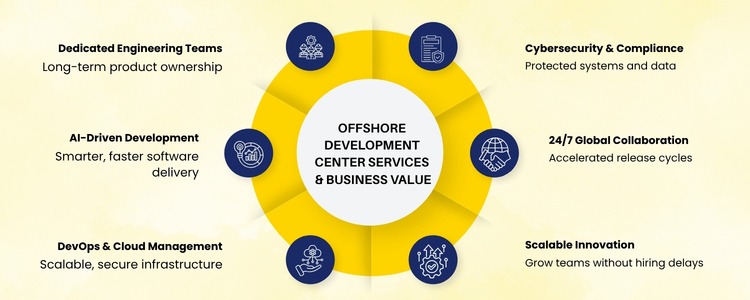
Table of Benefits: Offshore Delivery Center
Benefit
What It Means
Business Impact
Cost Efficiency
Lower operational overhead without compromising output quality
Reinvestment of savings into R&D and innovation
Access to Global Talent
Specialized skills often unavailable in the local market
Faster hiring for niche and emerging technologies
24/7 Development Cycle
Follow-the-sun model across time zones
Continuous progress and shorter release cycles
Scalability & Flexibility
Teams scale up or down without local hiring delays
Agility to match shifting project demands
Faster Time-to-Market
Parallel workstreams across geographies
Competitive advantage on product launches
Risk Mitigation & Continuity
Geographic redundancy protects operations
Business continuity during regional disruptions
Core Business Focus
Leadership bandwidth redirected from hiring to strategy
Sharper focus on core product and growth
How to Set Up an Offshore Development Center?
What Are the Future Projections of Offshore Delivery Centers?

Conclusion

Pratibha Soni








Error: Contact form not found. Error: Contact form not found.Subscribe to our Newsletter
Subscribe to our Newsletter