Recent Posts






The first wave of digital processes was faster but left decision-making firmly in human hands. The AI-led wave unfolding now is different in kind, not just degree; this system transformation, through the 2010s, was about moving work online: ERP systems, cloud migration, and the automation of repetitive, rules-based tasks. It makes them interpret context, recommend action, and increasingly decide, not merely execute. This shift is no longer experimental. As of FY26, India’s Global Capability Centre ecosystem alone employed more than 2.5 million professionals across over 2100 centers, generating roughly USD 98.5 billion in revenue, with AI adoption, cloud computing, and automation named as the defining trends shaping that growth toward an expected USD 110 billion by 2030. For B2B enterprises, the implication is direct: organizations still treating AI as a tool bolted onto legacy delivery infrastructure are already losing ground to those rebuilding the operating model itself. That distinction, augmentation versus redesign, is exactly where global delivery models are now being tested.
A traditional global delivery model (GDM) was built on a few stable assumptions: labor arbitrage as the primary cost lever, time-zone-based handoffs to maintain continuity, tiered onshore-offshore-nearshore structures, and scale achieved by adding headcount. AI is quietly dismantling each of these assumptions in turn. When AI agents can absorb Tier-1 support, reconciliations, and high-volume data processing at near-zero marginal cost, arbitrage built purely on cost-per-head loses its edge. When AI systems can execute autonomously around the clock, the necessity of time-zone relay diminishes. And when scaling no longer means proportionally scaling people, growth becomes a function of model capability and orchestration design rather than recruitment velocity. This is most visible inside Global Business Services and GCCs, where the center of gravity is shifting from cost-efficiency to strategic ownership. Recent industry analysis describes this directly: GCCs are increasingly measured not by headcount or labor arbitrage but by how quickly they can build products, scale intelligence, and generate business outcomes, a redefinition that positions them as innovation and decision-intelligence hubs rather than transactional cost centers. The GBS organizations pulling ahead right now are not the ones layering chatbots onto old workflows; they are the ones redesigning organizational structure itself around human-AI collaboration.
“Global delivery model” is no longer a single, settled concept; it now spans a spectrum of distinct operating archetypes, each with different cost logic, risk profile, and ideal use case. For B2B leaders evaluating where their organization actually sits, the comparison below lays out four emerging models side by side. In practice, most enterprises today sit somewhere inside the hybrid AI-augmented category, a transitional stage rather than an end state. The strategic question is not whether to move further along this spectrum but how deliberately and how fast.
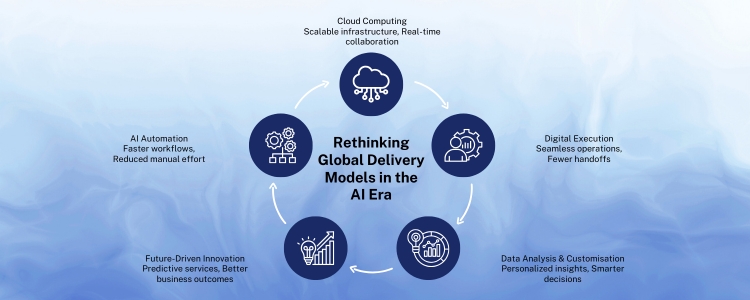
In a global delivery context, AI automation means transactional, rules-bound work, L1 support tickets, reconciliations, and routine documentation being absorbed by systems rather than routed through human queues. The tangible outcome is capacity redistribution: teams freed from repetitive throughput can be redeployed toward judgment-intensive, client-facing, or analytical work. For B2B clients, this translates into faster turnaround on standard requests without proportionally higher service costs, sharpening the delivery model’s competitive edge on speed alone. Cloud computing is the infrastructure layer that makes distributed, AI-driven delivery operationally possible, enabling real-time data access, model deployment, and workflow continuity across geographies without the latency or compliance friction that once constrained cross-border service delivery. The business outcome is consistency: a client in London and a client in Singapore draw on the same intelligence layer, with compliance and data residency requirements handled at the infrastructure level rather than negotiated per engagement. This consistency is increasingly a baseline expectation, not a differentiator. Digital execution goes beyond single-task automation; it is the orchestration layer, the “system of systems” that sequences multiple AI-enabled processes into one coherent delivery workflow, from intake to resolution to reporting. The outcome is fewer handoff points and fewer errors introduced at each transition, since orchestration replaces manual stitching between disconnected tools. For clients, this shows up as a delivery model that feels seamless end-to-end, rather than a chain of separately automated parts. AI-enabled data analysis allows delivery models to be tailored per client and per market in near real time, rather than running a single standard operating procedure across every engagement. The practical outcome is delivery that adapts; service-level patterns, escalation logic, and reporting formats shift based on what the data shows about a specific client’s behavior and risk profile. This level of customization, delivered at scale, is what separates a generic service provider from a strategic delivery partner. This is the forward-looking lever: AI-enabled delivery models that anticipate client needs before they are explicitly requested, using pattern recognition across historical data to flag emerging issues or opportunities early. The outcome is a shift from reactive service, responding to tickets and requests, to predictive service, where the delivery model itself becomes a source of foresight. For B2B relationships built on long-term trust, this predictive capability is increasingly what justifies premium positioning over commoditized alternatives.
The phrase “global delivery model” may itself be due for retirement. The term was built around an era when geography and headcount were the primary variables determining cost and capability. AI has replaced those variables with capability and orchestration: what a system can decide and how intelligently it is coordinated now matters more than where the work physically happens or how many people are assigned to it. What is emerging in its place looks closer to an intelligent delivery network: distributed, adaptive, and engineered around outcomes rather than locations. For CXOs and GCC leaders, this is not a future-tense conversation. The organizations gaining ground are auditing their current delivery models against AI-native alternatives now, while the gap between early movers and late adopters is still a competitive advantage rather than a baseline expectation. That window will not stay open indefinitely; the time to act on it is before it closes.
I write where strategy meets storytelling. As a passionate writer and literary enthusiast, I craft GCC-focused content that transforms industry insights into compelling narratives. Drawn to global business ecosystems, I enjoy turning research, innovation, and ideas into content that informs, connects, and inspires. With an analytical mind and a creative soul, I bring curiosity, collaboration, and a sharp eye for detail to every project. Adaptable and growth-driven, I believe the right words do more than communicate – they leave an impression.
The AI Revolution of the 21st Century: Digital Transformation
How AI Impacts on Global Delivery Models: Global Business Services
Comparative Analysis Table: Which AI Automated Global Delivery Model Stands Out
Model Type
Core Mechanism
Cost Structure
Speed / Scalability
Best Suited For
Key Risk
Traditional GDM
Labor arbitrage, tiered onshore/offshore handoffs
Headcount-linked, cost-per-FTE
Linear; scales by hiring
Static, high-volume transactional work
Margin erosion as wage gaps narrow
Hybrid AI-Augmented GDM
AI handles Tier-1 tasks; humans manage exceptions and judgment calls
Blended; falling cost-per-transaction
Faster; scales with model capacity, not headcount alone
Enterprises mid-way through GBS modernization
Inconsistent governance across AI and human layers
Fully Autonomous AI-Delivery GDM
AI agents execute end-to-end workflows with minimal human routing
Near-zero marginal cost per transaction
High; scales almost instantly
High-volume, rules-bound, low-ambiguity processes
Over-automation in judgment-heavy or compliance-sensitive functions
Platform / Ecosystem-Based GDM
Shared AI-enabled platforms orchestrate delivery across multiple clients or business units
Subscription or outcome-based pricing
Very high; network effects compound scale
Multi-entity enterprises and GCCs serving several business lines
Platform lock-in and data-governance complexity
What Do AI-Global Business Models Deliver?
Conclusion

Pratibha Soni









Error: Contact form not found. Error: Contact form not found.Subscribe to our Newsletter
Subscribe to our Newsletter