Recent Posts







Why StartUps turn to Global Capability Centers: StartUp Culture of 2026 You’d think startup culture in 2026 would still be about going it alone, bootstrapping relentlessly, moving fast, and solving problems in isolation. The reality looks very different. The most resilient startups these days don’t go it alone. They’re plugging into interconnected ecosystems built around Global Capability Centers (GCCs). What used to be just back-office hubs have turned into full-blown engines for growth, offering hands-on support for startups right from day one. Today’s entrepreneur thinks globally from inception but executes with local precision. They do not view partnerships as weakness. They view them as force multipliers. For founders facing tight funding, rapid AI changes, hiring challenges, and fierce global competition, joining a mature GCC ecosystem means they get something most incubators can’t provide, real execution power. This whole approach is changing how Global Capability Centers work in 2026. Now, they’re open networks that level the playing field, giving startups access to cutting-edge tools, deep market insights, and scalable business models, all much earlier than was ever possible for previous generations.
As Vijay Shekhar Sharma famously observed when discussing ecosystem-driven growth: “The next wave of Indian innovation will scale faster through strategic partnerships than through isolated execution.” Partnerships aren’t just nice to have anymore; they’re what keep businesses alive. Back in the day, networking meant shaking hands at events, swapping business cards, and hoping something good would happen down the line. Now, growth runs on ecosystems. When people see you in the media, you gain credibility. Credibility opens the door to partnerships. Partnerships bring you new customers. And when you show traction with customers, investors start to pay attention. The pathway is pretty clear: Early-stage startup support → GCC partnership → Digital transformation support → Enterprise validation → Global growth Picture this: you launch a company, and right from the start, you tap into AI innovation labs, experienced product architects, experts who know how to break into markets, compliance pros, and a network that’s plugged in globally. That’s not just theory; that’s exactly what a GCC-driven innovation network brings to the table. For startups in India in particular, partnering with a GCC levels the playing field. Suddenly, the tools and resources that used to be reserved for big, well-funded companies are yours: enterprise tech, digital transformation, and insider knowledge on scaling across borders, without needing to be a unicorn. So by 2026, partnerships aren’t simply a piece of strategy. They’re the baseline determining a founder’s success.
When founders evaluate GCC partnerships, the conversation is rarely about cost reduction alone. The most valuable relationships solve strategic growth challenges. Here’s the founder checklist that increasingly drives partnership decisions:
Bangalore, Hyderabad, and Mumbai are still the heavyweights for GCC operations. But lately, more companies are turning to Tier-2 cities to cut costs on satellite offices. After Brexit, UK-India shared service models are picking up steam, so you’ve got new ways to collaborate that didn’t exist before. Investors pay close attention to where you set up shop; they see location choices as signs of how scalable and mature your business really is. GCC-backed models make this possible. They don’t just provide cash; they open doors to shared infrastructure, hefty tech credits, co-investment deals, and partnerships with key vendors. In reality, working with the right GCC partner can cut 30–40% off your infrastructure costs. That frees up more money for building out your product, winning over customers, and keeping your best talent, exactly where you want your focus if you care about real digital transformation. The best GCC ecosystems bring in heavy hitters: fractional CTOs, CFOs, product leaders, cybersecurity pros, and go-to-market experts. You don’t have to blow your budget hiring full-time execs too soon. Instead, you tap into hands-on advice, mentorship, and playbooks that actually work, right when you hit those tough inflection points. Year one is all about nailing product-market fit. In year two, it’s time to scale up. Year three, you target institutional investors. By years four and five, you’re positioning for acquisition, partnerships, or an IPO. With a solid GCC framework behind you, every milestone feels less risky, and you get proven systems for growth and tighter operational discipline. The GCC-backed teams that win don’t just set goals; they stick to rhythms. They run bi-weekly sprint reviews, monthly strategy check-ins, and quarterly performance reviews. These routines keep everyone clear, raise the pace, and help the team stay coordinated, even when hyper-growth brings chaos. That’s how the big vision turns into real results.
GCC partnerships aren’t some miracle solution; they’re a tool, and like any tool, you’ve got to know how to use it or you end up hurting yourself. The startups that really win are the ones who know when to tap into GCC expertise and when it’s time to back their own guts.
Grassroots startup guidance doesn’t mean giving up your independence. It actually makes you stronger. Let’s be honest, by 2026, startups won’t go it alone anymore. Success comes from connecting with the right mix of talent, tech, funding, and serious execution. That’s what GCCs offer now: a full ecosystem that founders can tap into. The ones who do this early aren’t just riding the wave; they’re defining what the future of global business looks like.
I write where strategy meets storytelling. As a passionate writer and literary enthusiast, I craft GCC-focused content that transforms industry insights into compelling narratives. Drawn to global business ecosystems, I enjoy turning research, innovation, and ideas into content that informs, connects, and inspires. With an analytical mind and a creative soul, I bring curiosity, collaboration, and a sharp eye for detail to every project. Adaptable and growth-driven, I believe the right words do more than communicate – they leave an impression.
How Networking and partnerships matter in 2026
What StartUps look for in a partnership with GCCs
What Startups Seek
Why It Matters in 2026
GCC Advantage
Market Validation
De-risks product-market fit before scaling
Direct access to GCC’s enterprise client feedback loops
Global Scalability
India-born startups need APAC and EU/US roadmaps
Pre-built go-to-market infrastructure across regions
Access to Capital
Series A/B funding cycles demand credibility
GCC networks unlock strategic investors + corporate venture funds
Digital Innovation
AI/cloud/automation now table stakes
GCC R&D labs and tech stack partnerships included
Expansion Support
Regulatory, hiring, compliance complexity
GCC handles localization and legal scaffolding for multi-market entry
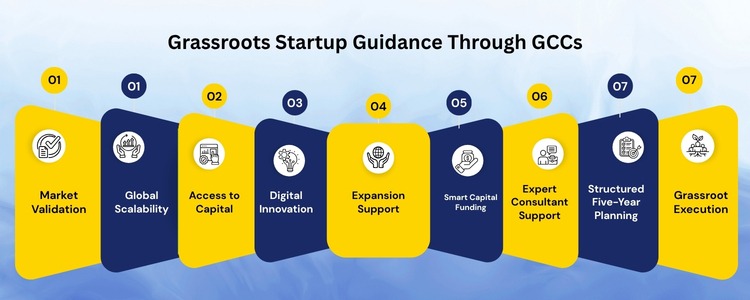
Ultimate Grassroot Level Guide For StartUps for setting up GCC
Potential Risks & Ways to Avoid it

Conclusion

Pratibha Soni










Error: Contact form not found. Error: Contact form not found.Subscribe to our Newsletter
Subscribe to our Newsletter
