Recent Posts







As companies grow and spread their operations across different countries, cutting costs isn’t the only thing on their minds. They’re looking for ways to run their businesses that deliver consistency, speed, good governance, and real business value. That’s where managed shared services come in. They’ve turned into a key strategy for forward-thinking organizations. Peter Drucker had it right when he said, “Do what you do best and outsource the rest.” But managed shared services aren’t just about outsourcing anymore; rather, they’ve evolved. Now, it’s about bringing together centralized operations, smart tech-driven processes, and real management know-how to make the whole company run more smoothly. With Global Capability Centers, Business Process Management platforms, and AI-driven automation now pretty much standard, companies are rethinking what should stay decentralized and what makes more sense to bring under one roof.
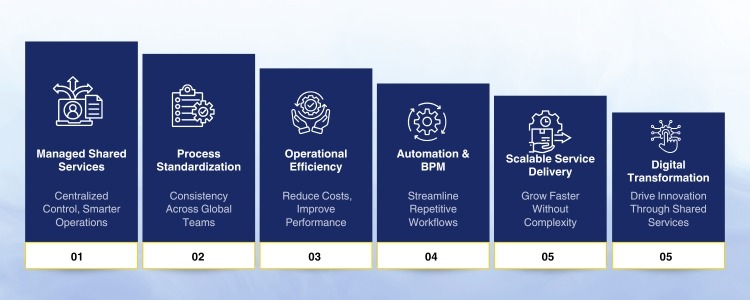
Managed shared services pull business functions into one place and put them under the care of a specialist team, either in-house or an outside partner. Everything runs according to clear performance standards and service agreements, so you know what to expect. This isn’t just about pinching pennies like the old shared service centers. The goal is to get better results. These setups mix process know-how, the latest tech, automation, analytics, and strong operational oversight, all into one streamlined service model. BPM technologies have really boosted the rise of managed shared services. Companies can now lay out standard workflows, automate boring tasks, tighten up compliance, and actually see what’s happening across different teams in real time. This approach is catching on fast, especially with businesses going through digital transformation. By centralizing support and letting the experts handle day-to-day execution, companies free up their own people to focus on bigger stuff, innovation, improving the customer experience, and long-term growth, instead of just keeping the lights on.
In the traditional shared services model, companies pull together all those repetitive, transactional tasks, think finance, payroll, procurement support, employee administration, and customer support, and run them from a central service center. The business still calls the shots, keeping everything in-house, but now the processes are standardized across departments. This setup isn’t just about tidiness; it’s about saving money and staying consistent. You’ll see large enterprises with stable operations opt for this model because they want control, but also want to cut out the redundancy. The managed shared services model keeps ownership inside the company but hands off the process management and all the heavy lifting around optimization to a third-party specialist. These providers show up with a toolkit: automation, industry knowledge, process benchmarks, and performance frameworks that push for continuous improvement. Unlike standard outsourcing, where you just shift tasks over, this model is about transforming how things work. The provider becomes responsible for hitting quality, efficiency, and compliance marks, and they stay on the hook for ongoing upgrades. When companies are growing fast, merging with others, or overhauling operations, the managed approach helps them scale up without ballooning their management team. GBS is the next step up, the most evolved flavor of shared services. It pulls multiple business functions together, from finance and HR to IT, analytics, legal, and customer ops, and runs them under one global roof. A GBS group acts more like an internal business, complete with service catalogs, customer-focused metrics, and a mandate for transformation across the enterprise. Now, the focus is on innovation, automation, and making decisions driven by solid data. Big multinational companies are gravitating toward this model. They get global standards and consistency, but also the agility to keep pushing forward. Some organizations face difficulties in fully centralizing everything. That’s where the Hybrid Shared Services Model comes in. Here, you get centralized governance at the top, but day-to-day execution can happen closer to business units when it makes sense. High-level strategy and standardized processes go in the shared center; anything that needs a local touch stays with the business unit. Industries like banking, healthcare, insurance, and pharma find real value in this hybrid approach, since they have complex compliance needs that change by region.
Managed shared services only deliver real value when you pick the right processes to centralize; there’s just no way around that. If a process is routine, driven by clear rules, easy to measure, and can run on tech, it’s almost always a solid choice. Now, if you’re working with a tight budget, start with transactional finance. Think accounts payable, receivable, payroll, expenses, and vendor management. They’re quick wins: you’ll see efficiency jump up and standards tighten fast. Mid-sized companies usually take things a step further, bringing HR ops, procurement support, compliance tasks, managing employee lifecycles, and even customer service into the fold. Honestly, automation and BPM tools make a massive difference here. You streamline, you standardize, and your processes just work better. Once your company’s bigger, especially on the global stage, you look at bigger fish: financial planning, analytics, cybersecurity, IT management, handling master data, and keeping up with regulatory reports. At this scale, managed shared services become critical to keeping everything running smoothly. Where you put these services matters, too. If you’re focused on cutting costs, you’ll run your transactional stuff from offshore hubs. But for knowledge-heavy or sensitive work, you want teams near business stakeholders, so you go nearshore or hybrid.
If one wants quick efficiency gains, sticking with the traditional model helps more quickly. But if you’re chasing growth and trying to modernize, managed shared services make sense. They let you keep some control, but you gain expertise and scale. For global companies dreaming bigger, GBS offers real strategic power; just be ready for a tough, complex rollout. Hybrid models are still the answer for organizations with tight regulations or lots of locations. Flexibility’s the priority, as it provides further relaxations.
The future of enterprise operations is all about smart, tech-driven service delivery. Companies aren’t just experimenting with digital transformation anymore; they’re racing ahead, and picking the right shared services model has become a major strategic move, not just an operational tweak. Sure, traditional shared services still streamline things and cut costs, but most organizations now lean toward managed shared services for bigger gains. These models offer serious scalability, better processes, and a steady pipeline of innovation. When organizations match the right processes to the right model, they see real improvements in cost, quality, compliance, and customer experience. Plus, all of this builds a stronger foundation for long-term growth.
I write where strategy meets storytelling. As a passionate writer and literary enthusiast, I craft GCC-focused content that transforms industry insights into compelling narratives. Drawn to global business ecosystems, I enjoy turning research, innovation, and ideas into content that informs, connects, and inspires. With an analytical mind and a creative soul, I bring curiosity, collaboration, and a sharp eye for detail to every project. Adaptable and growth-driven, I believe the right words do more than communicate – they leave an impression.
What are Managed Shared Services?
What are shared services models?
Which business processes are best suited to different SSCs?
Comparative Perspective—

Conclusion—

Pratibha Soni









Error: Contact form not found. Error: Contact form not found.Subscribe to our Newsletter
Subscribe to our Newsletter