Recent Posts






In the era of digital revolution, incorporating multiple sectors of modern livelihood, one can witness the rise of artificial intelligence, electric aviation, genetic engineering, and even the invention of brain chips as major revolutionary advancements. Tech has engulfed the organizations, be they media, logistics, consulting, or now even medical & pharmaceutical. The recent decade has left everyone’s mouth gaping; the impact left by the exacerbation of COVID-19 and months of ‘lockdown’ impeding growth was only a foreword to unprecedented circumstances, yet made us all realize the importance of having access to digital health. One can question, “What is digital health?” Why is it important? When and how does it help us? The answer is right before your eyes! From the moment of birth, as Darwin states, “the fittest survive,” and to be the ‘fittest’ depends on medical technology as the determining factor. Healthcare GCC is all set to rise, aiding digitized hospital platforms to perform surgeries with robots. Organizations seek advanced MedTechs now.
Medical Technology (MedTech) represents the convergence of medical science, engineering, data analytics, and software development to design solutions that improve patient outcomes and healthcare delivery. It encompasses both physical products, such as implantable devices, surgical robotics, imaging systems, and wearable health monitors, as well as digital innovations, including Software as a Medical Device (SaMD), AI-powered diagnostics, and connected health care platforms. Today, MedTech is one of the fastest-growing innovation sectors globally, driven by aging populations, chronic disease management, and the expansion of digital healthcare infrastructure. The industry is increasingly shifting from standalone devices toward integrated ecosystems that combine hardware, software, data, and predictive intelligence.
The MedTech industry is undergoing a profound transformation. Companies are moving beyond manufacturing devices to building intelligent healthcare ecosystems powered by cloud computing, AI, machine learning, and real-time patient monitoring. Connected medical devices, Software as a Medical Device (SaMD), digital therapeutics, and wearable integrations are rapidly becoming mainstream capabilities. India is increasingly becoming a strategic MedTech destination. Beyond cost efficiencies, global organizations are leveraging India’s deep engineering talent pool, digital product development capabilities, and growing familiarity with FDA, CE, and CDSCO regulatory pathways. This combination enables faster innovation cycles and scalable product development. The next frontier is already emerging: AI-powered diagnostics, autonomous clinical decision support systems, and robotic surgery platforms capable of delivering precision healthcare at an unprecedented scale.
There has been a fundamental change to the MedTech GCC role. Once support centers, they are now strategic innovation engines that co-own global product roadmaps, accelerate regulatory readiness, and drive digital transformation initiatives. Modern MedTech GCCs handle end-to-end Software as a Medical Device (SaMD) development, oversee firmware engineering of connected wearables, create cloud-native healthcare ecosystems, and assist in the development of machine learning models for diagnostic imaging and predictive healthcare applications. Rather than scattering disjointed activities across multiple vendors, organizations are consolidating these capabilities within GCCs to accelerate, improve quality, and govern.
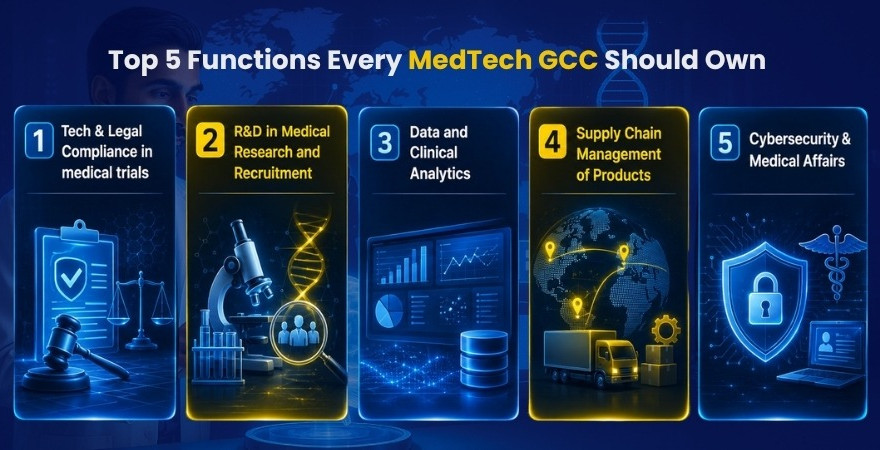
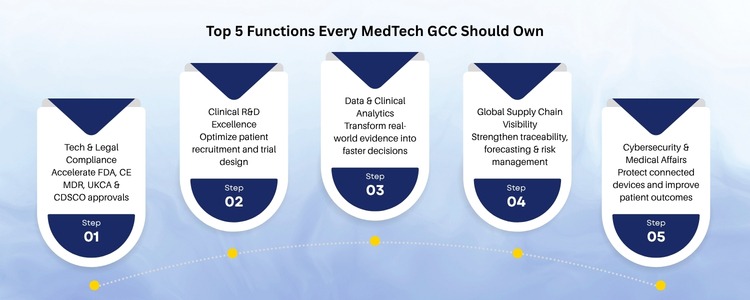
Regulatory complexity has become a competitive differentiator. MedTech companies simultaneously navigate FDA, CE MDR, UKCA, and CDSCO approval pathways while managing evolving software validation requirements. GCCs that own compliance operations reduce trial delays, accelerate approvals, maintain audit readiness, and embed regulatory requirements directly into product development cycles instead of treating compliance as a downstream activity. Clinical innovation depends on quality research and effective patient recruitment. GCCs should own trial design support, feasibility analysis, protocol optimization, and recruitment analytics. India’s diverse patient demographics, growing research ecosystem, and increasing clinical trial participation create unique opportunities for generating high-quality evidence while reducing recruitment timelines and improving trial representation. Healthcare data has evolved into a strategic asset. GCCs should lead real-world evidence generation, predictive trial modeling, biomarker analysis, patient stratification, and regulatory data package preparation. Organizations that own clinical analytics can accelerate decision-making, improve trial success rates, and strengthen regulatory submissions with evidence-backed insights. Global MedTech supply chains face increasing pressure from geopolitical uncertainty, regulatory requirements, and demand fluctuations. GCCs should own end-to-end visibility across manufacturing networks, cold-chain logistics management, vendor risk assessment, inventory forecasting, and product traceability. Centralized oversight improves resilience while reducing operational disruptions and compliance risks. Connected devices create new cybersecurity responsibilities. MedTech GCCs must own HIPAA- and GDPR-grade data protection frameworks, device vulnerability monitoring, secure software development practices, and post-market surveillance. Medical affairs teams should simultaneously monitor product performance, adverse events, clinician feedback, and real-world outcomes to support ongoing regulatory and commercial success.
Digital health transformed health care delivery by enabling patient access to care, remote monitoring, faster diagnosis, and continuous care pathways. But organizational maturity is a precondition for sustainable value creation. But a mature MedTech GCC should evolve beyond the foundational five functions and its own ten critical capabilities: software & IoT engineering, regulatory affairs, quality management, data & clinical analytics, supply chain management, cybersecurity, medical affairs, finance, human resources, and intellectual property management. There are opportunities, but problems persist. Fragmented regulations across geographies make data governance difficult, talent shortages persist in niche clinical-data and regulatory domains, and legacy medical device software often creates integration barriers as organizations move to cloud-native architectures. Success boils down to creating scalable operating models that can find the right balance between innovation and compliance.
India’s digital healthcare infrastructure is creating powerful tailwinds for MedTech GCC expansion. The Ayushman Bharat Digital Mission (ABDM) continues to establish a nationwide interoperable health ecosystem, with more than 90 crore ABHA accounts and extensive digital health record adoption across healthcare facilities. With healthcare systems requiring more interoperable data exchange, AI-enabled diagnostics, predictive care models, and connected patient experiences, global MedTech companies are likely to route a growing share of these innovation initiatives through Indian GCCs. India is set to become a major hub for next-gen MedTech innovation, given the convergence of digital public infrastructure, engineering talent, and healthcare modernization.
MedTech’s future isn’t just about shiny new devices or clever algorithms. The real edge goes to companies that pull everything together—innovation, compliance, clinical smarts, cybersecurity, and rock-solid operations—into a single, high-functioning model. You can spot the most resilient MedTech GCCs because they own their core functions. They don’t scatter critical work across a web of disconnected vendors. They bring those capabilities in-house, and that’s how they keep quality up, stay on top of regulations, and get products to market faster. For global MedTech players setting up or expanding in India, getting things done on the ground is just as crucial as big-picture strategy. Everything from regulatory approvals and compliance to hiring the right talent and building out the GCC matters. That’s where Inductus steps in, with real, local expertise that helps companies build strong teams, manage the twisty details of the MedTech world, and push for lasting growth worldwide.
I write where strategy meets storytelling. As a passionate writer and literary enthusiast, I craft GCC-focused content that transforms industry insights into compelling narratives. Drawn to global business ecosystems, I enjoy turning research, innovation, and ideas into content that informs, connects, and inspires. With an analytical mind and a creative soul, I bring curiosity, collaboration, and a sharp eye for detail to every project. Adaptable and growth-driven, I believe the right words do more than communicate – they leave an impression.
What is MedTech?
The Rise of MedTech in Global Scenario
Company
Core MedTech Focus
Notable Innovation
Medtronic
Connected Care & Implantables
AI-enabled insulin delivery systems
Philips Healthcare
Digital Health Platforms
Integrated patient monitoring ecosystems
Siemens Healthineers
Imaging & Diagnostics
AI-assisted radiology and precision diagnostics
GE HealthCare
Clinical Intelligence
Cloud-connected imaging and predictive analytics
Stryker
Robotic Surgery
Mako robotic-assisted surgical platform
How do GCCs aid organizations in MedTech?
Top 5 Functions Every MedTech GCC Should Own:
An Overhaul on “Digital Health”: Advantages and Challenges Involved
Need of the Hour: HealthTech growing Infrastructure
Conclusion-

Pratibha Soni










Error: Contact form not found. Error: Contact form not found.Subscribe to our Newsletter
Subscribe to our Newsletter