Recent Posts






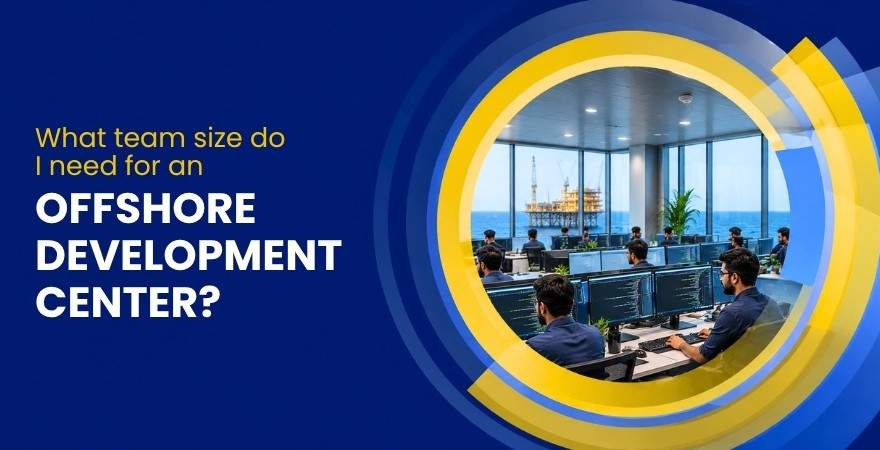
Building an offshore development center is no longer the challenge; sizing it correctly is. Companies expanding globally often struggle to determine how many people they actually need offshore to accelerate growth without creating unnecessary costs or management complexity. Hire too few, and delivery slows. Hire too many, and productivity declines under coordination overhead. The reality is that optimal ODC sizing depends on business maturity, product complexity, and growth objectives. This guide explains how to determine the right offshore development center team size for sustainable, scalable success.
An Offshore Development Center, or ODC, works like a remote arm of your company’s tech team, just based in another country. It’s not your typical outsourcing where you hand off projects now and then. Instead, you get a team that’s fully integrated with your goals, your culture, and the way you deliver products or services. The real draw with an ODC isn’t just saving money, though that’s always nice. You open the door to global talent you might not find at home. Development speeds up when your people work around the clock, and you don’t have to keep hunting for engineers in a tight local job market. Plus, if your business priorities change, say you need to ramp up for a new product launch or scale back for a bit, it’s much easier to adjust your team size. As digital transformation keeps picking up speed everywhere, companies count on these offshore centers to drive innovation, build resilience, and stay competitive worldwide. Dedicated offshore teams aren’t just a trend; they’re becoming a core part of how ambitious businesses think about growth.
The size of the team has a direct impact on the business results that an offshore development center can produce. A team of 5 people can easily maintain a product, add incremental features, and support a small number of customers. But its capacity to launch new products, enter new markets, or accelerate innovation remains limited. Conversely, an ODC of twenty can sustain multiple development streams concurrently, shorten release cycles, and allocate dedicated capacity for experimentation and growth initiatives. It makes the market more responsive and money-making. The key is to size your offshore team. Teams that are understaffed are often operational bottlenecks. Teams that are oversized suffer from diminishing returns due to increasing communication complexity and management cost. With strategic sizing, every new hire delivers quantifiable business value.
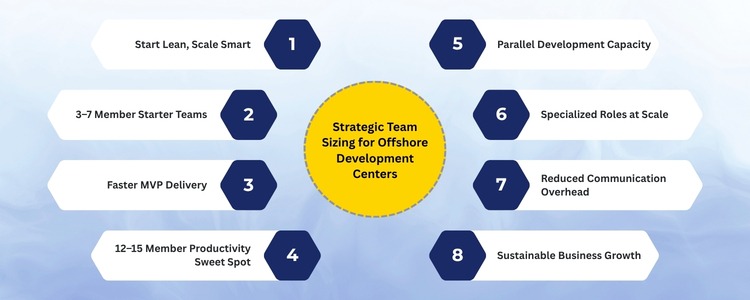
Small-cap organizations, usually with between 20 and 500 employees, take a very efficient approach to ODC investments. The main goal is often product development, MVP delivery, or speeding up engineering output without significantly increasing operational costs. For these businesses, a lean offshore team of three to seven professionals often strikes the perfect balance. A typical structure is 4 developers, 1 QA engineer, and a shared technical lead across functions. This model allows for speed of execution and cost discipline. Mid-cap companies typically have between 500 and 5,000 employees and face a different set of challenges. They often have multiple products, growing customer bases and increasing compliance requirements. At this stage, offshore engineering team planning becomes more organized. A typical offshore development center staffing model may include ten to twenty-five professionals, incorporating developers, QA specialists, DevOps engineers, project managers, and solution architects. Unlike startups that prioritize speed, mid-cap firms prioritize scalability, governance, and operational continuity. Most successful expansions occur in phases, adding specialized roles every six to twelve months as delivery complexity increases.
Starter teams are the most nimble and work best for validating a product or focused development effort. Growth teams have enough capacity to do parallel work streams while keeping communication efficient. This is where most organizations experience the biggest productivity gains. The sweet spot for many companies is between 12 and 15 professionals in practice. The size of this dedicated offshore team provides a good level of specialization without adding a lot of management layers. Beyond twenty-five, organizations need to build more robust governance structures, engineering leadership, and process frameworks. Without these controls, communication overhead can start to erode the productivity benefits that larger teams are supposed to deliver.
Team sizing decisions without strategic planning can backfire even on well-funded offshore initiatives. The most common mistake is underestimating resource needs. Smaller teams tend to burn out, release late, and have quality issues when demand outstrips capacity. Overexpansion causes another problem. Overhiring results in unused capacity, increased costs, and management inefficiencies. Other challenges include cultural integration gaps, fragmented knowledge transfer, and the complexities of time zone coordination. As teams grow, communication channels multiply, raising the risk of misunderstandings and delivery delays. But these challenges can be bridged if organizations plan the size of their offshore teams in a systematic manner. Clear onboarding frameworks, documented processes, cross-functional leadership, and phased hiring strategies mitigate execution risks exponentially while still managing team cohesion and productivity.
There is no one-size-fits-all formula to choose the perfect size of an offshore development center. The right answer depends on where you are in your growth stage, your product roadmap, your operations maturity, and your ambitions in the market. The infrastructure needed to support a startup building out its first platform looks very different than that of a mid-market company scaling multiple product lines or an enterprise looking to go global. The only constant is the value of strategic offshore team size planning. Companies that align team composition to business objectives are executing faster, more cost-efficiently, and more scalably. Evaluate your existing ODC model thoroughly, pinpoint capability gaps, and engage expert support as needed. The right-sized offshore development center is not just an operational asset; it’s a sustainable competitive advantage.
I write where strategy meets storytelling. As a passionate writer and literary enthusiast, I craft GCC-focused content that transforms industry insights into compelling narratives. Drawn to global business ecosystems, I enjoy turning research, innovation, and ideas into content that informs, connects, and inspires. With an analytical mind and a creative soul, I bring curiosity, collaboration, and a sharp eye for detail to every project. Adaptable and growth-driven, I believe the right words do more than communicate – they leave an impression.
What is an ODC and why should companies choose one?
How ‘Size’ Influences Market & Business Development
How ‘Mid-cap’ and ‘Small-cap’ Companies Dedicate Teams for ODCs
What Team-Size Balances Perfect Harmony With ODCs?
Team Type
Team Size
Recommended Composition
Starter Team
5–8
4–5 Developers, 1 QA, 1 Tech Lead, Shared PM
Growth Team
15–20
10–12 Developers, 2–3 QA, 1 DevOps, 1 PM, 1 Architect
Enterprise Team
30+
Multiple Scrum Teams, Dedicated QA, DevOps, Product Owners, Engineering Managers
Risks & Challenges Involved
Conclusion


Pratibha Soni









Error: Contact form not found. Error: Contact form not found.Subscribe to our Newsletter
Subscribe to our Newsletter