Recent Posts






Modern enterprises are under pressure from every direction. Finance teams are expected to deliver real-time insights, HR functions must support distributed workforces, procurement teams are tasked with controlling costs, and leadership demands greater operational agility, all while budgets remain under scrutiny. Against this backdrop, many organizations arrive at the same strategic question: How long does it take to implement a Shared Service Center (SSC)? For CFOs, COOs, and transformation leaders, the answer is far more than a scheduling exercise. The shared service center implementation timeline directly influences investment planning, change management, resource allocation, and expected return on investment. The reality is that there is no universal implementation clock. A regional SSC supporting a handful of functions can be operational within 6-8 months, while a global transformation involving multiple countries and business units may require a longer journey of 8-10 months. Understanding the typical SSC implementation duration and the factors that shape it is essential for setting realistic expectations and achieving long-term success.
Think of a shared service center as a centralized command center for business operations. Instead of every business unit maintaining its own finance, payroll, HR, procurement, or administrative teams, these functions are consolidated into a single operational hub that serves the entire organization. Much like a hub-and-spoke transportation model, the SSC becomes the central engine powering multiple business units simultaneously. The objective is not simply consolidation: it is standardization, efficiency, and control.
Look around. Are teams in different cities handling the same processes? Does each department run payroll or manage HR its own way? Are overhead costs creeping up and eating into profits? That’s usually a red flag. It tells you maybe it’s time to centralize things. A Shared Service Center isn’t just about saving money. It pushes accountability, tightens compliance, builds processes you can actually scale, and frees up leaders to focus on growing the business instead of wrestling with admin headaches. As companies grow, whether by snapping up competitors, expanding worldwide, or broadening their offerings, the patchwork approach gets harder to manage. It just doesn’t hold up. Knowing how long it’ll take to roll out a Shared Service Center gives leaders clarity. They can see if the timing lines up with where the business is headed and if the investment really fits their priorities.
India isn’t just a place to cut costs anymore; it’s become a powerhouse for shared services and global capability centers. If you set up a shared service center here, you’re looking at slashing operational costs by as much as 40–60%. And honestly, the talent pool is massive. There are more than five million people skilled in everything from finance and tech to HR, analytics, procurement, and customer service. Its location works out well, too. India lets you run operations around the clock, covering North America, Europe, Asia-Pacific, and the Middle East without missing a beat. But cost and talent aren’t the only draws. The country has a full-fledged ecosystem, consultants, tech providers, transition experts, and service partners all ready to help. This setup cuts down on the time it takes to get your SSC up and running, since most of the typical headaches just don’t come up. On top of that, you get real expertise in regulatory compliance, GST, labor laws, multilingual support, and global process management. So, it’s not just about saving money; you’re tapping into know-how that’s hard to find elsewhere. What really makes the difference is the infrastructure. You don’t need to reinvent the wheel. Companies plug right into proven frameworks, experienced people, and vendor networks, so getting value happens fast.
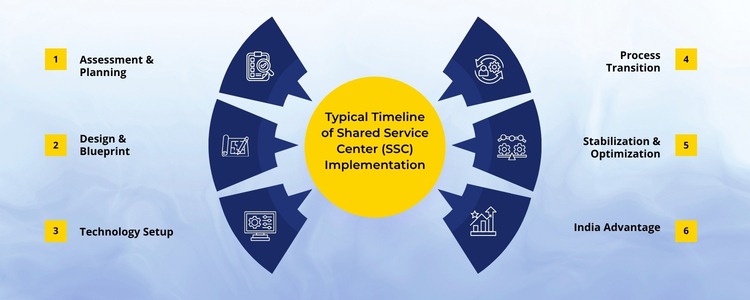
While every organization is different, most Shared Service Center programs follow a structured roadmap spanning 12–24 months. Typical SSC Implementation Timeline Assessment ↓ Design ↓ Technology Setup ↓ Transition ↓ Stabilization This phase is about the business case, operating model, governance, location, and scope. Organizations set the baseline for the SSC implementation timeline, identify stakeholders, and assess process readiness. This is where companies begin to create their SSC implementation roadmap end-to-end. Designs of process maps, service catalogs, governance frameworks, KPIs, and organizational structures. Decisions made during this phase determine approximately 70% of long-term SSC success. Technology becomes the SSC’s backbone. This phase contains ERP integration, workflow automation, data migration, cybersecurity controls, reporting dashboards, and infrastructure deployment. Complex system integrations are often the critical path to implementation. This is usually the most resource-intensive part. Processes are migrated, knowledge transferred, employees trained, and service delivery responsibilities formally transitioned. This phase can account for almost 50% of the total shared service center implementation timeline in global implementations. The SSC is in full operation, performance metrics are monitored, and continuous improvement initiatives start. Organizations realize higher value and lower total cost of ownership by improving service levels, removing bottlenecks, and streamlining workflows. The main factors affecting timelines are: India-based SSC programs, in particular, often complete implementation 20-30% faster due to the country’s mature ecosystem, experienced talent base, and established transformation frameworks.
So, how long does it really take to set up a shared service center? Honestly, for most companies, you’re looking at anywhere from 7 to 9 months. But let’s not pretend it’s a simple timeline for everyone. The exact pace depends on how complicated your organization is, what processes you want to include, whether your tech is up to speed, and if your team is actually on board. The ones who get it right put in a lot of work upfront, mapping out the whole implementation process before making any big moves. This approach keeps things from getting messy down the line and helps you roll out your new setup faster, without unwanted surprises. Sure, it takes patience and some serious discipline to pull this off. But the payoff is big. Most companies start seeing solid returns in 18 to 30 months. You’ll cut operating costs and boost your service quality, and your business suddenly becomes way more scalable. And if you want to speed things up, India is a top spot for launching shared services. The talent, infrastructure, and business climate make it a reliable destination.
I write where strategy meets storytelling. As a passionate writer and literary enthusiast, I craft GCC-focused content that transforms industry insights into compelling narratives. Drawn to global business ecosystems, I enjoy turning research, innovation, and ideas into content that informs, connects, and inspires. With an analytical mind and a creative soul, I bring curiosity, collaboration, and a sharp eye for detail to every project. Adaptable and growth-driven, I believe the right words do more than communicate – they leave an impression.
What are shared services centers?
What and why should one look for SSC?
Advantages of setting up a shared services center in India
Timeline with Phases of Setting-up a SSC

Conclusion

Pratibha Soni










Error: Contact form not found. Error: Contact form not found.Subscribe to our Newsletter
Subscribe to our Newsletter