Recent Posts







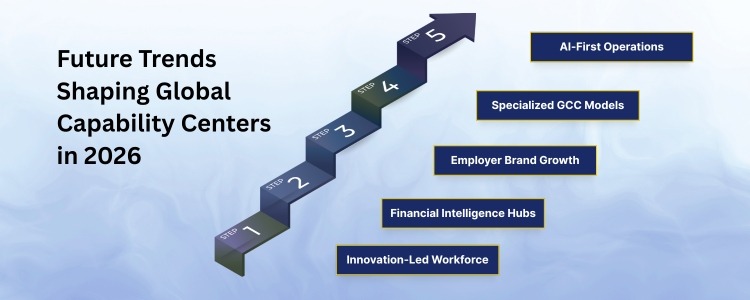
What happens when the world’s largest enterprises stop viewing talent hubs as support centers and start treating them as engines of enterprise value creation? That shift is already underway. In 2026, the Global Capability Center (GCC) model is undergoing its most significant transformation since the rise of offshoring two decades ago. What began as a cost-efficiency play has evolved into a strategic operating model powering innovation, product ownership, AI adoption, and business resilience across multinational organizations. The modern Global Capability Center is no longer measured by headcount or labor arbitrage. It is measured by how quickly it can build products, scale intelligence, generate business outcomes, and create competitive advantage. Five interconnected forces are driving this transformation: AI-first GCCs, specialized operating models, employer-brand expansion, financial centralization, and innovation-led workforce strategies. Together, they are redefining what successful GCCs will look like by the end of this decade.
The future GCCs are now driven by factors that are not constrained to mere ‘cheap’ availability, AI-first GCC enablement, conversion to GCC ‘Giants’ to premium goal-centric support, opportunities for both domestic and global Governments, and a youth-powered innovation is what the trends of time suggest— By 2026, the most impressive global capability centers will be built around AI. First, they’re not just bolting it on. Teams weave AI and machine learning right into their everyday workflows. You see intelligent automation, real-time decision-making, automated testing setups, and generative AI copilots everywhere. Banks and pharma companies, especially, these guys now automate compliance, risk checks, and regulatory reporting, slashing what used to be thousands of manual hours. Just look at how BFSI and life sciences firms use AI-driven governance systems. These frameworks track policy adherence nonstop and shrink the time spent on audits. The era of generic shared-service centers is ending. A new generation of highly specialized GCC archetypes is emerging. A decade ago, most GCCs operated quietly behind their parent brands. Today, they actively cultivate their own market identity. Employer branding, university partnerships, engineering communities, innovation forums, research publications, and executive thought leadership have become critical growth levers. The strongest GCCs now attract talent because professionals actively want to work there, not simply because they belong to a global company. This shift is closely tied to digital talent transformation. High-caliber professionals increasingly evaluate organizations based on learning opportunities, innovation exposure, and career acceleration. Consequently, GCC branding has moved from an HR discussion to a boardroom priority. Enterprise finance is going through another big shift. Global Capability Centers are taking on more responsibility, not just treasury operations but also FP&A, regulatory reporting, tax intelligence, internal controls, and performance analytics. These days, a lot of multinational companies have CFO dashboards running straight out of their GCCs. That means leaders get real-time insights into how their business is doing everywhere, not just in one market. Top GCCs aren’t just about squeezing out more efficiency anymore. Now, it’s all about speed and how fast they can innovate. You see innovation labs popping up, agile teams working constantly, rapid prototyping in action, and AI-centric centers leading the charge. They’re even treating experimentation as startups do; it’s becoming the norm. The real game-changer? Talent. Companies that keep investing in reskilling, breaking down silos, and building up their leaders are leaving old-school, top-down organizations in the dust.
Global Capability Centers do not operate in isolation. Talent economics, regulatory maturity, innovation ecosystems, and digital readiness vary significantly across geographies. For founders evaluating expansion strategies, understanding these differences is essential. The standout insight: while several countries offer compelling GCC advantages, no market currently combines scale, STEM talent, engineering depth, AI capability, and operating economics at the level India does.
The scale of expansion is unprecedented; more than 400 new GCCs have been established in the past five years, reflecting sustained confidence from multinational corporations seeking long-term capability creation rather than short-term cost optimization. Engineering and R&D-focused GCCs are growing 1.3 times faster than the broader market, signaling a decisive shift toward innovation ownership. India also contributes 28% of the world’s STEM talent and 23% of global software engineering talent, creating an unparalleled foundation for digital transformation. Leadership maturity is rising equally fast, with global leadership positions expected to grow from 6,500 today to over 30,000 by 2030; the majority of this info is backed by government research. These developments collectively reinforce India’s trajectory toward becoming the world’s leading GCC innovation capital by 2030.
Following are the Future Opportunities invested in World of GCCs: But along with this we also have potential Risks involved:
The future of the Global Capability Center is no longer about delivering services more efficiently; it is about creating enterprise value more intelligently. AI-first GCCs’ technology, automated operational settings, and future-ready modern and youthful workforce are the new deciding factors. For founders and enterprise leaders, the message is clear: the winners of 2030 are being built today. The defining question is no longer whether your organization needs a Global Capability Center; it is whether your GCC is being designed for the future that is already arriving.
I write where strategy meets storytelling. As a passionate writer and literary enthusiast, I craft GCC-focused content that transforms industry insights into compelling narratives. Drawn to global business ecosystems, I enjoy turning research, innovation, and ideas into content that informs, connects, and inspires. With an analytical mind and a creative soul, I bring curiosity, collaboration, and a sharp eye for detail to every project. Adaptable and growth-driven, I believe the right words do more than communicate – they leave an impression.
Latest Trends Observed in Global Capability Centers:
Country-Based Comparative Analysis—
Country
GCC Count
Talent Pool Strength
Cost Index
AI Readiness
Regulatory Ease
Key Sectors
India
Very High
Exceptional
Low
Very High
High
Technology, BFSI, ER&D, AI
Poland
High
Strong
Medium
High
Very High
Finance, Engineering, IT
Philippines
High
Moderate
Low
Medium
High
Customer Operations, BPO
Mexico
Growing
Strong
Medium
Medium
High
Manufacturing, Supply Chain
UAE
Growing
Niche High-End Talent
High
High
Very High
FinTech, Digital Services
Malaysia
Growing
Strong
Medium-Low
High
High
Shared Services, Analytics
India’s Stand in this Global Narrative—
Future Projections & Risks-
Conclusion-

Pratibha Soni







Error: Contact form not found. Error: Contact form not found.Subscribe to our Newsletter
Subscribe to our Newsletter