Recent Posts







Every founder, CTO, and CHRO eventually faces the same dilemma: should you keep scaling through external talent, or is it time to build capability that belongs entirely to your organization? In the early stages of growth, the staff augmentation model often feels like the obvious choice. It offers speed, flexibility, and immediate access to specialized talent without the burden of creating an overseas entity. However, as organizations mature, product complexity increases, and global operations expand, leadership teams begin asking a different question: Are we still renting capability when we should be building it? The answer isn’t simply about cost. It is about ownership, control, scalability, and long-term competitive advantage. This guide provides a practical framework for determining when a Global Capability Center (GCC) becomes a smarter strategic investment than staff augmentation
A Global Capability Center (GCC), often referred to as a captive center, is a dedicated offshore unit established and operated exclusively for a parent organization. Unlike traditional outsourcing arrangements, a GCC functions as a direct extension of the enterprise itself. Under a captive center strategy, the organization owns the operating model, hiring processes, leadership structure, intellectual property, technology stack, governance mechanisms, and cultural environment. Employees work for the company rather than for a third-party vendor, creating deeper alignment with corporate objectives and business outcomes.
Staff augmentation is a flexible workforce strategy where organizations hire external talent through a staffing or technology partner to fill skill gaps, capacity constraints, or project-based requirements. Rather than forming a legal entity or operational infrastructure, companies get access to professionals who plug in to existing teams for a defined period of time. This enables companies to grow rapidly without long-term organizational commitment. Staff augmentation is particularly appealing to startups, scale-ups, and enterprises with tight delivery schedules. It cuts upfront investment, reduces the complexity of hiring, and gives access to niche skills that might be hard to recruit internally. When the need is software engineering, cloud migration, cybersecurity expertise, or quality assurance, staff augmentation is a practical answer when speed and flexibility are more important than long-term ownership. In a staff augmentation engagement, the vendor sources, screens, and deploys talent as per the client’s requirements. Commercial arrangements will typically be on the basis of time and material contracts, monthly retainers, or fixed-term contracts. This model makes it easy for organizations to scale the team up or down. The benefits are obvious: fast onboarding, little infrastructure, and immediate access to expert skills. But there are natural limits to this model too. fragmented knowledge accumulation, employee loyalty mostly to the vendor, and institutional expertise walking out when contracts expire. These factors may, over time, create dependency risks for strategically important functions.
The discussion around GCC vs. staff augmentation can often revolve around cost. The decision, in fact, is one of strategic intent. Organizations must look at four key dimensions: duration of demand, strategic importance of the function, intellectual property sensitivity, and scale of operations. If the need is temporary, staff augmentation generally gives you more flexibility. Where the function is expected to be a long-term driver of business value, a GCC can generate significantly higher returns. This is where the GCC decision framework comes in handy. The tipping point is rarely headcount alone; it is when capability becomes central to competitive advantage.
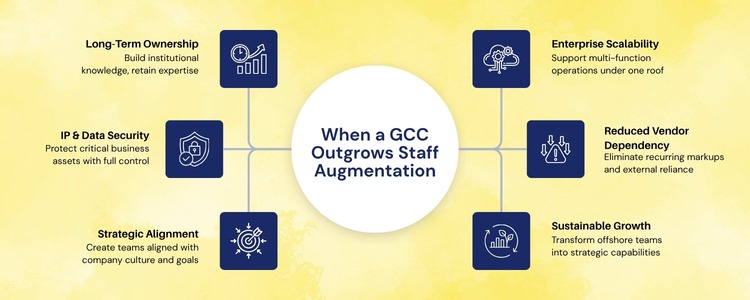
A GCC is the go-to model once an offshore strategy shifts from just ticking boxes to actually building value for the business. You’ll know it’s time when you see these signs: you’re planning to build skills for the long haul, your security and compliance needs suddenly take center stage, and your operations start getting more complex at an enterprise level. When all these pieces come together, it just makes sense. The efficiency and cost benefits of a GCC start to beat out the flexibility that comes with standard staff augmentation. When your need for talent stretches over years instead of just a few quarters, building a Global Capability Center (GCC) simply makes more sense. Sure, setting one up costs more upfront, but those expenses spread out as you run the operation longer. Plus, you keep your hard-earned institutional knowledge and specialized expertise, and you don’t have to start from scratch every time; everything stays consistent. On the other hand, staff augmentation eats into your budget with constant vendor fees, endless cycles of hiring and replacing, and scattered expertise. The truth is, renting talent racks up costs over time and leaves you with less control. If you deal with sensitive data, proprietary algorithms, regulated info, or mission-critical IP, you need tight control. It’s not just a nice-to-have; it’s a strategic necessity. A GCC gives you direct control over security: you set the policies, choose who gets access, manage governance, and stay on top of compliance. That’s a big deal in industries like BFSI, healthcare, fintech, and other regulated sectors. Staff augmentation partners might have solid security standards, but your sensitive information still moves through third-party contracts, and that’s risky. As regulations get tougher around the world, more companies turn to GCCs for stronger protection and peace of mind. Scaling up: The bigger you get, the more complex your needs. You might need to run engineering, analytics, finance, procurement, cybersecurity, product management, and R&D all under one roof, all working together. GCCs shine here. They bring dedicated infrastructure, centralized leadership, clear processes, and real cross-functional teamwork. Staff augmentation works well if you need a few experts for specific projects. But if you’re running a global organization with hundreds or thousands of professionals, you need something stronger, a backbone, not a patch. That’s what a GCC delivers.
Both models have their place in a smart global workforce strategy. Staff augmentation works best when you need specialized talent right away, want to boost your team for a specific project, or just need extra hands without a long-term commitment. It’s all about speed, flexibility, and keeping things simple on the operations front. On the other hand, a Global Capability Center makes more sense if you’re looking to run core business functions offshore, protect your intellectual property, foster innovation, and scale steadily for the long haul. At that point, you stop thinking just about adding people; you start thinking about owning and building real capabilities. The top organizations aren’t stuck comparing which model is best in theory. Instead, they look at what actually fits their strategy, growth plans, and appetite for risk. Take a hard look at where your organization stands. If you’re seeing signs that point toward investing in long-term operational muscle, it’s probably time to consider if setting up a GCC is the right next move for your global growth.
I write where strategy meets storytelling. As a passionate writer and literary enthusiast, I craft GCC-focused content that transforms industry insights into compelling narratives. Drawn to global business ecosystems, I enjoy turning research, innovation, and ideas into content that informs, connects, and inspires. With an analytical mind and a creative soul, I bring curiosity, collaboration, and a sharp eye for detail to every project. Adaptable and growth-driven, I believe the right words do more than communicate – they leave an impression.
What are Global Capability Centers?
What is staff augmentation?
GCC vs. Staff-Augmentation
Why should you prefer a GCC setup?

Conclusion-

Pratibha Soni









Error: Contact form not found. Error: Contact form not found.Subscribe to our Newsletter
Subscribe to our Newsletter