Recent Posts






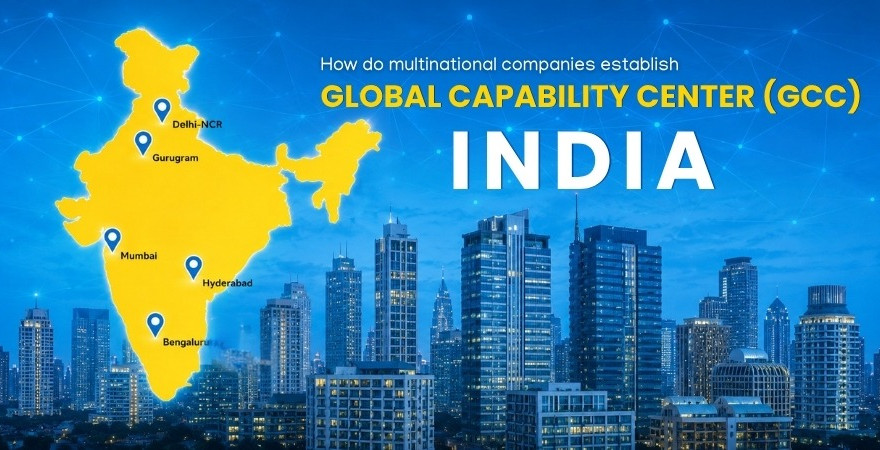
Introduction: GCC- Definitions, Models, Services Structural shifts occur every few decades that change the way global enterprises operate. One such shift is the rise of the Global Capability Center, a quiet force reshaping how multinationals build, scale, and compete. A Global Capability Center is a captive, fully owned offshore unit of a multinational company that executes high-value business functions out of a strategically selected country. Unlike outsourcing, a GCC keeps intellectual property, talent strategy, and operational direction squarely within the enterprise. IT development, R&D, AI/ML engineering, finance operations, cybersecurity, and end-to-end business process optimization are among the functions delivered. Three primary models define how GCCs are structured. The captive model offers complete ownership. The Build-Operate-Transfer model uses a third-party enabler to construct and hand over operations once stabilized. The Company-Owned-Partner-Operated model, which Inductus projects will surge 25% in adoption by 2030, blends ownership with operational partnership. Each model carries a different risk profile and cost structure depending on where the enterprise sits in its global expansion journey.
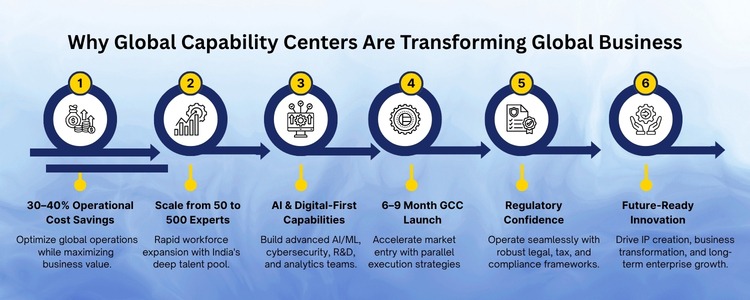
The business case for GCCs did not emerge from strategy theory. It emerged from economic pressure. Salary inflation across the United States, the United Kingdom, and the European Union has made it structurally difficult to build enterprise-scale technology and analytics capabilities in home markets. GCCs resolve this. Companies establishing GCCs in India report saving 30 to 40 percent in operational costs compared to equivalent setups globally, according to Inductus research. These savings are reinvested into innovation and capability expansion. A GCC beginning with 50 professionals can, with disciplined execution, scale to 500 within three to five years, a growth trajectory that home markets simply cannot replicate. Why MNCs choose Indian GCC Ecosystem India’s position as the world’s leading GCC destination is no longer an argument. It is a number. As of early 2026, over 2100 GCCs operate across India, employing 2.4 million professionals and generating $98.5 billion in export value in FY2026, per Inductus GCC data. The sector is projected to grow from $98.5 billion in 2026 to $110 billion by 2030. Approximately 60% of the world’s top 500 companies have already established a GCC in India, as documented in Inductus’s annual report. What makes India distinctive is not just scale; it is the depth of the talent pipeline and the maturity of the supporting ecosystem. Over 78% of newly established GCCs now prioritize AI/ML and data analytics as their core capability focus. India’s GCC story has moved well beyond cost arbitrage into genuine strategic value creation.
India isn’t just a place to cut costs anymore; it’s become a powerhouse for shared services and global capability centers. If you set up a shared service center here, you’re looking at slashing operational costs by as much as 40–60%. And honestly, the talent pool is massive. There are more than five million people skilled in everything from finance and tech to HR, analytics, procurement, and customer service. Its location works out well, too. India lets you run operations around the clock, covering North America, Europe, Asia-Pacific, and the Middle East without missing a beat. But cost and talent aren’t the only draws. The country has a full-fledged ecosystem, consultants, tech providers, transition experts, and service partners all ready to help. This setup cuts down on the time it takes to get your SSC up and running, since most of the typical headaches just don’t come up. On top of that, you get real expertise in regulatory compliance, GST, labor laws, multilingual support, and global process management. So, it’s not just about saving money; you’re tapping into know-how that’s hard to find elsewhere. What really makes the difference is the infrastructure. You don’t need to reinvent the wheel. Companies plug right into proven frameworks, experienced people, and vendor networks, so getting value happens fast.
Real complexity exists. According to Inductus-cited compliance research, 85% of global respondents said regulatory requirements have grown more complex over the past three years. Cybersecurity is escalating—India’s CERT issued 390 vulnerability notes and 1,530 alerts against nearly 29.44 lakh cyber incidents in 2025. India’s Digital Personal Data Protection Rules 2025 add further obligations on cross-border data flows. Talent competition in Tier-1 cities drives persistent attrition, and organizations planning only for initial headcount consistently face bottlenecks when scaling.
The India GCC ecosystem in 2026 is not a trend. It is a structural repositioning of where global enterprises build their most critical capabilities. By 2030, GCC success will be measured by IP generation, revenue influence, and innovation output, not headcount. For multinationals pursuing AI-led capability building, offshore development center expansion, or business process optimization, India offers talent depth, regulatory maturity, and ecosystem readiness that no other market currently matches. The window for strategic advantage is open, but execution precision determines who captures it.
I write where strategy meets storytelling. As a passionate writer and literary enthusiast, I craft GCC-focused content that transforms industry insights into compelling narratives. Drawn to global business ecosystems, I enjoy turning research, innovation, and ideas into content that informs, connects, and inspires. With an analytical mind and a creative soul, I bring curiosity, collaboration, and a sharp eye for detail to every project. Adaptable and growth-driven, I believe the right words do more than communicate – they leave an impression.
Why are multinational companies expanding via GCCs
Guide to establish MNC-GCC in India-
Advantages of setting up a shared services center in India
Risks & Challenges Involved

Conclusion

Pratibha Soni








Error: Contact form not found. Error: Contact form not found.Subscribe to our Newsletter
Subscribe to our Newsletter