Recent Posts






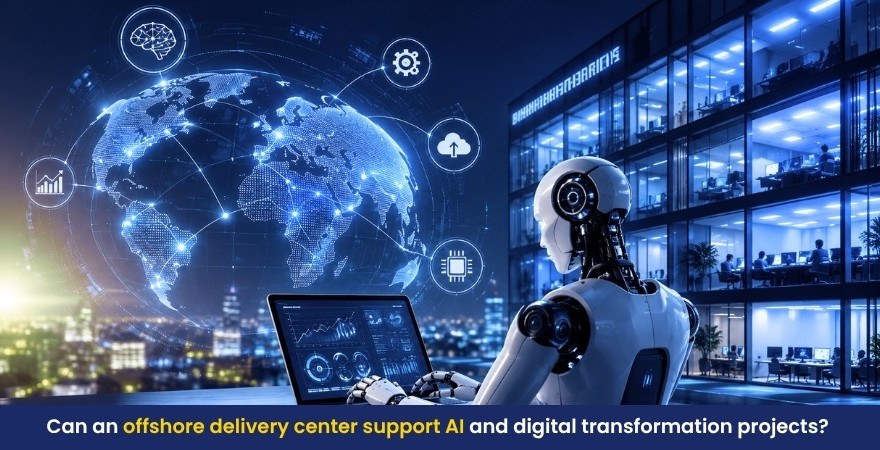
Offshore Delivery Center for AI Projects / AI Enablement / Data Engineering For years, the offshore delivery center was seen as a cost lever, a place to route repetitive work while the real innovation stayed close to headquarters. Can an offshore delivery center for AI projects actually carry the weight of building intelligent systems, or is that assumption already outdated? The evidence suggests the model has moved faster than the perception. Offshore teams are now writing data pipelines, training models, and running MLOps that power enterprise AI initiatives. The real question isn’t whether ODCs can support AI and digital transformation. It’s that many already do, and the ones doing it well have become strategic enablers of enterprise AI adoption, not just delivery units.
AI has become this decade’s defining competitive currency, the way electricity rewired industry a century ago and the internet rewired commerce two decades later. Every enterprise sector is racing not just to pilot AI but to operationalize it, embedding it into products, decisions, and daily workflows at scale. That race is exposing a hard truth: building AI in-house at the speed the market demands requires data engineers, MLOps specialists, and domain-trained AI talent that most organizations simply don’t carry on staff. Enterprise AI spending keeps climbing year over year, and the widening gap between ambition and internal capacity is exactly where the AI offshore development center has emerged, not as a stopgap, but as a structural answer.
What are Offshore Delivery Centers (ODC)? An offshore delivery center is often mistaken for a scaled-up BPO or a staff-augmentation arrangement, a place that simply executes tasks handed down from headquarters. That no longer fits. A modern, AI-enabled Offshore Delivery Center functions as an extension of a company’s core delivery capability: a dedicated team, its own infrastructure, and ownership of outcomes, not just task completion. Instead of being looped in after strategy is set, today’s ODCs are embedded early, shaping architecture and data strategy alongside the business rather than behind it. How do ODCs incorporate AI automation? Inside a capable ODC, AI isn’t a bolt-on feature; it’s built into the delivery process itself. Automated QA and testing frameworks catch defects before they reach production. AI-assisted code review shortens release cycles. Predictive resourcing models forecast where engineering capacity will be needed weeks in advance. None of this works without clean data underneath it, which is why offshore data engineering services have become a core competency: building structured, governed pipelines that make AI models trainable and trustworthy, rather than demos that never scale. How do ODCs handle digital transformation projects? Digital transformation work extends well beyond AI models, encompassing cloud migration, legacy system modernization, and API-first architecture under a single offshore delivery umbrella. What separates a mature ODC from a project-by-project vendor is governance: initiatives move through a phased discovery-pilot-scale structure with defined checkpoints, not open-ended scope. That discipline is what makes offshore digital engineering services viable for enterprise-grade transformation, where a failed pilot stays contained instead of catastrophic, and a successful one has a clear, funded path to scale across the business.
Successful AI-enablement inside an offshore delivery center rarely happens by accident. It follows a handful of repeatable operating approaches that separate mature ODCs from ones still finding their footing. The table below breaks down the models doing the heaviest lifting today. These approaches rarely operate in isolation. Together, they explain why certain industries have moved faster than others in offshoring their AI ambitions.
Representing the energy sector at this year’s summit is Molyama Kromah, head of British Petroleum TSI—the engineering and subsurface pillar of British Petroleum’s Pune business and technology center. “BP p.l.c. is a British multinational oil and gas company headquartered in London, England. It is one of the oil and gas “supermajors” and one of the world’s largest companies measured by revenues and profits.” With 25 years of experience as an oil and gas professional at BP, Molyama has worked across Trinidad, the UK, and Egypt in both operated and non-operated businesses. For more than five years now, based in India, she began by supporting the development of gas fields off the country’s East Coast before stepping into her current leadership role in 2023. A reservoir engineer by training with an MSc in petroleum engineering, Molyama has developed and executed long-term strategies for oil and gas businesses and has operationalized critical transformation plans for BP. She brings genuine enthusiasm for the industry’s direction and a strong commitment to building a bright, sustainable future for the global energy sector.
Why does an international voice matter on an Indian stage? Because the GCC story is no longer a back-office narrative; it is a global one. Leaders like Dr. Heinzelmann and Molyama Kromah have built and scaled capability centers across continents, and their on-ground experience translates boardroom ambition into working playbooks that Indian GCCs can adapt and apply. As the summit’s discussions increasingly turn toward an AI-enabled GCC hour, these global perspectives help separate genuine capability building from mere automation hype. From scratch ideas around talent, governance, and technology to full-fledged success stories of scaled operations, international speakers offer a reality check grounded in what has actually worked elsewhere. Their presence strengthens the summit’s core mission: shaping future strategy that can carry India’s GCC economy from its current $65 billion base toward the ambitious $450 billion vision projected for 2040.
Tech & IT Technology and IT companies were the earliest adopters, and it shows. Offshore teams here accelerate product engineering cycles, build AI-driven features directly into existing software, and scale DevOps and MLOps pipelines to match release schedules that would overwhelm a smaller in-house team. For this sector, the offshore delivery center for AI projects isn’t a support function; it’s often where a meaningful share of the actual product roadmap gets built. Banking & Finance Management Banking and financial services bring a different set of demands, where accuracy and compliance matter as much as speed. Offshore teams here build fraud-detection models trained on transaction-level data, develop risk-scoring algorithms for credit decisioning, and manage sensitive financial data pipelines under strict regulatory and security frameworks. The work is less visible than a consumer-facing AI feature, but it’s often where the highest-stakes AI decisions actually get made. E-Commerce & Manufacturing Industries E-commerce and manufacturing pull ODCs in two different directions. E-commerce leans on offshore AI teams for recommendation engines, demand forecasting, and real-time inventory optimization. Manufacturing leans on the same underlying skillset for predictive maintenance, IoT-driven digital twins, and supply chain automation that reduces downtime before it happens. Different industries, same offshore engineering discipline underneath: data pipelines feeding models that make operational decisions faster than a human team could alone.
The question was never really whether an offshore delivery center could support AI and digital transformation; the sectors above already answer that. What separates the enterprises pulling ahead from the ones falling behind is how fast they restructure their ODC partnerships to keep pace with an AI race that isn’t slowing down.
I write where strategy meets storytelling. As a passionate writer and literary enthusiast, I craft GCC-focused content that transforms industry insights into compelling narratives. Drawn to global business ecosystems, I enjoy turning research, innovation, and ideas into content that informs, connects, and inspires. With an analytical mind and a creative soul, I bring curiosity, collaboration, and a sharp eye for detail to every project. Adaptable and growth-driven, I believe the right words do more than communicate – they leave an impression.
The AI Factor of the 21st Century: Digital Race
Role of the Offshore Delivery Center in Digital Transformation
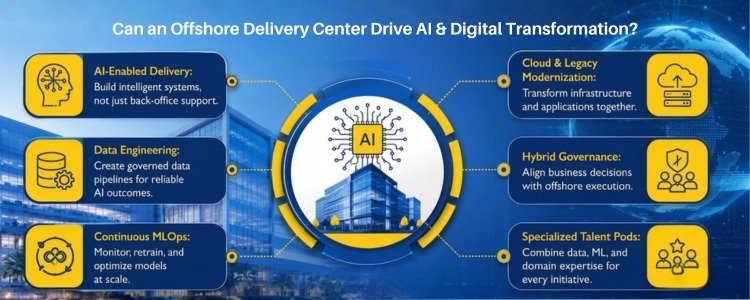
Key Approaches of Offshore Development Centers for AI Enablement & Digital Projects
Approach
Why It Matters
Agile/Iterative AI Pilots
Small, time-boxed pilots validate a model’s business value before offshore teams commit engineering capacity to full-scale build-out.
Center of Excellence (CoE) Model
A dedicated internal hub standardizes AI tooling, coding practices, and governance across every project the ODC delivers.
Hybrid Onshore-Offshore Governance
Joint steering committees keep decision-making close to the business while execution stays offshore, reducing miscommunication on scope and priorities.
Data-First Infrastructure Setup
Data pipelines and storage architecture are built before model development starts, preventing the rework that derails most AI projects.
Continuous MLOps Integration
Models are versioned, monitored, and retrained on a set schedule, rather than deployed once and left to degrade silently.
Talent Pod Specialization
Small, cross-functional pods of a data engineer, ML engineer, and domain analyst are staffed per initiative instead of spreading generalists thin.
Our Distinguished Speaker: Molyama Kromah
From Scratch Ideas to Success Stories: Bringing International Voice on Forefront
Largest Sectors Benefiting: ODCs' AI & Digital Projects
Conclusion

Pratibha Soni





Error: Contact form not found. Error: Contact form not found.Subscribe to our Newsletter
Subscribe to our Newsletter