Recent Posts






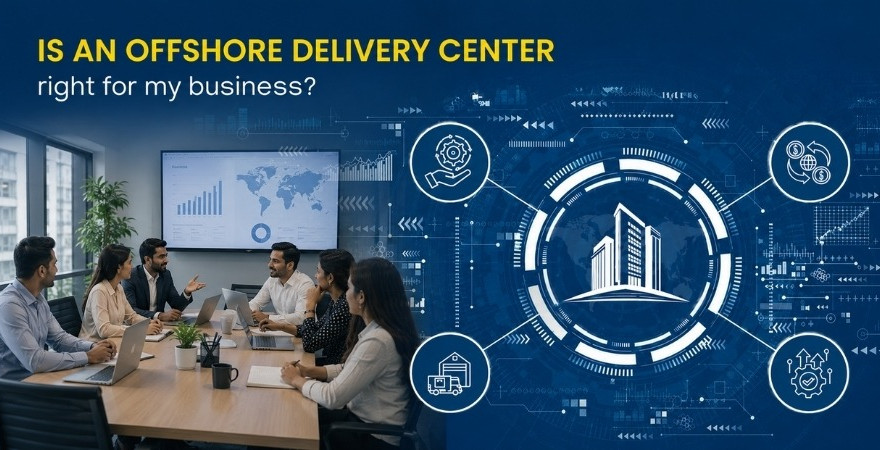
Something has shifted in how growing companies scale their tech and operations teams. Instead of signing another vendor contract and hoping for consistency, more businesses now build their own offshore delivery center, an extension of the company itself, not a rented team behind someone else’s P&L. That shift is the real story of 2026. It comes down to one decision: keep outsourcing project by project or invest in an owned offshore delivery center that grows with the business. This piece breaks that decision down, not with vague definitions, but with a practical framework you can apply.
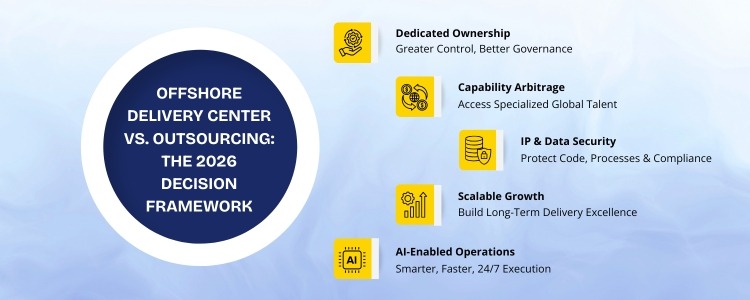
The old BPO-era definition, a low-cost vendor team handling overflow work, no longer fits. In 2026, an offshore delivery center functions as a genuine extension of the parent company’s own delivery capability, not a third-party team working at arm’s length. Modern ODCs blend software development, QA, technical support, and increasingly AI-augmented workflows under one roof, reporting into the same governance structure as any domestic team. The bigger change is the underlying motive: companies once set up offshore hubs in India, the Philippines, and Eastern Europe purely for cost arbitrage. Today, the pull is capability arbitrage, access to specialized engineering, data, and domain skills that are scarce or expensive at home. This is closely related to, but distinct from, an Offshore Development Center and a Global Capability Center (GCC), a difference worth unpacking later in this piece.
No two ODCs look the same, because no two businesses need the same mix of capability. Below is how offshore delivery centers typically map to different industries, often shaped early on by dedicated ODC consulting services that help define team structure before a single hire is made.
A quick caution: an ODC isn’t right for every business. Early-stage startups or single short-term projects are usually better served by outsourcing until scale justifies a dedicated setup.
Major Differences & Similarities in ODCs and GCCs Most content online treats these terms as interchangeable; they aren’t. An ODC is typically service and delivery-focused, faster to stand up, and often launched through a Build-Operate-Transfer (BOT) model with lower upfront investment. A GCC is a larger, wholly-owned strategic hub, frequently housing multiple functions, technology, finance, and R&D, and signals a deeper, longer-term market commitment. The similarity is worth noting: both are converging toward hybrid, AI-enabled delivery models in 2026, and an ODC frequently serves as the stepping stone toward a full GCC as a company’s offshore footprint matures.
There’s no universally “right” answer here, only the right answer for your scale and control needs. Outsourcing still works for short-term, low-stakes projects. But if you’re past that stage, an offshore delivery center is where lasting capability gets built. If you’re weighing the two, Inductus can help map the decision to your specific growth stage.
I write where strategy meets storytelling. As a passionate writer and literary enthusiast, I craft GCC-focused content that transforms industry insights into compelling narratives. Drawn to global business ecosystems, I enjoy turning research, innovation, and ideas into content that informs, connects, and inspires. With an analytical mind and a creative soul, I bring curiosity, collaboration, and a sharp eye for detail to every project. Adaptable and growth-driven, I believe the right words do more than communicate – they leave an impression.
What is an offshore delivery center in 2026?
Table of Services to Different Businesses Provided by Offshore Delivery/Development Centers
Business Type
Core Services Delivered
Example Use Case
SaaS / Tech companies
Software development, DevOps, QA automation
A US-based SaaS company runs its full QA automation pipeline through its Bangalore ODC, cutting release cycles from six weeks to two.
Fintech
Compliance-heavy back-office processing, core engineering
A European neobank routes KYC document review through its Manila ODC while a dedicated offshore team in Warsaw builds core banking APIs.
Healthcare / MedTech
Regulatory-compliant data processing, clinical R&D support
A US medtech firm’s Pune ODC manages HIPAA-aligned data annotation for its diagnostic imaging models.
Retail / E-commerce
Customer support, inventory and supply-chain technology
A UK retailer’s Cebu ODC runs 24/7 customer support alongside inventory-forecasting tools built by its own engineers.
Manufacturing / Logistics
Supply chain analytics, ERP administration
A German industrial manufacturer’s Kraków ODC maintains its SAP ERP environment and builds predictive-maintenance dashboards.
How to Recognize If an Offshore Delivery Center is Right for My Business
Key Responsibilities of a Dedicated Offshore Delivery Center
Dimension
Offshore Delivery Center (ODC)
Global Capability Center (GCC)
Ownership Model
Often BOT, vendor-assisted, or hybrid
Fully owned by the parent company
Scale
Focused team, single or few functions
Large, multi-function operation
Cost Structure
Lower upfront investment
Significant capital commitment
Strategic Purpose
Delivery execution and capacity
Long-term strategic capability building
Typical Company Stage
Growth-stage, scaling businesses
Established enterprises

Conclusion

Pratibha Soni








Error: Contact form not found. Error: Contact form not found.Subscribe to our Newsletter
Subscribe to our Newsletter