Recent Posts







As US startups scale, limitations in the local talent market frequently emerge as a critical bottleneck to growth. Technical expertise is scarce in some areas, salaries are exorbitant, and it takes an average of four or five months to fill a single senior engineering position. One of the simplest methods to address this without sacrificing code quality or delivery speed is to create an offshore development team through a structured offshore delivery center. This analysis explores the offshore delivery model, detailing its structure, cost considerations, implementation best practices, and the common errors US startups make during early-stage execution.
The numbers are straightforward. In the US, the average base compensation for a software engineer is between $120,000 and $150,000 annually, not including equity, payroll taxes, and benefits. A developer with comparable skills can make between $18,000 and $45,000 a year in the Philippines, Poland, or India, depending on region and seniority. According to industry research, 50-60% of companies prioritize cost efficiency as the leading rationale for IT outsourcing, with 60-70% also citing access to critical skills. For capital-constrained startups, both considerations are equally material. Beyond cost, offshore development services give startups access to a larger pool of engineers across specialized stacks. It might be difficult for a US startup developing a data-intensive SaaS product to locate three senior data engineers in Austin or Denver in a timely manner. That same team can be staffed in six to eight weeks by an offshore delivery center in Hyderabad or Bangalore. The global IT outsourcing market had been estimated to be worth $617.69 billion in 2023, rising to $904.95 billion in 2030. The figure shows that there has been a structural change, not a temporary trend. Companies across size segments are using offshore models as a core part of how they build and operate technology teams.
The offshore delivery center, on the other hand, is a facility or unit established in a low-cost location to work as an extended part of the company’s team. The offshore delivery center is not really a vendor model in its truest form. Engineers working from an offshore delivery center report back into the product and engineering structure at the startup, run their sprints with the same onshore team, and build the same product. The distinction is important because many entrepreneurs confuse project-based outsourcing with an offshore delivery center. When you outsource a project, you give the scope and get the results. By using an offshore delivery center model, you are creating a team that is responsible for long-term results rather than just deliverables. An appropriate setup for an offshore delivery center usually entails full-stack development, QA automation, DevOps, data engineering, and sometimes even product design. The number of engineers in such a group ranges from three to five, and even up to fifty or more, without the need for the startup to be responsible for employing people locally.
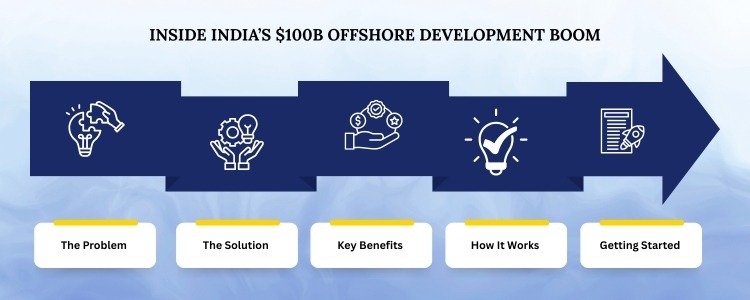
The global delivery model represents the mechanism through which tasks are divided between the onshore and offshore teams. Typically, in the structure of startups, the onshore team takes care of the strategy of the project as well as communicating with stakeholders and designing the architecture. The execution part is done by the offshore team. There are three common structures within the global delivery model: Follow the sun: The offshore and onshore teams operate sequentially. The offshore team picks up the work in the morning after US-based team members turn it over at the end of the day. The total cycle time for development jobs is decreased as a result. Parallel workstreams: Both teams focus on developing different modules or product areas at once. This is most efficient if the architectural design of the product allows for well-defined demarcations between different modules. Embedded model: The offshore engineers are completely integrated with the onshore team. They participate in all planning sessions, reviews, and retrospective meetings. The distinction between the onshore and offshore engineers is only geographical. Most startups at the Series A or Series B stage use a hybrid of the embedded model and parallel workstreams, depending on the team’s maturity and the complexity of the product. The global delivery model will entail investments in tools, documentation, and communication strategies. When startups consider the delivery system as a plug-in rather than a process-driven framework, there will be reduced efficiency in output as well as increased staff turnover.
There is a fundamental difference between strategic outsourcing and staff augmentation. Staff augmentation entails the addition of individuals, while strategic outsourcing entails delegating a particular function to be handled by the offshore delivery center. While strategic outsourcing entails investment at the beginning in terms of alignment and integration, it allows the partner organization to shoulder the burden of managing recruitment, among other aspects. In contrast, staff augmentation provides rapid access to talent but places greater management and operational burden on the startup. This frequently leads to inconsistent delivery results for early-stage businesses with limited internal bandwidth. For startups looking to grow specialized teams, usually consisting of five or more engineers, with defined product ownership and organized oversight, strategic outsourcing is therefore more appropriate.
All-in costs for offshore engineers differ according to location, experience, and whether you use a managed offshore delivery center or hire employees from an employer-of-record. Approximate monthly fully loaded costs by region: The costs cover salaries, statutory allowances, employer contributions, and minimal infrastructure. The costs incurred for managed offshore delivery center costs by a third party include an additional margin of 15% to 25% over the cost of engineers, including hiring, HR, facility, and account management costs. The costs saved by an entrepreneurial firm that downsizes its three US-based middle-level engineers earning $130,000 each by outsourcing the job to three Indian engineers who earn $50,000 a year each is about $240,000 per annum. For teams of ten or more people, savings are over $1 million per annum.
There are two primary paths: build your own or use a managed model. Build your own: The startup registers a local entity in the target country, leases office space, recruits directly, and manages all local HR and compliance. This provides maximum control, but it will take between six and twelve months to implement and will require knowledge of the legal and human resource systems locally. It is feasible for startups that wish to have 30 or more offshore engineers within 24 months. Managed offshore delivery center: The startup contracts with a local operator who provides the legal entity, facilities, HR, payroll, and recruitment. The startup will decide whom to hire and how to manage the team, while the operator will handle all other matters. It will take between four and eight weeks to set up this arrangement, which is more commonly used by startups with 5 to 25 offshore engineers. In any case, three main elements are needed in the offshoring delivery center: a clearly defined technical leader offshore, who will be able to take daily decisions; well-established coding standards and deployment practices; and the communication frequency needed to keep the offshore team focused on product priorities without having to be available at all times.
There are some common traits among startups that successfully operate offshore delivery centers. Firstly, they consider the offshore employees their own employees and not contractors. Secondly, they commit to spending money on travel, ensuring that one of their onshore executives travels to the offshore center within 90 days and once every year thereafter. Thirdly, they allocate ownership of particular products to the offshore team and do not have them go through a ticket queue. Fourthly, they offer market-rate salaries to their employees. IT outsourcing via a well-defined offshore delivery center is no shortcut; it is an intentional business model that demands as much management focus as forming an in-house team. If implemented successfully, it provides US-based startups with the capability to develop and grow much more rapidly than domestic hires can help them do, at an economic package that prolongs runway and conserves cash for product development and marketing investments.
Companies can cut their costs by 30-50% due to the availability of high-quality but inexpensive labor from India. The low cost of property and infrastructure investments also adds to the efficiency of operations. A favorable currency position also assists multinational corporations in managing their expenditures and maximizing benefits. Most significantly, all these economies are achieved without sacrificing quality, innovation, or speed of delivery. India is home to a massive resource pool of skilled professionals in AI and data science, making innovation easier. Over 500 GCCs with an emphasis on AI are available for technologies such as machine learning and GenAI. These GCCs assist firms in developing their own proprietary platforms and IP. .Thus, Indian GCCs are crucial in the context of global AI innovation and transformation. India is expected to have 2,100-2,500 GCCs by 2030 due to high growth. These centers will become more important for international business, innovation, and product development. GCCs will be at the forefront of innovation, including AI, digitization, and decision-making. In general, they will make a significant contribution to India’s economy and international business. India boasts an enormous reservoir of STEM professionals, which allows firms to expand their workforce rapidly. It has a robust digital infrastructure, which fosters innovation and international business. Its cost efficiencies make it extremely effective as opposed to other international destinations. A developed environment in AI, cloud computing, and data science ensures constant innovation and development. Global Capability Centers (GCCs) in India are enterprise-owned hubs that deliver end-to-end services like product development, R&D, AI, and digital transformation. They go beyond traditional outsourcing to drive innovation and business strategy. With a keen analytical mindset and a passion for data-driven insights, Babita Gangwar brings expertise in research, analysis, and strategic evaluation. As a Research Analyst, she focuses on transforming complex data into actionable intelligence that supports informed decision-making. She collaborates across teams to deliver high-quality research outputs, ensuring accuracy, relevance, and impact. Her interests span market research, data analytics, and emerging industry trends. A detail-oriented professional, she actively contributes to knowledge development through reports, presentations, and research initiatives.
Why US Startups Use Offshore Development Services
What an Offshore Delivery Center Actually Does
The Global Delivery Model: How It Works in Practice
Strategic Outsourcing vs. Staff Augmentation
Cost Structure: What to Expect
Location
Junior Engineer
Mid-Level Engineer
Senior Engineer
India
1,800 to $2,800
3,000 to $5,000
$5,500 to $8,500
Poland
$3,500 to $5,000
$5,500 to $8,000
$8,500 to $13,000
Philippines
$1,500 to $2,500
$2,800 to $4,500
$4,500 to $7,000
Mexico
$2,500 to $4,000
$4,000 to $6,500
$6,500 to $10,000
How to Set Up an Offshore Delivery Center
What US Startups Get Right When It Works

frequently asked questions (FAQs)
1.What cost advantages do GCCs in India offer?
2.How do GCCs in India support AI and innovation?
3.What is the future outlook for GCCs in India?
4.What makes India a top destination for GCC expansion?
5.What are Global Capability Centers (GCCs) in India?

Babita Gangwar









Error: Contact form not found. Error: Contact form not found.Subscribe to our Newsletter
Subscribe to our Newsletter
