Recent Posts







Most enterprises tell the same story about AI agents. A pilot works well, so a second team builds its own agent, then a third does. Within a year, dozens of agents are reading data, calling tools and triggering workflows. Yet few leaders can say with confidence who approved each agent, what it can access, or what it did last Tuesday. This isn’t a failure of ambition. The agents are usually well built. What is missing is an architecture layer that governs them. That layer is easy to skip when the pressure is to ship, and expensive to retrofit later. This blog explains why agentic AI changes the governance problem, what the missing layer looks like, and how to build it before scale makes it urgent.
From assistants to autonomous actors Earlier generations of enterprise AI mostly produced outputs. A model summarised a document or suggested a reply, and a human decided what to do next. AI agents work differently. They plan, choose tools, act across systems and chain steps together, often without anyone watching each one. They approve, update, send, query and escalate. That shift moves the risk. When AI only advised, the main governance questions were about accuracy and bias. When AI acts, the questions become who is accountable for the action, what the agent was allowed to do, and whether the action can be traced and reversed. Where traditional governance breaks Traditional governance relies on review boards, policy documents and periodic audits. These work when change is slow and decisions are made by people. Agents make decisions in seconds, at volume, across many systems. A policy PDF cannot stop an agent from pulling the wrong dataset, and a quarterly audit cannot catch an action that happened this morning. The risks that appear at scale As agent numbers grow, the same handful of problems appear. Shadow agents built outside IT’s view multiply. Sensitive data leaks into prompts or third-party tools. Agents take actions that were never intended, or loop and consume budget unchecked. Audit trails are incomplete, and ownership is unclear when something goes wrong. None of these is exotic, and each gets harder to fix with every agent added.
What it is The missing piece is a governance layer built into the architecture. It is a control plane that sits between your agents and everything they touch, including models, data, tools and enterprise systems. Every request an agent makes passes through it. It checks identity, applies policy, records the action and routes risky decisions to a human. Think of it as air traffic control for agents. The pilots are skilled, but the sky stays safe because every flight is visible, follows shared rules and can be directed when needed. Why teams skip it Teams skip this layer for understandable reasons. Governance feels like friction when the goal is to show value quickly. Ownership is unclear, because security, data, IT and the business each assume another team has it covered. And many assume the model provider’s built-in safeguards are enough. Those safeguards matter, but they govern the model, not your agents, your data or your business rules. The cost of skipping it The cost arrives later and in larger form. Agents have to be re-engineered to meet compliance needs. Leaders freeze new deployments because they can’t explain the risk. Scale-up stalls just when the business wants more. Governance added afterwards is slower and costlier than governance designed in.
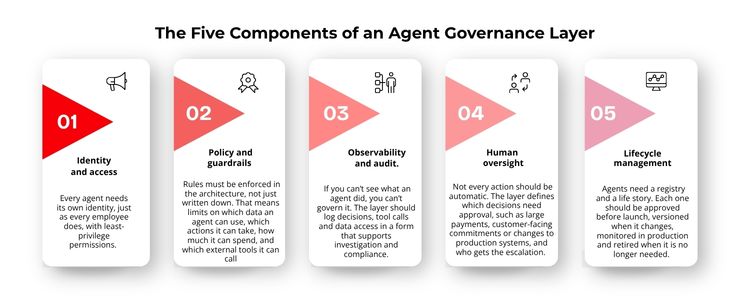
A strong governance layer is not one tool. It is five capabilities working together, and each one answers a question leaders will eventually be asked. Every agent request passes through the control plane before it reaches models, data or tools. Together, these five turn governance from a document into a working system.
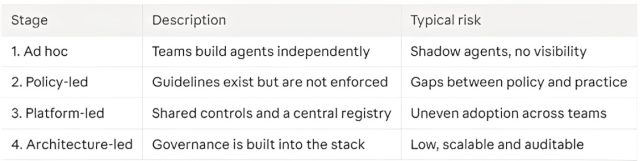
Most organisations sit somewhere on a maturity curve, and it helps to be honest about where. The table below shows four common stages. A simple self-check is to pick any agent running today and ask four questions. Who owns it? What can it access? What did it do yesterday? Who would stop it if it went wrong? If any answer takes more than a few minutes to find, you are likely at stage one or two. Most enterprises are, and recognising that is the first step to moving up.
Building the governance layer does not need a multi-year programme. A sequence that works in practice looks like this. Start with an inventory. You cannot govern what you cannot see. Find every agent in use, including the ones teams built informally, and record its purpose, owner, data access and tools. This alone often surprises leadership. Classify by risk. Not every agent needs the same controls. An internal tool that drafts meeting notes is different from one that approves transactions. Sorting agents into risk tiers lets you apply heavy controls where they matter and keep low-risk work moving. Build the control layer once and reuse it. The biggest mistake is governing each agent separately. Build shared identity, policy, logging and approval services, and let every team plug into them. This makes governance a platform rather than a burden, and it makes new agents faster to launch, not slower. Pilot, measure and scale. Begin with a few high-value agents, measure what the controls catch and what they cost in speed, then tune and extend. Governance that teams see as helpful gets adopted. Governance that feels like a barrier gets bypassed.
Architecture alone is not enough. A governance layer needs people who can design and operate it, including AI platform engineers, security architects, data specialists and risk and compliance experts. These skills are scarce and in demand everywhere, and many enterprises find that hiring them quickly, at the scale required, is the real bottleneck. This is one reason global organisations increasingly build dedicated capability in India through Global Capability Centres (GCCs). India offers deep engineering, AI and cybersecurity talent, and a GCC lets a company grow a team that works as part of its own organisation, with full control of intellectual property and technical direction. For work as sensitive as AI governance, that control matters.
AI agents will keep spreading through the enterprise, and the pace will not wait for governance to catch up. The organisations that scale well will not be the ones that move slowest. They will be the ones that built the control layer first, so each new agent launches faster and with less risk than the last. The takeaway is simple. Treat governance as architecture, not paperwork. Build the layer before you need it, and your agents will be able to grow as fast as your ambitions.
I write where strategy meets storytelling. As a passionate writer and literary enthusiast, I craft GCC-focused content that transforms industry insights into compelling narratives. Drawn to global business ecosystems, I enjoy turning research, innovation, and ideas into content that informs, connects, and inspires. With an analytical mind and a creative soul, I bring curiosity, collaboration, and a sharp eye for detail to every project. Adaptable and growth-driven, I believe the right words do more than communicate – they leave an impression.
Why Agentic AI Changes the Governance Game
The Architecture Layer Most Enterprises Skip
The Five Components of an Agent Governance Layer
Where Does Your Enterprise Stand?
A Practical Roadmap to Build It
Who Builds and Runs It
Conclusion


Pratibha Soni










Error: Contact form not found. Error: Contact form not found.Subscribe to our Newsletter
Subscribe to our Newsletter