Recent Posts







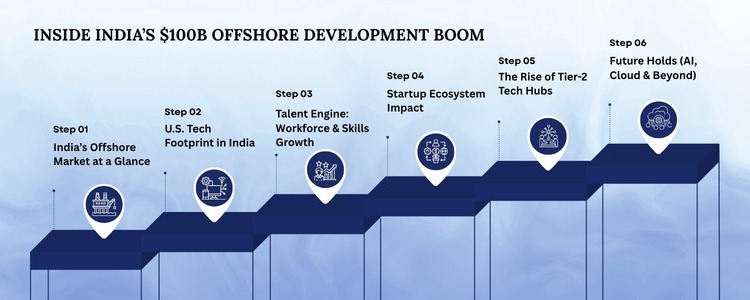
India currently holds roughly 55% of the global offshore services market. This market share is a result of policy adjustment, steady growth in the number of technical personnel in India, and strategic planning by US technology companies, which started expanding their businesses in India long before the current worldwide boom in technology expansion. In order to analyze the link between India’s technological development and its startup culture, it is necessary to consider real numbers, geography, and personnel involved in India’s offshore services industry.
Offshore development centers (ODCs) in India represented a $65 billion segment of value generated for US firms as of 2024. It is predicted that the industry will be worth $100 billion in 2030. At present, around 2.1 million employees are employed in the centers in India, and an estimated increase of 600,000 to 900,000 more workers will be seen in the coming years. At present, around 1.9 million employees are employed in the centers in India, and an estimated increase of 600,000 to 900,000 more workers will be seen in the coming years. At a compound annual growth rate of 8.20%, the global market for IT services outsourcing is expected to reach USD 661.96 billion in 2025 and surpass USD 1,345.48 billion by 2034. India holds the largest proportion of that global market, mostly because of its skill pool and cost structure. A large part of offshore development center (ODC) activities in India is carried out by large companies with more than 10,000 workers. Companies that operate at a scale that enables them to create and maintain sizable, committed engineering teams in India include Amazon, Microsoft, Alphabet Inc., IBM, and Indian IT services companies like Tata Consultancy Services, Infosys, and Wipro.
U.S.-based companies have established between 1,000 and 1,100 GCCs in India, which represent the majority of the country’s total GCC footprint. There are five U.S. technology companies, Amazon, Apple, Google, Meta, and Microsoft, that collectively employ approximately 200,000 professionals in India. Between July 2020 and July 2025, Apple witnessed an increase in its workforce in India from 1,398 people in July 2020 to 3,372 people in July 2025, resulting in a compound annual growth rate of 19.8%. The workforce at Microsoft increased from 12,090 in July 2020 to 22,012 people in July 2025. Amazon remains the largest employer in this group, with 127,409 employees as of July 2025, up from 84,114 in 2020 (EPFO data analyzed by Thurro Research, September 2025). Collectively, Meta, Apple, Google, Amazon, Microsoft, and Netflix added over 32,000 jobs in India in 2025, representing an 18% year-on-year increase. This number is partly a reaction to stricter H-1B visa regulations in the US, where sponsorship now costs about $100,000 per candidate. Microsoft revealed plans to spend USD 17.5 billion over four years, from 2026 to 2029, on cloud and AI infrastructure in India. This suggests a sustained dedication to using India as a hub for product development, R&D, and technical operations supporting international business lines. A U.S.-based software solutions company called Guidewire made an announcement regarding its expansion in India, which involves doubling the number of its employees in India from 500 to 1,000 by 2028 after employing about 500 professionals at two Indian locations (Bengaluru and Chennai) until 2025 (Inductus GCC, 2025). Such a trend in general among all organizations signifies a paradigm shift in thinking within U.S. technology firms operating in India from mere cost optimization to a vital part of global engineering capabilities.
Offshore development centers (ODCs) and global capability centers (GCCs) have similar but different purposes. While ODCs may function under managed services or develop, operate, and transfer agreements, GCCs are usually completely owned subsidiaries of the parent company. Both GCCs and ODCs indicate that the foreign company will set up a physical location in India to conduct its business. There are 1,800+ GCCs in India producing a revenue of $65 billion with an employment force of over 2.1 million professionals. The figure amounts to about 55% of the worldwide pool of GCC professionals. During the initial two quarters of 2025, some 50 new GCCs opened up in India. From early 2024 to late 2025, about 110 new GCCs came into existence in India. For example, companies like Microsoft, Goldman Sachs, and Walmart maintain large-scale GCCs in India wherein engineers perform their duties in cloud computing, finance systems, and e-commerce platforms. These centers function as global engineering hubs that play a significant role in the actual creation of the firm’s products.
Offshore development centers (ODCs) have an impact on startup culture in India through some clear pathways. The first and foremost is that of the talent supply chain. India churned out 1.5 million engineers in 2024, while there were 5.4 million software developers working in the economy (IBEF, 2025). This pool is shared by Indian-founded entrepreneurs, domestic technology services companies, and major U.S.-owned ODCs. Professionals working in a development center offshore for several years within an already established U.S. company are exposed to high-quality software processes, worldwide delivery systems, and product-oriented mindsets. A portion of that talent eventually moves into startup roles, either as employees or as founders. Bengaluru, which has more than 880 GCCs and ODCs and contributes one-third of all new centers established during FY2024, was also home to 8 out of the 10 startups who made it to India’s unicorn list in 2024 and 2025. Global leadership roles based in India have surged at a 40% compound annual growth rate over the past five years, to surpass 6,500 roles in 2024, while over 1,050 are occupied by women, highlighting an expanding pool of leaders operating in India’s technology ecosystem.
Microsoft has established large offshore development centers (GCCs/ODCs) in cities like Bengaluru and Hyderabad, where hundreds of engineers contribute to products that include cloud computing and artificial intelligence, which operate internationally. Such centers help employees gain experience working with massive software projects, international processes, and cutting-edge technology. Eventually, many individuals depart from Microsoft to work with startups or establish their own businesses, carrying immense knowledge with them. Additionally, Microsoft interacts with startups through initiatives and collaborations and as a client for innovative solutions. This creates a direct link between offshore development work and startup growth, making such centers an important part of India’s startup pipeline.
India’s tech outsourcing remains attractive to US firms due to its cost structure and large labor pool. India’s GitHub developer base increased by 28% in 2024 and is expected to exceed the US developer base by 2028. India has more than 17 million GitHub developers (IBEF, 2024). India’s IT sector revenue is expected to grow to USD 282.6 billion in FY2025-26, increasing by 5.1% per year (NASSCOM, 2025). The most highly demanded specialized positions for the year 2025 in ODCs and GCCs are in the fields of artificial intelligence and machine learning, cloud computing, data science and analysis, cybersecurity, risk management, and governance. The demand for specialized IT positions grew by around 25 to 30 percent in 2025, transitioning from commodity support jobs to valuable technical work. The GCCs in India have operational capabilities that are generally 40% cheaper than the same processes performed by the company’s home market. Despite the low costs, the quality of production does not suffer. This cost-to-value ratio has sustained demand for ODC and GCC expansion across economic cycles. The knowledge base created inside large offshore development centers does not stay within those organizations permanently.
Bengaluru and Hyderabad account for the majority of GCC and ODC activity. Bengaluru contributes over 880 such centers, while Hyderabad has over 355 such centers. Hyderabad benefits from T-AIM along with a startup ecosystem of more than 940 companies. Collectively, both cities represent the largest share of 2025 activity. Tier 2 cities are gaining ground. Jaipur, Coimbatore, Ahmedabad, and Trivandrum have become cities for expansion and provide a cost advantage of 25% to 30% over first-tier cities. The 2025 Union Budget has provided an enabling structure for the ODCs and GCCs to expand even beyond metro areas. From 2024 to 2029, Karnataka’s GCC policy seeks to create 500 GCC centers, 350,000 jobs, and $50 billion in GDP. 35% of all GCC workers in India are employed by at least 875 GCC units in Karnataka. Tamil Nadu provides high-paying GCC jobs with a payroll subsidy of up to 30% of earnings for the first year. Chennai employed 95,000 employees in its GCC workforce compared to Bangalore, which hired 68,000 in the same year. From 2016 to 2024, GCCs and offshore development centers contributed to 40% of the entire leasing activities in the top urban areas in India. GCCs have been noted to contribute an estimated 40% of office space absorption in India by 2025. There are currently 17,000 startups and 8 unicorns reported in the state of Uttar Pradesh as of 2025. The geographical spread of startups largely aligns with the geographical dispersal of technical workers, which in turn reflects where ODCs and GCCs are based. The geographic spread of startups largely aligns with the geographical spread of technical workers, which in turn reflects where ODCs and GCCs are based.
India has become the third-biggest startup ecosystem in the world, and at the midway point in 2025, there were more than 181,000 DPIIT-certified startups, compared to around 159,000 in January 2025. India’s ecosystem includes 125 unicorns that are valued collectively at over USD 366 billion. In 2025, startups in India received almost USD 11 billion in investment. At USD 3.9 billion, early-stage funding increased by 7% annually. In 2025, 42 IT businesses went public, a 17% increase from 36 in 2024. M&A activity increased to 136 deals, a 7% increase. Over 159,000 entrepreneurs received more than USD 17.5 billion in startup investment through 2025; INR 604 crore in loans, including those for women-led businesses, were funded by government-backed guarantees. The software market in India is projected to develop at a compound annual growth rate of 18.8% from 2025 to 2030, reaching USD 47,574.2 million. The largest and fastest-growing category of the market is application software. Most of the time, companies are not directly funded by GCCs or offshore development centers (ODCs). Through workforce development, knowledge transfer, and the level of highly skilled workers in particular cities, they play a part in the emergence of startups. According to data from Bengaluru, Hyderabad, Pune, and Chennai, the cities with the highest ODC and GCC activity also produce the greatest number of startups and the greatest proportion of unicorn-stage businesses.
Global tech expansion by U.S. companies into India is not slowing down. The addition of 32,000 employees by major U.S. tech businesses in 2025, Microsoft’s planned USD 17.5 billion infrastructure investment, and the opening of almost 50 new GCCs in the first two quarters of 2025 alone all point to further build-out. As businesses expand their worldwide AI capabilities through engineering teams based in India, a large amount of this growth is increasingly concentrated in artificial intelligence, cloud computing, and data infrastructure. Tech companies in India from the United States cannot be said to operate as employers alone. In the creation of their ODCs and GCCs, they are providing the kind of technical work environments, concentrations of people, and expertise needed for startups to emerge in the country. The relationship between global tech growth and the emergence of startups becomes clear when one considers the structure in which professionals and venture capital coincide geographically.
Companies can cut their costs by 30-50% due to the availability of high-quality but inexpensive labor from India. The low cost of property and infrastructure investments also adds to the efficiency of operations. A favorable currency position also assists multinational corporations in managing their expenditures and maximizing benefits. Most significantly, all these economies are achieved without sacrificing quality, innovation, or speed of delivery. India is home to a massive resource pool of skilled professionals in AI and data science, making innovation easier. Over 500 GCCs with an emphasis on AI are available for technologies such as machine learning and GenAI. These GCCs assist firms in developing their own proprietary platforms and IP. .Thus, Indian GCCs are crucial in the context of global AI innovation and transformation. India is expected to have 2,100-2,500 GCCs by 2030 due to high growth. These centers will become more important for international business, innovation, and product development. GCCs will be at the forefront of innovation, including AI, digitization, and decision-making. In general, they will make a significant contribution to India’s economy and international business. India boasts an enormous reservoir of STEM professionals, which allows firms to expand their workforce rapidly. It has a robust digital infrastructure, which fosters innovation and international business. Its cost efficiencies make it extremely effective as opposed to other international destinations. A developed environment in AI, cloud computing, and data science ensures constant innovation and development. Global Capability Centers (GCCs) in India are enterprise-owned hubs that deliver end-to-end services like product development, R&D, AI, and digital transformation. They go beyond traditional outsourcing to drive innovation and business strategy. With a keen analytical mindset and a passion for data-driven insights, Babita Gangwar brings expertise in research, analysis, and strategic evaluation. As a Research Analyst, she focuses on transforming complex data into actionable intelligence that supports informed decision-making. She collaborates across teams to deliver high-quality research outputs, ensuring accuracy, relevance, and impact. Her interests span market research, data analytics, and emerging industry trends. A detail-oriented professional, she actively contributes to knowledge development through reports, presentations, and research initiatives.
The Scale of Offshore Development Centers in India
U.S. Tech Companies in India: The Build-Out in Numbers
Global Capability Centers: The Structural Layer Beneath ODCs
How Offshore Development Centers Connect to India's Startup Pipeline
Example: Microsoft in India
The Workforce and Cost Dynamics Behind Tech Outsourcing India
Geographic Spread: Beyond Bengaluru and Hyderabad
What the Numbers Show for India's Startup Ecosystem
Global Tech Expansion and What It Means for India Going Forward

frequently asked questions (FAQs)
1.What cost advantages do GCCs in India offer?
2.How do GCCs in India support AI and innovation?
3.What is the future outlook for GCCs in India?
4.What makes India a top destination for GCC expansion?
5.What are Global Capability Centers (GCCs) in India?

Babita Gangwar








Error: Contact form not found. Error: Contact form not found.Subscribe to our Newsletter
Subscribe to our Newsletter